...and I am SO EXCITED! He gets here tomorrow night and will stay for about 6/7 days. I got a lot of work done early so I'll be taking a few days off. Here's the tentative schedule:
-eat lots of traditional Japanese food, visit neighborhood restaurants, look for Mt. Fuji through the unseasonal rain and haze, etc.
-come to school and learn about the tea ceremony
-visit a temple and sit in zazen (meditation, but if there's another monk with a stick, Dan's on his own and I'll be reading in the next room - fair warning)
-go to Tokyo and see as much as possible
-go to Kamakura and see the big Buddha and the bamboo forests
-go down the peninsula/coastline to Ohito to visit an onsen and another favorite traditional restaurant
-free day....
Whoo hooo!!!!
And right after all this, I return to school for the graduation ceremonies and lots of exam-grading...but no one's thinking that far ahead.
Dan I hope you get here no problem.
21 February 2006


14 February 2006
Food & Fat
The inner frustration has gone on long enough and it's time I let it out. I could discuss this with Mayumi, but she doesn't need a diatribe on Americans and fat, either. It's too far removed from her everyday reality.
In general (IN GENERAL), French people stay slim because they monitor their consumption like hawks, and they walk or ride bikes a lot. Chocolate after dinner? No no no, I'll just have this apple. I ate chocolate on Sunday with Abby at La Duree. Drive to school and back? Hell no, Paris traffic is crazy, I'll take my bike.
In Japan, most people stay relatively thin for a couple reasons (my own observations):
1) Genes. I've watched people eat TONS of noodles on a regular basis and remain thinner than I am. I've also watched Japanese people consume tons of tea, alcohol, and sodium (through soysauce and other forms), yet drink little to almost NO water. But they never seem dehydrated. When I go out with friends and ask for water, they always tell me it's strange. You don't want beer? You don't want tea? You drink a lot of water. That is strange for us. I've never seen a Japanese person drinking plain water, and it's unusual to find bottled water in a vending machine amongst the 10 different types of teas, colas, and sugared coffees, all of which dehydrate you. I may be wrong, but I also haven't heard of many kidney problems.
I've noticed that Japanese women don't really swing their hips, but seem to swing their legs out at the knee instead for better mobility. In fact, it looks like it is physically impossible for them to move their hips from side to side. Then I read that a certain tendon is significantly shorter in Japanese women than Western women, making it nearly impossible for them to swing their hips. Western women may have larger hips, but I like being able to swing 'em. It makes dancing much more fun.
The POINT of all that was to say: Japanese bodies are truly different from Western bodies, in multiple ways. They must process foods differently, as evidenced by their uncanny ability to take in large amounts of carbs and salt and relatively little water, but remain healthy and slim.
2) Diet. In general, the Japanese diet is one of the healthiest in the world. Aside from all the beer, tempura (deep-fried foods), fatty meats and oily, high-calorie ramen dishes, Japanese eat FISH, RICE, and VEGETABLES. You know this already. But what most people don't acknowledge is that it's very easy to eat yourself fat in Japan: there's PLENTY of junk food and fat.
Before I came to Japan I was clueless about the food. I read a couple books on Japanese cuisine to familiarize myself with the basics, but I expected one of my biggest hurdles to be enjoying the food. As it turns out, that hurdle was much easier to jump than I expected, and I like a good majority of Japanese cuisine. But the problem I never expected was being so unfamiliar with things that I literally did not know if it was healthy or not. Sometimes I couldn't tell if something was meat or vegetable. (And you thought you'd ALWAYS know that difference, for SURE, right? Nope.) Sometimes I couldn't tell if something came off the land or out of the ground or from the sea. Sometimes I still can't tell how something is flavored. I try many foods but I usually have no idea if what I'm eating is healthy or not. Obviously fresh vegetables are good for you. But what about that slightly-rubbery, slightly-squishy, slightly fibrous, clear-grey, brown-speckled sliver of material that's been covered in a spicy sauce? What the hell IS that? Does it provide any nutrition at all? Is it full of fat? Is it just added to the dish to help fill you up, a different kind of white rice? Turns out it's a high-fiber substance made from seaweed called konyakku. They say it's good for you...and now I have come to enjoy it. But to have no idea what you are putting into your body is unnerving, to say the least. I am constantly asking people, "Is this healthy? Is this unhealthy?" And the answer I usually get is, "No, it's high-calorie," or "Yes, it cleans your blood."
Then I see crazy things on the internet, about how obese people are unfairly discriminated against, about how people eat so much they can't walk through doors, about how being overweight is blamed on genes and thyroids and advertising, about how obesity is a "disease" like alcoholism, about how McDonald's should be held responsible for people's health problems, about how an obese woman sued an airline company because they asked her to buy a 2nd seat on the plane....and it all makes me want to scream.
A few days ago, another teacher who has never spoken to me in my six months in Japan, stood by my desk silently watching me eat some Chinese pudding. I endured his stare because people always watch me eat. I hate being observed while eating, but it's a part of life I am still learning to accept as a foreigner in a small town. But then, this teacher who I've never heard SPEAK, much less speak to me, in English, smiled like a wise Native American / Indian chief and dubbed me, "Eating Spirit." He said only, "Eating Spirit," and then walked away. I had to laugh. Naturally, I don't stick to any meal schedules. I eat when I'm hungry, and I abstain when I'm not. This means I eat at crazy hours in between meal-times, which makes it look like I am constantly eating. I know some people around me think I eat all day long. What they don't realize is that I eat about 3 bites at a time.
Anyway, I thought this teacher named me "Eating Spirit" because he thinks I eat all the time. I was a little embarrassed and self-conscious and fell back into my hole about Americans thinking of fat and eating all the time. Later, another teacher told me he said "Eating Spirit" not because he thinks I'm getting fat, but because he was impressed with what I'm willing to try. Even though I never had a conversation with this teacher, unbeknownst to me he was noticing WHAT I ate. Evidently he was so impressed with the variety he opened his mouth to say only, "Eating Spirit," similar to "Daring Spirit" or "Adventuresome Spirit" or "Fighting Spirit." Being American, of course, I thought it was in reference to calories or fat or weight-gain.
I don't know why America is so fat and so obsessed with being fat. I don't know how the French are disciplined enough to eat chocolate eclairs only once a month. If they eat so little sweets, how do all the bakeries stay in business? The biggest mystery, though, is how the Japanese avoid kidney problems.
I DO know that I eat when I'm hungry no matter what time it is, that I eat what I am craving at the time, that I don't eat when I'm not hungry (no matter what time it is), and that I absolutely hate being pressured to eat or drink more when I am full. I think if I stick to my gut and walk to work instead of always riding the bus, and do yoga when I feel like I need yoga, and play tennis every now and then, and go skiing once a year, I'll be okay. And so would you. Do not blame McDonald's because the only one putting the fries in your mouth is you. And pointing fingers at major franchises or your mother or your own thyroid gland just really pisses me off.
In general (IN GENERAL), French people stay slim because they monitor their consumption like hawks, and they walk or ride bikes a lot. Chocolate after dinner? No no no, I'll just have this apple. I ate chocolate on Sunday with Abby at La Duree. Drive to school and back? Hell no, Paris traffic is crazy, I'll take my bike.
In Japan, most people stay relatively thin for a couple reasons (my own observations):
1) Genes. I've watched people eat TONS of noodles on a regular basis and remain thinner than I am. I've also watched Japanese people consume tons of tea, alcohol, and sodium (through soysauce and other forms), yet drink little to almost NO water. But they never seem dehydrated. When I go out with friends and ask for water, they always tell me it's strange. You don't want beer? You don't want tea? You drink a lot of water. That is strange for us. I've never seen a Japanese person drinking plain water, and it's unusual to find bottled water in a vending machine amongst the 10 different types of teas, colas, and sugared coffees, all of which dehydrate you. I may be wrong, but I also haven't heard of many kidney problems.
I've noticed that Japanese women don't really swing their hips, but seem to swing their legs out at the knee instead for better mobility. In fact, it looks like it is physically impossible for them to move their hips from side to side. Then I read that a certain tendon is significantly shorter in Japanese women than Western women, making it nearly impossible for them to swing their hips. Western women may have larger hips, but I like being able to swing 'em. It makes dancing much more fun.
The POINT of all that was to say: Japanese bodies are truly different from Western bodies, in multiple ways. They must process foods differently, as evidenced by their uncanny ability to take in large amounts of carbs and salt and relatively little water, but remain healthy and slim.
2) Diet. In general, the Japanese diet is one of the healthiest in the world. Aside from all the beer, tempura (deep-fried foods), fatty meats and oily, high-calorie ramen dishes, Japanese eat FISH, RICE, and VEGETABLES. You know this already. But what most people don't acknowledge is that it's very easy to eat yourself fat in Japan: there's PLENTY of junk food and fat.
Before I came to Japan I was clueless about the food. I read a couple books on Japanese cuisine to familiarize myself with the basics, but I expected one of my biggest hurdles to be enjoying the food. As it turns out, that hurdle was much easier to jump than I expected, and I like a good majority of Japanese cuisine. But the problem I never expected was being so unfamiliar with things that I literally did not know if it was healthy or not. Sometimes I couldn't tell if something was meat or vegetable. (And you thought you'd ALWAYS know that difference, for SURE, right? Nope.) Sometimes I couldn't tell if something came off the land or out of the ground or from the sea. Sometimes I still can't tell how something is flavored. I try many foods but I usually have no idea if what I'm eating is healthy or not. Obviously fresh vegetables are good for you. But what about that slightly-rubbery, slightly-squishy, slightly fibrous, clear-grey, brown-speckled sliver of material that's been covered in a spicy sauce? What the hell IS that? Does it provide any nutrition at all? Is it full of fat? Is it just added to the dish to help fill you up, a different kind of white rice? Turns out it's a high-fiber substance made from seaweed called konyakku. They say it's good for you...and now I have come to enjoy it. But to have no idea what you are putting into your body is unnerving, to say the least. I am constantly asking people, "Is this healthy? Is this unhealthy?" And the answer I usually get is, "No, it's high-calorie," or "Yes, it cleans your blood."
3) Regulation. Japanese people pay attention to their current states. (I love this because I'm hyper-aware of what is going on with my own body. It may annoy my friends and family, but I think it's fascinating.) For example, if a Japanese woman has eaten too much junk food in the past day or two, or just consumed too much in general, she says to herself, "Hmm, I've felt different lately," or "My pants are a little tight," or "That blemish near my mouth means I've been eating too much." (Yes, they actually believe that, but I swear it's true. Since different body parts are connected like in acupuncture, they believe that if something is wrong with your stomach, it will show up around your mouth, as a cold sore or pimple or other blemish. Pay attention and you'll notice it's completely true.) Anyway, they keep themselves in check, and are constantly adjusting to find an equilibrium. If they've eaten too much for a couple days, they cut back for a couple days. In the long run, this means they don't get fat. Americans, on the other hand (myself often included), believe in the "What-the-Hell" effect. My friends and I coined this phrase in high school. Oh wow, I want a second slice of cake. Well, my first piece was big and already bad for me, so what the hell? On to the second slice. I've been eating so much sugar lately. I guess one more bite won't hurt me, what the hell. In goes the gummy-worm. But you can see how in Japan the logic is different, and ultimately much better.
How any American stays thin is a mystery because everyone is overly-obsessed with it. Including me. Yesterday a teacher gave me a whole flourless chocolate cake. It looked incredible, and I made a joke about sharing it with others so I won't get fat. "You?" he said seriously. "You are afraid of getting fat?" And my immediate response was, "Of course I am, I'm American." It was a joke, and we both laughed, but later I realized how true it was. Why must Americans think about it so much? And why do Americans treat health like FASHION? This annoys me no end. Eat low-fat. Eat margarine. Eat butter. Eat low-carb. Don't eat chocolate. Now eat dark chocolate. Buy this book. Watch this TV program. Go to the gym. Do spot-work on your abs. Actually, spot-work doesn't do any good. Make yoga into something completely unspiritual and fashionable and aerobic. Add pilates. Drive your car to the gym.Then I see crazy things on the internet, about how obese people are unfairly discriminated against, about how people eat so much they can't walk through doors, about how being overweight is blamed on genes and thyroids and advertising, about how obesity is a "disease" like alcoholism, about how McDonald's should be held responsible for people's health problems, about how an obese woman sued an airline company because they asked her to buy a 2nd seat on the plane....and it all makes me want to scream.
A few days ago, another teacher who has never spoken to me in my six months in Japan, stood by my desk silently watching me eat some Chinese pudding. I endured his stare because people always watch me eat. I hate being observed while eating, but it's a part of life I am still learning to accept as a foreigner in a small town. But then, this teacher who I've never heard SPEAK, much less speak to me, in English, smiled like a wise Native American / Indian chief and dubbed me, "Eating Spirit." He said only, "Eating Spirit," and then walked away. I had to laugh. Naturally, I don't stick to any meal schedules. I eat when I'm hungry, and I abstain when I'm not. This means I eat at crazy hours in between meal-times, which makes it look like I am constantly eating. I know some people around me think I eat all day long. What they don't realize is that I eat about 3 bites at a time.
Anyway, I thought this teacher named me "Eating Spirit" because he thinks I eat all the time. I was a little embarrassed and self-conscious and fell back into my hole about Americans thinking of fat and eating all the time. Later, another teacher told me he said "Eating Spirit" not because he thinks I'm getting fat, but because he was impressed with what I'm willing to try. Even though I never had a conversation with this teacher, unbeknownst to me he was noticing WHAT I ate. Evidently he was so impressed with the variety he opened his mouth to say only, "Eating Spirit," similar to "Daring Spirit" or "Adventuresome Spirit" or "Fighting Spirit." Being American, of course, I thought it was in reference to calories or fat or weight-gain.
I don't know why America is so fat and so obsessed with being fat. I don't know how the French are disciplined enough to eat chocolate eclairs only once a month. If they eat so little sweets, how do all the bakeries stay in business? The biggest mystery, though, is how the Japanese avoid kidney problems.
I DO know that I eat when I'm hungry no matter what time it is, that I eat what I am craving at the time, that I don't eat when I'm not hungry (no matter what time it is), and that I absolutely hate being pressured to eat or drink more when I am full. I think if I stick to my gut and walk to work instead of always riding the bus, and do yoga when I feel like I need yoga, and play tennis every now and then, and go skiing once a year, I'll be okay. And so would you. Do not blame McDonald's because the only one putting the fries in your mouth is you. And pointing fingers at major franchises or your mother or your own thyroid gland just really pisses me off.
10 February 2006
08 February 2006
Cat's Tongue
Today was a challenging day. If you don't want all the details, skip down to the 3rd major paragraph, and then keep reading.
Yesterday, the high schoolers stayed at home, and the classrooms were filled with nervous junior high students trying to pass my high school's entrance exam. Even though my school is public, kids have yet another exam to pass and yet another acceptance to worry about, before they even hit their equivalent of 9th grade. I tried to be as friendly as possible to the little, big-eyed students in their military uniforms. Seriously, their outfits look like juvenile navy uniforms. Straight-laced, wide-collared, brass-buttoned, uptight, and unforgiving.
Today, I had to grade the English compositions of those 350 kids. I worked with 2 other English teachers from 8 am to 5 pm with one 30-minute break. Between each set we took a 2-minute stretch break and rotated seats so our necks would be bent at various angles throughout the day (my idea, I was proud of that one because evidently it had never occured to anyone else).
Reading the same ideas over and over was tedious, and grading fairly on a scale from 1 to 6 was difficult...but the truly hard part was acting Japanese. I can't decide if this is a good thing or a bad thing, but I realized I have become much more adept at keeping my opinion to myself. Especially when I disagree, this truly feels like a sacrifice. But I'm acquiring the skill.
Now I understand just how often and how comfortably I disagree with people, go my own way, and do my own thing without giving it a second thought. In fact, in America this behavior is often considered a strength, an attitude I've received compliments for being "brave enough" to possess. But in Japan, of course, it works the other way. The strong person is the one who does not express her opinion or her own desires if they are contrary to the group. Harmony, harmony, harmony. If you conceal your emotions and conceal your real opinion you're golden. If someone asks directly for your opinion and you give an ambiguous, indirect answer, you're golden. For example, I was the main person responsible for the English compositions, because I'm considered the resident English expert. But in true Japanese fashion, I didn't grade anything independently. I worked with 2 other teachers and we read and discussed each essay before agreeing on the final grade. Since I'm a native speaker, finding mistakes and repetitions and patterns was extremely easy for me. I could judge the score in about 5 seconds. But instead of declaring my opinion as soon as it came to me--as I would do in America--I waited for someone else to speak first. I listened to them discuss, compare, re-read, ask questions, etc. while I silently nodded my head in agreement, or made a sharp intake of breath if I didn't agree. Usually I agreed with the other teachers' ideas, but I never expressed my opinion assuredly. If I definitely agreed I would hesitate as if I were still thinking, and say, "I think so..." and trail off as if to say "Maybe, I could be wrong, but maybe..." That meant "Yes." And they understood.
If I disagreed--and had logical, rational, persuasive reasons for disagreeing--I didn't say anything if I was already outnumbered by the others. I let the cat hold my tongue, so to speak, and I went along with what was already agreed upon. Let me tell you, it felt like a sacrifice. It felt like willingly wearing handcuffs. If someone asked for my opinion and I didn't agree (for example if they thought the grade should be a 5, but I thought 4), I would say, "Yes, it might be 5...but well, maybe it could be 4, I'm not really sure, it's difficult." That very clearly meant "I think you're wrong, it should be 4." And they understood that as well. So if I disagreed we had to spend at least 5 more minutes talking about what was the best conclusion.
One time we could not reach a consensus, but I simply couldn't give up my opinion -- I felt sure that I was right. I totally disagreed and well, trying to fit into Japanese society does not mean you want to toss everything aside and become Japanese. I had to stick by this one. I wanted to cast off the chains and stand by my unharmonious, individual opinion, even if it went against the group. And this is how I expressed my complete, utter disagreement: I looked them in the eye and shrugged. I never said a word, but the message was clear. I lost the battle 1 to 2.
An American suppressing her opinion or needs can feel oppressed, snubbed, undervalued, even helpless or depressed. Of course, I can very well say whatever I want, and I know it will be excused because I'm American. But I'm really trying to be beneficial here, and I won't help anyone if I'm constantly adding stress or strain as the token gaijin.
When we finished, the teachers thanked me generously for my hard work, doting on how tired I must be (even though they just went through it all with me). Then they looked at each other and said, "Wow, grading this year was very smooth. That went really well."
I smiled to myself. Those 2 sentences mumbled at the end of a long day were all the positive reinforcement I needed. Maybe they had no idea how hard I'd worked to help things run smoothly. But I felt like I succeeded.
In Japanese, there's no expression for "Cat got your tongue?" That implies someone is waiting to hear your opinion. There is, however, the expression, "cat's tongue," which I most definitely have. It means you're sensitive to hot foods and have to let things cool before you can eat them. It works wonders to explain why I'm not drinking my tea right away. "Cat's tongue," I say knowingly. And they understand.
Yesterday, the high schoolers stayed at home, and the classrooms were filled with nervous junior high students trying to pass my high school's entrance exam. Even though my school is public, kids have yet another exam to pass and yet another acceptance to worry about, before they even hit their equivalent of 9th grade. I tried to be as friendly as possible to the little, big-eyed students in their military uniforms. Seriously, their outfits look like juvenile navy uniforms. Straight-laced, wide-collared, brass-buttoned, uptight, and unforgiving.
Today, I had to grade the English compositions of those 350 kids. I worked with 2 other English teachers from 8 am to 5 pm with one 30-minute break. Between each set we took a 2-minute stretch break and rotated seats so our necks would be bent at various angles throughout the day (my idea, I was proud of that one because evidently it had never occured to anyone else).
Reading the same ideas over and over was tedious, and grading fairly on a scale from 1 to 6 was difficult...but the truly hard part was acting Japanese. I can't decide if this is a good thing or a bad thing, but I realized I have become much more adept at keeping my opinion to myself. Especially when I disagree, this truly feels like a sacrifice. But I'm acquiring the skill.
Now I understand just how often and how comfortably I disagree with people, go my own way, and do my own thing without giving it a second thought. In fact, in America this behavior is often considered a strength, an attitude I've received compliments for being "brave enough" to possess. But in Japan, of course, it works the other way. The strong person is the one who does not express her opinion or her own desires if they are contrary to the group. Harmony, harmony, harmony. If you conceal your emotions and conceal your real opinion you're golden. If someone asks directly for your opinion and you give an ambiguous, indirect answer, you're golden. For example, I was the main person responsible for the English compositions, because I'm considered the resident English expert. But in true Japanese fashion, I didn't grade anything independently. I worked with 2 other teachers and we read and discussed each essay before agreeing on the final grade. Since I'm a native speaker, finding mistakes and repetitions and patterns was extremely easy for me. I could judge the score in about 5 seconds. But instead of declaring my opinion as soon as it came to me--as I would do in America--I waited for someone else to speak first. I listened to them discuss, compare, re-read, ask questions, etc. while I silently nodded my head in agreement, or made a sharp intake of breath if I didn't agree. Usually I agreed with the other teachers' ideas, but I never expressed my opinion assuredly. If I definitely agreed I would hesitate as if I were still thinking, and say, "I think so..." and trail off as if to say "Maybe, I could be wrong, but maybe..." That meant "Yes." And they understood.
If I disagreed--and had logical, rational, persuasive reasons for disagreeing--I didn't say anything if I was already outnumbered by the others. I let the cat hold my tongue, so to speak, and I went along with what was already agreed upon. Let me tell you, it felt like a sacrifice. It felt like willingly wearing handcuffs. If someone asked for my opinion and I didn't agree (for example if they thought the grade should be a 5, but I thought 4), I would say, "Yes, it might be 5...but well, maybe it could be 4, I'm not really sure, it's difficult." That very clearly meant "I think you're wrong, it should be 4." And they understood that as well. So if I disagreed we had to spend at least 5 more minutes talking about what was the best conclusion.
One time we could not reach a consensus, but I simply couldn't give up my opinion -- I felt sure that I was right. I totally disagreed and well, trying to fit into Japanese society does not mean you want to toss everything aside and become Japanese. I had to stick by this one. I wanted to cast off the chains and stand by my unharmonious, individual opinion, even if it went against the group. And this is how I expressed my complete, utter disagreement: I looked them in the eye and shrugged. I never said a word, but the message was clear. I lost the battle 1 to 2.
An American suppressing her opinion or needs can feel oppressed, snubbed, undervalued, even helpless or depressed. Of course, I can very well say whatever I want, and I know it will be excused because I'm American. But I'm really trying to be beneficial here, and I won't help anyone if I'm constantly adding stress or strain as the token gaijin.
When we finished, the teachers thanked me generously for my hard work, doting on how tired I must be (even though they just went through it all with me). Then they looked at each other and said, "Wow, grading this year was very smooth. That went really well."
I smiled to myself. Those 2 sentences mumbled at the end of a long day were all the positive reinforcement I needed. Maybe they had no idea how hard I'd worked to help things run smoothly. But I felt like I succeeded.
In Japanese, there's no expression for "Cat got your tongue?" That implies someone is waiting to hear your opinion. There is, however, the expression, "cat's tongue," which I most definitely have. It means you're sensitive to hot foods and have to let things cool before you can eat them. It works wonders to explain why I'm not drinking my tea right away. "Cat's tongue," I say knowingly. And they understand.
04 February 2006

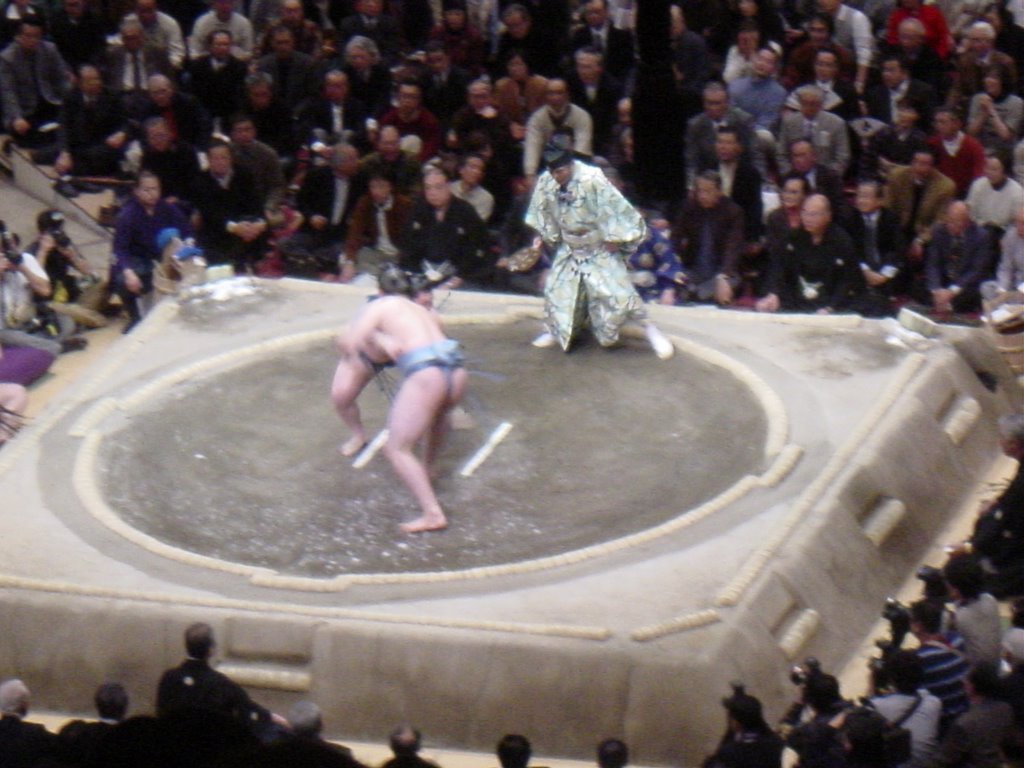
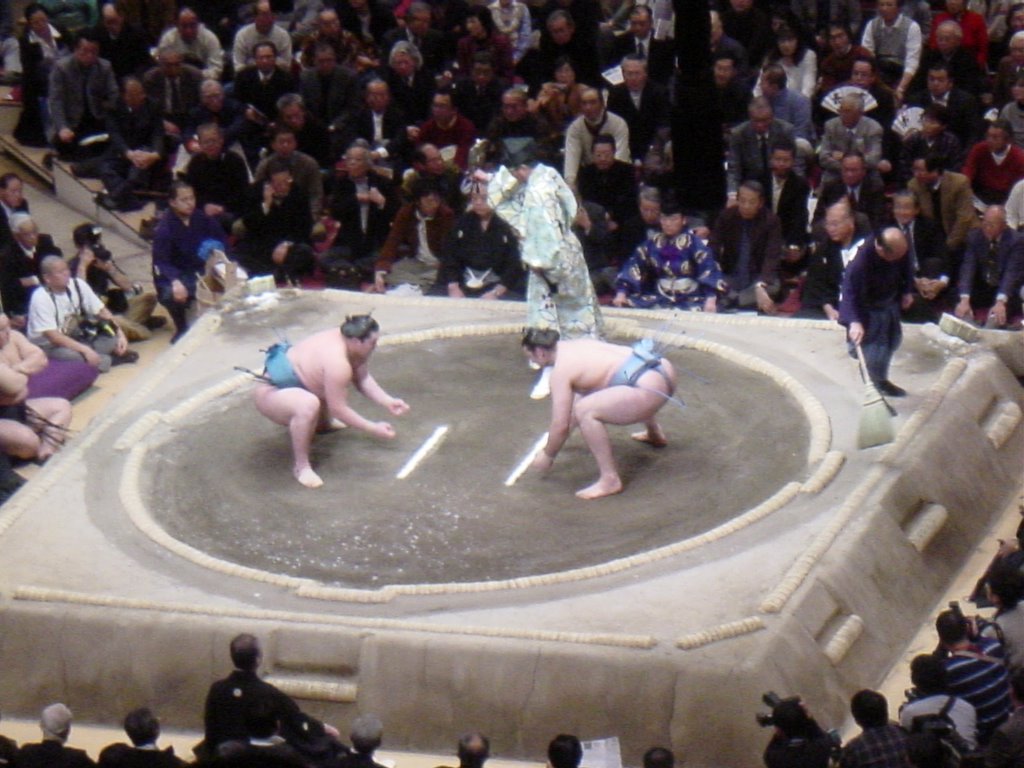
02 February 2006
Snooze No More
I'll admit something ridiculous. For the past 2 weeks, I've set my alarm for 6 am with the intention of getting up to exercise. Instead, I've spent every day hitting snooze, dreading the cold, and getting out of bed too late to eat breakfast at home.
But today was different. First, I was awakened at 4 am by the newspaper delivery people. All the bike-riders in Japan, but these guys ride motorcycles. Today was one of the rare mornings they had a conversation under my window over the roar of muffler-free engines. When I was awakened from a deep sleep, I thought that vandals were taking over our apartment complex, or that I'd caught a teacher in the act of partying until 4 am. Then I remembered the newspapers--which I can't read--that are delivered to all my neighbors.
My alarm went off at 5:30. I hit snooze one time, once again bowing to that evil cycle. But as I dozed I had one of those half-dreams you confuse with reality. Usually I half-dream about getting dressed, brushing my teeth, etc., so I think I'm accomplishing something when I'm actually just lying there half-conscious. But today I dreamed about another teacher (the funny one who lived in America and likes 70s music) laughing at me.
"Hehe, you lazy Americans are all the same. I knew you wouldn't get up."
That was enough motivation for me! I kept thinking, "Oh yeah?? Oh yeah?!" and got my ass out of bed.
I rolled onto my tatami floor, did yoga while the sun came up, showered, put on more makeup than usual, pulled on some clothes I don't wear all the time, made a cup of coffee (and even frothed the milk, thanks to Meegan!), and drank it in silence as the crows began screaming at 7am, like clockwork, just as they do every day.
I felt really peaceful and happy, with that inner quiet that can only come from feeling the sun rise. I even welcomed the crows and their obnoxious barking. After coffee I did a few chores and left early enough to make the 30-minute walk to work. By the time I reached school the endorphins had kicked in and I was supressing the urge to twirl on the sidewalk. It was wonderfully ridiculous.
Despite the fact that I'm sleepy now, there is only one word to describe how getting out of bed for all that makes me feel:
Sexy. Never thought I'd see the day when "5:30 am" could mean "hot."
Am I getting old? Or just turning into my father?
I guess either of those options would be just fine. :)
But today was different. First, I was awakened at 4 am by the newspaper delivery people. All the bike-riders in Japan, but these guys ride motorcycles. Today was one of the rare mornings they had a conversation under my window over the roar of muffler-free engines. When I was awakened from a deep sleep, I thought that vandals were taking over our apartment complex, or that I'd caught a teacher in the act of partying until 4 am. Then I remembered the newspapers--which I can't read--that are delivered to all my neighbors.
My alarm went off at 5:30. I hit snooze one time, once again bowing to that evil cycle. But as I dozed I had one of those half-dreams you confuse with reality. Usually I half-dream about getting dressed, brushing my teeth, etc., so I think I'm accomplishing something when I'm actually just lying there half-conscious. But today I dreamed about another teacher (the funny one who lived in America and likes 70s music) laughing at me.
"Hehe, you lazy Americans are all the same. I knew you wouldn't get up."
That was enough motivation for me! I kept thinking, "Oh yeah?? Oh yeah?!" and got my ass out of bed.
I rolled onto my tatami floor, did yoga while the sun came up, showered, put on more makeup than usual, pulled on some clothes I don't wear all the time, made a cup of coffee (and even frothed the milk, thanks to Meegan!), and drank it in silence as the crows began screaming at 7am, like clockwork, just as they do every day.
I felt really peaceful and happy, with that inner quiet that can only come from feeling the sun rise. I even welcomed the crows and their obnoxious barking. After coffee I did a few chores and left early enough to make the 30-minute walk to work. By the time I reached school the endorphins had kicked in and I was supressing the urge to twirl on the sidewalk. It was wonderfully ridiculous.
Despite the fact that I'm sleepy now, there is only one word to describe how getting out of bed for all that makes me feel:
Sexy. Never thought I'd see the day when "5:30 am" could mean "hot."
Am I getting old? Or just turning into my father?
I guess either of those options would be just fine. :)
01 February 2006
Dream Chaser
I can honestly say I am no longer in the honeymoon phase. And I can honestly say I love this place, and especially these people.
Today, I signed the form and decided to leave Japan in August.
As my friend Doug so eloquently put it, "I could stay another year. But it's time to chase my dreams somewhere else."
Hai...wakarimashita.
Today, I signed the form and decided to leave Japan in August.
As my friend Doug so eloquently put it, "I could stay another year. But it's time to chase my dreams somewhere else."
Hai...wakarimashita.
30 January 2006
The Sweet Potato Man
There are a lot of things in Japan I don’t understand immediately, because they are incredibly old traditions practiced with a modern technological twist. For instance, the lack of central heating means many people warm their homes with fires or kerosene heaters. My friend Meegan and I often joke that we live in paper houses. Well, a long time ago, people did live in paper houses, and that meant major fire hazards in the winter when everybody was trying to stay warm. In the tightly-packed villages it was easy for many homes to be destroyed by one family’s poorly-maintained heating. So, every night a town crier would walk through the village streets reminding everyone to put out their fires before going to bed. Today, from about 8pm onward, a little truck meanders through the streets sounding a tinny, high-pitched bell, reminding people to turn off kerosene heaters before hitting the futon.
One little truck, however, winds through the streets in all seasons. The size of a small garbage truck, with large strips of firewood and a mysterious brown box in the bed, this old, dirtied, little truck is driven by the sweet potato man. The sweet potato man is much younger than you’d expect, and instead of pushing a cart through town and yelling, he plays a recording from the loudspeaker on top of his vehicle. “Oishii! O imo, oishii yo!” which translates roughly as “Soooo good! Sweet potatoes, delicious sweet potatoes!” Then he sings other Japanese phrases which I imagine to be, “Come get your sweet potatoes! You know you want one! They’re soooo good!”
I imagine a lot of people could be annoyed by the sweet potato man, but I was quite charmed by him on my first day in Fuji. I thought the advertising was romantic, like the ice cream truck or the milk bottle deliveries I was born too late to experience. The sweet potato man always makes me smile, because he reminds me of some idyllic time in America when neighborhoods were safe and you could buy treats with only a few coins. I’m a fan of sweet potatoes and always wanted to try one, but with the echoing loudspeaker I could never tell exactly where the truck was, or when it could come by my driveway.
Today was a different story. My arms were loaded with grocery bags after work. I was tired and the peach sky was cold. But I smiled because I heard the potato man. Then, I realized he was coming up my street! He was right in front of me! I saw a little girl walk to the end of her driveway, and as the truck pulled over I stopped to watch. I felt like a tourist for the first time in Japan – my presence was turning a mundane occurrence into a spectacle. But I made no attempts to hide my blatant mental note-taking. It felt good to watch for once, instead of always being the subject of observation.
The little girl, who was about 5 years old, was one of the most beautiful little girls I’ve ever seen. Her dark hair was in Heidi plaits on either side of her head, and her almond-shaped eyes were as huge as an anime characters’. I was obviously making her self-conscious, and as she awkwardly pushed wisps of hair out of her eyes, she threw sideways glances at me during her dialogue with the sweet potato man.
The sweet potato man was thin, somewhere in his 30s, with a kind and sun-worn face. He was extremely gentle with the little girl, which made me think he had children around her age. Dutifully, as if by routine, she asked for 3 potatoes, and he nodded like he already knew how many to give her. The man went to the side of his truck, pulled on some gloves, and opened a rusted, heat-blackened, brown metal box. It was basically a portable oven, and the smoky aroma that escaped when he lifted the hatch was like potion. It took me a split-second to decide I wanted one, too. The smell was warm and sweet and spicy, very three-dimensional even though I was a good 10 feet away. The man dropped 3 long, purplish potatoes into a plain paper bag, carefully accepted change from the little girl, and showed her where to hold the bag since the potatoes were still hot. She smiled at him shyly, then turned and ran towards her apartment, obviously glad to escape my stare.
The potato man looked at me for the first time then, with my purse and coat and grocery bags, and I saw the strain flash off his face, replaced by something else when he decided I was “safe.” Perhaps I was not as much of an outsider as he thought. I lived in this neighborhood.
“I’ve heard you almost every day for the past 6 months,” I wanted to tell him. But instead, I said only, “How much for one, please?”
My potato plopped into the bag and he carefully folded the top as if it were expensive packaging. “It’s still hot, so please be careful.”
“Yes,” I said, and we smiled. My miniscule but sufficient Japanese skills were an obvious relief to him.
It was only 5 o’clock but I ate the potato immediately. The flesh inside wasn’t orange, but instead a dirty-banana-yellow, and it was so delicious there was no need to add anything. It’s amazing that something can simply be yanked from the dirt, heated for a while, and come out tasting so sweet and tangy and spicy and satisfying. I had a glass of red wine but not too much else for dinner.
I hear the sweet potato man all the time, but now I know what all the fuss is about.
One little truck, however, winds through the streets in all seasons. The size of a small garbage truck, with large strips of firewood and a mysterious brown box in the bed, this old, dirtied, little truck is driven by the sweet potato man. The sweet potato man is much younger than you’d expect, and instead of pushing a cart through town and yelling, he plays a recording from the loudspeaker on top of his vehicle. “Oishii! O imo, oishii yo!” which translates roughly as “Soooo good! Sweet potatoes, delicious sweet potatoes!” Then he sings other Japanese phrases which I imagine to be, “Come get your sweet potatoes! You know you want one! They’re soooo good!”
I imagine a lot of people could be annoyed by the sweet potato man, but I was quite charmed by him on my first day in Fuji. I thought the advertising was romantic, like the ice cream truck or the milk bottle deliveries I was born too late to experience. The sweet potato man always makes me smile, because he reminds me of some idyllic time in America when neighborhoods were safe and you could buy treats with only a few coins. I’m a fan of sweet potatoes and always wanted to try one, but with the echoing loudspeaker I could never tell exactly where the truck was, or when it could come by my driveway.
Today was a different story. My arms were loaded with grocery bags after work. I was tired and the peach sky was cold. But I smiled because I heard the potato man. Then, I realized he was coming up my street! He was right in front of me! I saw a little girl walk to the end of her driveway, and as the truck pulled over I stopped to watch. I felt like a tourist for the first time in Japan – my presence was turning a mundane occurrence into a spectacle. But I made no attempts to hide my blatant mental note-taking. It felt good to watch for once, instead of always being the subject of observation.
The little girl, who was about 5 years old, was one of the most beautiful little girls I’ve ever seen. Her dark hair was in Heidi plaits on either side of her head, and her almond-shaped eyes were as huge as an anime characters’. I was obviously making her self-conscious, and as she awkwardly pushed wisps of hair out of her eyes, she threw sideways glances at me during her dialogue with the sweet potato man.
The sweet potato man was thin, somewhere in his 30s, with a kind and sun-worn face. He was extremely gentle with the little girl, which made me think he had children around her age. Dutifully, as if by routine, she asked for 3 potatoes, and he nodded like he already knew how many to give her. The man went to the side of his truck, pulled on some gloves, and opened a rusted, heat-blackened, brown metal box. It was basically a portable oven, and the smoky aroma that escaped when he lifted the hatch was like potion. It took me a split-second to decide I wanted one, too. The smell was warm and sweet and spicy, very three-dimensional even though I was a good 10 feet away. The man dropped 3 long, purplish potatoes into a plain paper bag, carefully accepted change from the little girl, and showed her where to hold the bag since the potatoes were still hot. She smiled at him shyly, then turned and ran towards her apartment, obviously glad to escape my stare.
The potato man looked at me for the first time then, with my purse and coat and grocery bags, and I saw the strain flash off his face, replaced by something else when he decided I was “safe.” Perhaps I was not as much of an outsider as he thought. I lived in this neighborhood.
“I’ve heard you almost every day for the past 6 months,” I wanted to tell him. But instead, I said only, “How much for one, please?”
My potato plopped into the bag and he carefully folded the top as if it were expensive packaging. “It’s still hot, so please be careful.”
“Yes,” I said, and we smiled. My miniscule but sufficient Japanese skills were an obvious relief to him.
It was only 5 o’clock but I ate the potato immediately. The flesh inside wasn’t orange, but instead a dirty-banana-yellow, and it was so delicious there was no need to add anything. It’s amazing that something can simply be yanked from the dirt, heated for a while, and come out tasting so sweet and tangy and spicy and satisfying. I had a glass of red wine but not too much else for dinner.
I hear the sweet potato man all the time, but now I know what all the fuss is about.
17 January 2006
Should We Wait for Moss?
This post is for Andrew, who may understand moss better than anyone.
Tonight I wanted to unwind somewhere alone, but not in my apartment. I wanted a coffee-shop atmosphere that was closer than a 40-minute train-ride away. I decided that Mos Burger, only 15 minutes away, was my best bet.
I ordered oshiruko (a kind of sweet, red-bean soup with rice cakes) and pulled out a book. A few minutes later 2 students plopped down at my table. I was in the mood to zone out and read, but I really love my "kids" (as teachers have an annoying habit of calling them), so I welcomed the interruption. (In fact, I was amazed they sat down without even speaking to me first. At school they'd be too shy to approach like that.) I'm surprised by how much more relaxed around me the students are outside of school. They are even more willing to speak English, as if being off school grounds gives them more leeway to make mistakes. We had a great discussion about pet rabbits, cram school, Australia...and I discovered some fellow aspiring writers. I love the students.
After cramming down their burgers before biking off to cram school (extra math study -- don't you know Japanese children don't sleep?), the girls left and I returned to my book. About 2 hours later I felt someone staring at me. So many people stare at you outside of Tokyo that I didn't really take note...until the man did something no stranger has done before: he spoke to me, in English.
"Excuse me, may I talk with you?" he asked politely. He was a fairly attractive, early-to-middle-aged businessman. I'm not the kind of girl who automatically checks for wedding rings, so I don't know if he was married or not. In his finely-tailored, expensive suit, he looked out of place sitting behind a wadded Mos Burger wrapper and a paper cup. I realized then he'd finished eating some time ago and had been staring at me for longer than I thought.
My natural reaction to strangers who approach me in any way is to totally reject them. Especially if I am obviously alone, and the stranger is obviously male. I am terrified of that situation. I've never felt unsafe in Japan, but I'm not one to throw such caution to the wind. I remember one night in Paris, I happened to be the only passenger in my metro car. A man got on at the far end, but with each stop, sat closer and closer to me. We remained alone in the car, and internally I was freaking out. I was planning fake-out routes that would lead him far away from my real apartment, racking my brain for cafes that I knew would still be open...desperately crafting an escape should this man decide to follow me home. Before too long, I watched his mouth open in slow motion to speak to me, and all I could think was, "Shit!"
"Good evening," he said in slurred French. "Will you sleep with me?"
I glared at him.
"No," I said firmly, with a "and that's the end of this conversation" tone.
The man shrugged.
"Okay, well...can I have a cigarette, then?"
I told him I don't smoke, and fortunately, he left me alone.
So naturally, I was annoyed and nervous when this Japanese man spoke to me. Who cares how nice or affluent he looked. I'm alone; can't he see that I'm alone? How rude to put me in this uncomfortable situation. I could tell immediately that his English was too good for the "I just want to practice my English" excuse.
"Actually, I have to finish this," I said, pointing at my book with urgency. I made my expression as pained as possible. "I'm sorry."
"Oh, I see," he responded, looking incredibly disappointed, and worse, lonely. Turning back to my book, I started to feel guilty.
Guilty! Why did I feel guilty? I started rationalizing. All the kindness you have been shown by strangers in this country, and you're so self-centered you can't even speak to this man in a well-lit, public place. Maybe he looks lonely for a good reason. Maybe he was just trying to add a little variety to his boring night at Mos Burger. Maybe you should just put down the book and talk to him. Besides, your bus comes in 30 minutes, so you have an excuse to leave if he's awful.
Tonight I wanted to unwind somewhere alone, but not in my apartment. I wanted a coffee-shop atmosphere that was closer than a 40-minute train-ride away. I decided that Mos Burger, only 15 minutes away, was my best bet.
I ordered oshiruko (a kind of sweet, red-bean soup with rice cakes) and pulled out a book. A few minutes later 2 students plopped down at my table. I was in the mood to zone out and read, but I really love my "kids" (as teachers have an annoying habit of calling them), so I welcomed the interruption. (In fact, I was amazed they sat down without even speaking to me first. At school they'd be too shy to approach like that.) I'm surprised by how much more relaxed around me the students are outside of school. They are even more willing to speak English, as if being off school grounds gives them more leeway to make mistakes. We had a great discussion about pet rabbits, cram school, Australia...and I discovered some fellow aspiring writers. I love the students.
After cramming down their burgers before biking off to cram school (extra math study -- don't you know Japanese children don't sleep?), the girls left and I returned to my book. About 2 hours later I felt someone staring at me. So many people stare at you outside of Tokyo that I didn't really take note...until the man did something no stranger has done before: he spoke to me, in English.
"Excuse me, may I talk with you?" he asked politely. He was a fairly attractive, early-to-middle-aged businessman. I'm not the kind of girl who automatically checks for wedding rings, so I don't know if he was married or not. In his finely-tailored, expensive suit, he looked out of place sitting behind a wadded Mos Burger wrapper and a paper cup. I realized then he'd finished eating some time ago and had been staring at me for longer than I thought.
My natural reaction to strangers who approach me in any way is to totally reject them. Especially if I am obviously alone, and the stranger is obviously male. I am terrified of that situation. I've never felt unsafe in Japan, but I'm not one to throw such caution to the wind. I remember one night in Paris, I happened to be the only passenger in my metro car. A man got on at the far end, but with each stop, sat closer and closer to me. We remained alone in the car, and internally I was freaking out. I was planning fake-out routes that would lead him far away from my real apartment, racking my brain for cafes that I knew would still be open...desperately crafting an escape should this man decide to follow me home. Before too long, I watched his mouth open in slow motion to speak to me, and all I could think was, "Shit!"
"Good evening," he said in slurred French. "Will you sleep with me?"
I glared at him.
"No," I said firmly, with a "and that's the end of this conversation" tone.
The man shrugged.
"Okay, well...can I have a cigarette, then?"
I told him I don't smoke, and fortunately, he left me alone.
So naturally, I was annoyed and nervous when this Japanese man spoke to me. Who cares how nice or affluent he looked. I'm alone; can't he see that I'm alone? How rude to put me in this uncomfortable situation. I could tell immediately that his English was too good for the "I just want to practice my English" excuse.
"Actually, I have to finish this," I said, pointing at my book with urgency. I made my expression as pained as possible. "I'm sorry."
"Oh, I see," he responded, looking incredibly disappointed, and worse, lonely. Turning back to my book, I started to feel guilty.
Guilty! Why did I feel guilty? I started rationalizing. All the kindness you have been shown by strangers in this country, and you're so self-centered you can't even speak to this man in a well-lit, public place. Maybe he looks lonely for a good reason. Maybe he was just trying to add a little variety to his boring night at Mos Burger. Maybe you should just put down the book and talk to him. Besides, your bus comes in 30 minutes, so you have an excuse to leave if he's awful.
I looked up at him then, debating whether or not to get his attention after turning him down. But soon he looked back at me, made eye contact, and said, "May I just ask you one question?"
So I said yes, and ended up having a very pleasant, entertaining conversation with this man who had just moved to Fuji from Tokyo. He missed the big city, and he was bored. Although he never lived abroad, his English was superb and he was obviously an intelligent, well-spoken man. Towards the end of the conversation he asked my name. (He never did ask for a phone number or email address, which made me feel much safer chatting with him.) I told him my name and then tried to make the "Rollin, rollin, rollin!" joke. (Japanese men seem to think the pronunciation of my name sounds like "rolling," and more than one person has started singing that song when I tell them my name.) So I tried to make him laugh. But instead, he seemed very serious, almost sad, and said,
"What does that mean, anyway? Rolling? I know it means moving on..." he said, and made a forward-rolling motion with his hands. "So that must mean you have a wandering spirit -- never in one place for too long." And for only the second time he looked straight into my eyes.
I didn't say anything but just smiled at him. I felt oddly exposed after that comment, as if he'd unexpectedly pegged my character 20 minutes into the conversation. I'm having a lot of trouble deciding if I want to stay in Japan for two years, or move on to something different after one.
"Wandering spirit," I repeated. "Yes, maybe so." And while the idea made me happy, it only seemed to make him sad.
Most Japanese people barely express their emotions in public, much less to someone they hardly know. The secret is to watch their eyes. Even if they don't make eye contact, you can see a lot in someone's eyes. Not only inside them, but around them: most likely if a Japanese person is sad or stressed, it will show only in the delicate skin around his eyes. And I could see, just barely, his muscles tense when I said that.
Much later, I remembed a conversation I'd had with Mayumi. We were running around a temple garden like little kids, excited by our new discovery of such a beautiful place so close to our school. There was, of course, tons of moss flowing softly over the garden stones.
"Look," I demanded. "It's so beautiful."
"Yeah," Mayumi said. "Don't you say, 'A rolling stone gathers no moss'?"
I smiled at Mayumi and laughed as my peaceful temple visions blurred with Mick Jagger and that huge tongue.
"Right." I said, returning my attention to the green fuzz.
"Yeah." Mayumi pressed. "There's one example of how our cultures can be totally opposite. You think it's good to keep moving, because gathering moss is a bad thing, and it means you've been in one place for too long. But in Japan we think moss is beautiful. We have the exact same expression, but with a completely opposite meaning. We also say: a rolling stone gathers no moss. But we want the moss. If you're constantly on the go, if you never stay in one place, you'll never grow any moss. It's good to just be still."
It wasn't until much later, in the bathtub, that it occurred to me why my joke may have dampened the Japanese man's spirit. Maybe he was hoping I would just sit still.
14 January 2006
Thank You, Ms. Rice
"We have not, as a country, made the kind of intellectual investment that we need to make in the exchange of people, in the exchange of ideas, in languages and in cultures..." said Rice, who holds a doctorate in international studies and was a specialist in Soviet affairs."
--Washington Post
--Washington Post
12 January 2006
Gomi, Poi! Mo iikai!
Or maybe it's "ikkai." But gomi = trash, and poi = a sound effect used when dunking trash in a basket. Mo ikkai = one more time.
I have avoided this topic for quite some time, for fear of sounding paranoid or overly-attentive to detail. But now it's gone on long enough, and it's time I tell you all about it.
Japan has very strict garbage-sorting rules: what to burn, what not to burn, what to cut up, what to tie in very specific ribbon before throwing out, what to de-cap, what to recycle...and there are certain dates for disposing of certain materials: cardboard, aluminum, glass, broken electric stuff, newspapers, styrofoam, cloth and fabrics, plastics, large household items, small household items...ALL of these things can only be thrown away on ONE day of the month. (And each type of item has a different disposal day, so you can't just throw it out together. Everything must be sorted.) Also, what DAY you're allowed to throw things away changes every month. For example, in January I have to hold my aluminum cans until the 19th. But in February I can get rid of them on the 10th.
I dump my "normal," burnable garbage on Tuesdays and Fridays only, about one block away from my apartment. But for all other products listed above, I haul them to the dump-site about 4 blocks away. To a gaijin this seems like quite a long, complicated, ridiculous process. In fact, after a few months I quit buying aluminum cans altogether, because I don't like dealing with throwing them away. All my beer and soft-drink consumption takes place outside my home.
Because of all this sorting, I'm acutely more aware of what I throw away. I pay attention to the packaging, what the products are made of, and how fast I fill my garbage cans. Which brings me to the point of my story: I am convinced someone is going through my trash.
This is very strange, but perhaps not very surprising. Other than John, I'm the only white person for a 20-mile radius. I've run into more than one person I've never spoken to before (the cashier at the drugstore, the waitress at the coffee shop, etc.), and they have all said, "Oh, you're the teacher!" It's a strange feeling to know that everything you buy, consume, and do outside your home really IS being monitored by someone else. Considering how interested people are in what goes into my buggie at the grocery store, it may not be shocking that people are interested in what goes into my trash.
I have avoided this topic for quite some time, for fear of sounding paranoid or overly-attentive to detail. But now it's gone on long enough, and it's time I tell you all about it.
Japan has very strict garbage-sorting rules: what to burn, what not to burn, what to cut up, what to tie in very specific ribbon before throwing out, what to de-cap, what to recycle...and there are certain dates for disposing of certain materials: cardboard, aluminum, glass, broken electric stuff, newspapers, styrofoam, cloth and fabrics, plastics, large household items, small household items...ALL of these things can only be thrown away on ONE day of the month. (And each type of item has a different disposal day, so you can't just throw it out together. Everything must be sorted.) Also, what DAY you're allowed to throw things away changes every month. For example, in January I have to hold my aluminum cans until the 19th. But in February I can get rid of them on the 10th.
I dump my "normal," burnable garbage on Tuesdays and Fridays only, about one block away from my apartment. But for all other products listed above, I haul them to the dump-site about 4 blocks away. To a gaijin this seems like quite a long, complicated, ridiculous process. In fact, after a few months I quit buying aluminum cans altogether, because I don't like dealing with throwing them away. All my beer and soft-drink consumption takes place outside my home.
Because of all this sorting, I'm acutely more aware of what I throw away. I pay attention to the packaging, what the products are made of, and how fast I fill my garbage cans. Which brings me to the point of my story: I am convinced someone is going through my trash.
This is very strange, but perhaps not very surprising. Other than John, I'm the only white person for a 20-mile radius. I've run into more than one person I've never spoken to before (the cashier at the drugstore, the waitress at the coffee shop, etc.), and they have all said, "Oh, you're the teacher!" It's a strange feeling to know that everything you buy, consume, and do outside your home really IS being monitored by someone else. Considering how interested people are in what goes into my buggie at the grocery store, it may not be shocking that people are interested in what goes into my trash.
How did I come to this conclusion? I am very punctual about my dumping (hah), and I always dump on the correct day and in the correct place -- along with everyone else in my neighborhood. By the time I come home from work, all the garbage is removed, and the street corner is left tidy and blank...except (!) for a few things that have blown up and down the street. Those few things always belong to me.
Now, I always tie my garbage bags closed, in the "correct" way, as carefully instructed by my Japanese friend. So I tie, dump, and dispose of my trash in exactly the same manner, on exactly the same days, as everyone else in my neighborhood. Yet my trash is the only trash I see strewn on the road. I have seen things that could have only belonged to me: wrapping paper from friends at home, empty bags of candy that I just bought for students, packaging for the exact same pen I just bought, small boxes that covered presents from Japanese friends, and (the real kicker) a Crest toothpaste box that could have only come from me, from America, as such toothpaste does not exist in Japan.
The first time this happened, I blamed it on the wind, even though no one else's trash was lying about. The second time this happened, I blamed it on my bag-tying skills, even though I knew that was a stupid excuse. The third time this happened, I blamed it on the garbage men, even though they didn't spill anyone else's garbage. But today was the tenth, yes the tenth, time this has happened, and I thought that was enough evidence to provide me with a post.
It's funny: even though my trash no longer "belongs" to me, the thought of someone picking it apart still makes me feel strange and self-conscious, even violated if it's taken to extremes. I mean, do you really want someone else inspecting your garbage? No. You toss the stuff one time, and forget about it. But in Japan, I find myself thinking, "Gomi, poi! Uhhh....mo ikkai."
11 January 2006
More Tanka
I got some pretty interesting responses from the last poem, so I wanted to share more - see if I can spark any more flames of interest.
A tanka, which is about 1300 years old, is structured by syllables of 5 - 7 - 5 - 7 - 7. But of course those are lost in translation. The meanings still get to me, though.
The following are my favorites, because reading them is like looking at my own brain. I know exactly what these young authors are talking about.
When I turned
the page of my calendar
at the end of the month,
the scene in my room
changed a bit.
-- H. I.
Mt. Fuji,
which I see
on my way to school
in the morning,
always makes me stop.
-- A. F.
The longest telephone call I've ever made
was to my mother.
Talking with her
somehow
calms me down.
-- M. M.
If it were Manga,
I could skip unpleasant days,
even test days,
by just writing
"A few days later..."
--Y. K.
From the time I began
to search for "What I could be,"
"What I want to be"
faded
further and further away.
-- M. T.
When I take up my pen
in the soft afternoon sunlight,
prisms of light
play in the margin
of my notebook.
-- S. S
Resting my pen,
I look through the window's glass
at the western sky,
and my heart is moved
by the evening glow.
-- A. O
Hope you enjoy. Maybe I'll write some of my own. Then you really could look at my brain.
A tanka, which is about 1300 years old, is structured by syllables of 5 - 7 - 5 - 7 - 7. But of course those are lost in translation. The meanings still get to me, though.
The following are my favorites, because reading them is like looking at my own brain. I know exactly what these young authors are talking about.
When I turned
the page of my calendar
at the end of the month,
the scene in my room
changed a bit.
-- H. I.
Mt. Fuji,
which I see
on my way to school
in the morning,
always makes me stop.
-- A. F.
The longest telephone call I've ever made
was to my mother.
Talking with her
somehow
calms me down.
-- M. M.
If it were Manga,
I could skip unpleasant days,
even test days,
by just writing
"A few days later..."
--Y. K.
From the time I began
to search for "What I could be,"
"What I want to be"
faded
further and further away.
-- M. T.
When I take up my pen
in the soft afternoon sunlight,
prisms of light
play in the margin
of my notebook.
-- S. S
Resting my pen,
I look through the window's glass
at the western sky,
and my heart is moved
by the evening glow.
-- A. O
Hope you enjoy. Maybe I'll write some of my own. Then you really could look at my brain.
09 January 2006
Tanka
For all the restrictions, expectations, social rules, and accompanying stress in Japanese society, the people in this country never fail to touch my heart (and that phrase, in itself, is a sentimental wording I probably picked up in Japan). I used to believe I was a complete introvert, and that my peace and happiness derived from the inside of me. But one definition of an extrovert--one who gains energy and a sense of happiness from others (outside of me)--seems more appropriate for me in Japan. As I struggle with very difficult decisions or am just plain tired, I come to my school and little things happen that make me happy. It literally feels like something inside me warms and begins to melt.
A student mailed me a New Year's card, and when I sought her out in a crowded hall to say thank you, the look on her face raised my mood about 3 notches. Later, a teacher approached me with a thin book and said, "I heard you like haiku. I want to give this to you."
"This" was a collection of 100 tanka (like haiku but longer) written by Japanese students. The book was edited by professors at Toyo University, who had to choose the best 100 poems from 60,000 submissions. (No, there are no typos in that number.) The book was an effort to pass on Japan's traditional history of structured poetry, and also to acknowledge and contribute to (support? help? further?) globalization by translating each poem into English. The teacher's gesture and thoughtfulness brought me up another 5 notches. I can't wait to read this. But I had to stop after the first poem, because it resonated with me so well that I just couldn't move on to the second one, without letting this one linger:
I wonder
what my elder sister
who left home saying,
"I'll look for the meaning of life"
is doing now?
--Sachiko Matsuda
A student mailed me a New Year's card, and when I sought her out in a crowded hall to say thank you, the look on her face raised my mood about 3 notches. Later, a teacher approached me with a thin book and said, "I heard you like haiku. I want to give this to you."
"This" was a collection of 100 tanka (like haiku but longer) written by Japanese students. The book was edited by professors at Toyo University, who had to choose the best 100 poems from 60,000 submissions. (No, there are no typos in that number.) The book was an effort to pass on Japan's traditional history of structured poetry, and also to acknowledge and contribute to (support? help? further?) globalization by translating each poem into English. The teacher's gesture and thoughtfulness brought me up another 5 notches. I can't wait to read this. But I had to stop after the first poem, because it resonated with me so well that I just couldn't move on to the second one, without letting this one linger:
I wonder
what my elder sister
who left home saying,
"I'll look for the meaning of life"
is doing now?
--Sachiko Matsuda
05 January 2006
Wouldn't Ya' Know
It's snowing, for the 2nd day in a row, in the town that never gets snow. It's beautiful but...you know how to finish that sentence. It's too cold. A few teachers told me that a record has been broken and it's the coldest winter they've had in 60 years. It is lovely, though. Looks like angels had a pillowfight.



Kimono Day!
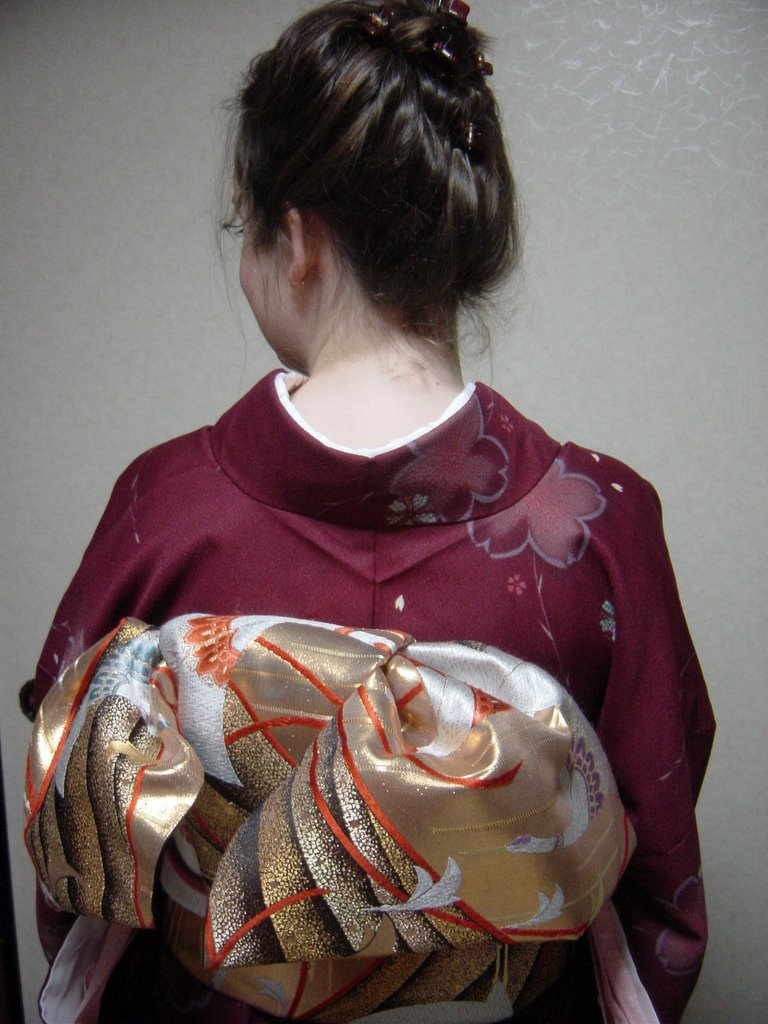
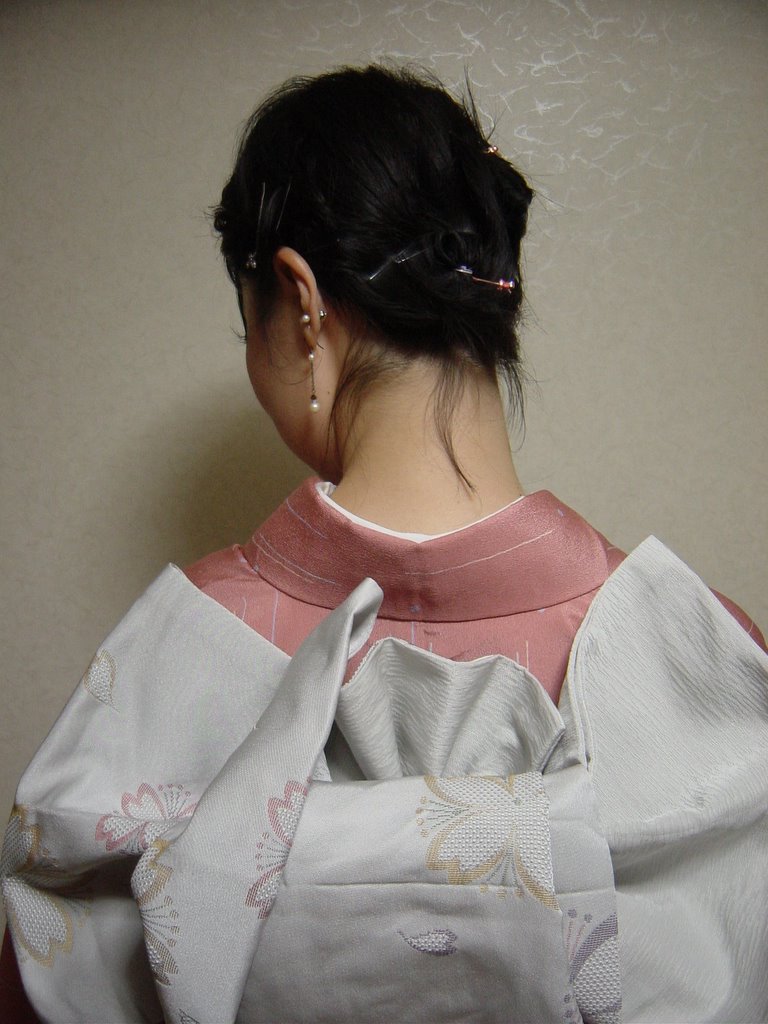
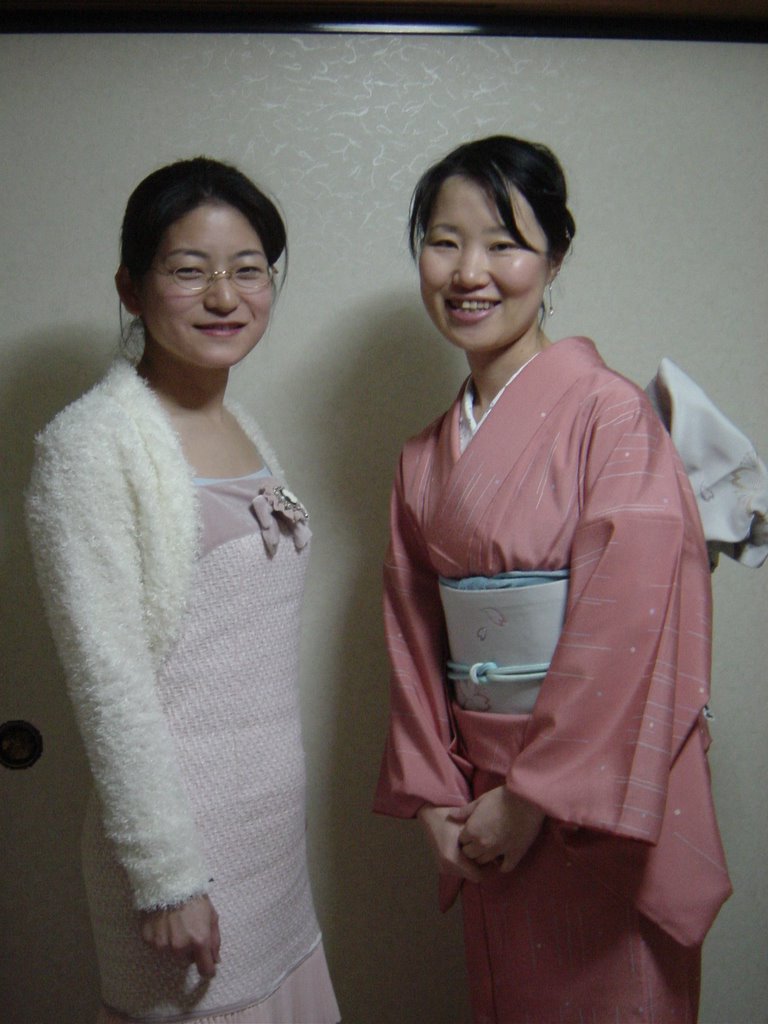
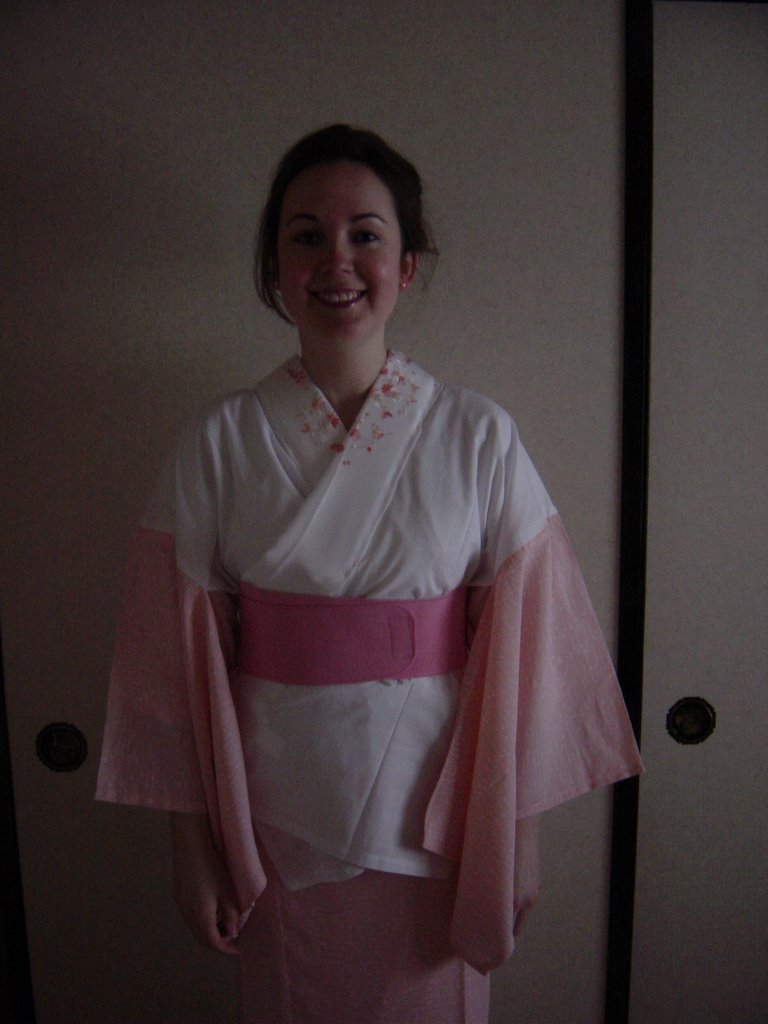
Our friend Migiwa was very nice -- not only did she lend us her kimonos, but also she dressed us and stayed in Western clothes to help if we had any crises (it's impossible to bend over in a kimono, and nearly impossible to use the bathroom, and if anything came undone, Mayumi and I would have no idea how to fix it). So we were lucky to have a very relaxing day thanks to Migiwa. It felt like playing dress-up. The picture of me in a pink-and-white cotton thing is the kimono "underwear," and they were shocked I wanted my picture taken "in my underwear." But I thought the process of getting dressed would be interesting to share. Actually, I have on about 4 layers under what you see in that picture, including real underwear, long underwear, hose, and a bath towel wrapped around my waist. These undergarments are followed by more layers and bands aroud my waist to eliminate any curves, making me straight up and down. There's a reason kimonos are designed not to show off curves: a long time ago when everything was made of silk, they passed kimonos down from generation to generation. All kimonos are pretty long, but each woman's waist and height are different. So if tons of fabric is wrapped around your waist, including the outer kimono, it's easier to have one kimono fit many women: you simply adjust the length by rolling the fabric into bands around the waist, and there's no need to worry about waist size, leg length, etc. One size fits all.
So the idea is to look curve-less, which may seem strange to westerners. But fear not, some parts of the kimono are designed for purely "sexual" purposes. (Why else is "scoop-neck" or "mini" in a western woman's vocabulary?) The most obviously sexy part of the kimono design is around the neck. The nape of the neck is considered very sexy, I'd venture to say almost erotic, when exposed. This is one reason why the pinning of all the layers is a delicate process: the kimono is wrapped very tightly, but must be done in such a way that the collar stays away from the back of your neck. The effect is really beautiful. See pictures.
Also, the big "bows" in the back are created by a waistband called an obi. There are many ways to tie the obi and of course everything is symbolic. The one I have was only worn by the highest caste of women in the Edo Period (Meiji Period? Meg please help!). Sometimes it's used today in weddings. Other parts of the kimono symbolize different things about rank and age and purpose, from the colors and designs on the fabric to the length of the sleeves.
Anyway, it took 45 minutes for Migiwa to complete both of our kimonos. There are so many layers, special knots, wrappings, pinnings, and unpinnings, the process is truly an art that requires both muscle (to wrap so tightly) and patience (to be yanked and wrapped and pinned for about 20 minutes). While we were getting dressed, Mayumi put on a Kelly Clarkson CD, and I couldn't help but laugh at the irony: the stereo was blasting "It Feels Like I Can't Breathe" as Migiwa was tying all my knots.
I don't mean to complain, though -- it's quite a lovely experience and, with hairdos and more make-up than usual, we felt quite feminine. It was somewhat similar to the prom. After we spent most of the day getting dressed, we went to the temple, where we prayed, read our fortunes for the year, and then had coffee and cake (uh, a very tiny piece of cake) at a coffeeshop. Then we came home and danced around Mayumi's apartment a bit before finally getting undressed and calling it a day.
Hope you enjoy the photographs. Mayumi doesn't realize how beautiful she is.
So the idea is to look curve-less, which may seem strange to westerners. But fear not, some parts of the kimono are designed for purely "sexual" purposes. (Why else is "scoop-neck" or "mini" in a western woman's vocabulary?) The most obviously sexy part of the kimono design is around the neck. The nape of the neck is considered very sexy, I'd venture to say almost erotic, when exposed. This is one reason why the pinning of all the layers is a delicate process: the kimono is wrapped very tightly, but must be done in such a way that the collar stays away from the back of your neck. The effect is really beautiful. See pictures.
Also, the big "bows" in the back are created by a waistband called an obi. There are many ways to tie the obi and of course everything is symbolic. The one I have was only worn by the highest caste of women in the Edo Period (Meiji Period? Meg please help!). Sometimes it's used today in weddings. Other parts of the kimono symbolize different things about rank and age and purpose, from the colors and designs on the fabric to the length of the sleeves.
Anyway, it took 45 minutes for Migiwa to complete both of our kimonos. There are so many layers, special knots, wrappings, pinnings, and unpinnings, the process is truly an art that requires both muscle (to wrap so tightly) and patience (to be yanked and wrapped and pinned for about 20 minutes). While we were getting dressed, Mayumi put on a Kelly Clarkson CD, and I couldn't help but laugh at the irony: the stereo was blasting "It Feels Like I Can't Breathe" as Migiwa was tying all my knots.
I don't mean to complain, though -- it's quite a lovely experience and, with hairdos and more make-up than usual, we felt quite feminine. It was somewhat similar to the prom. After we spent most of the day getting dressed, we went to the temple, where we prayed, read our fortunes for the year, and then had coffee and cake (uh, a very tiny piece of cake) at a coffeeshop. Then we came home and danced around Mayumi's apartment a bit before finally getting undressed and calling it a day.
Hope you enjoy the photographs. Mayumi doesn't realize how beautiful she is.
03 January 2006


New Year's
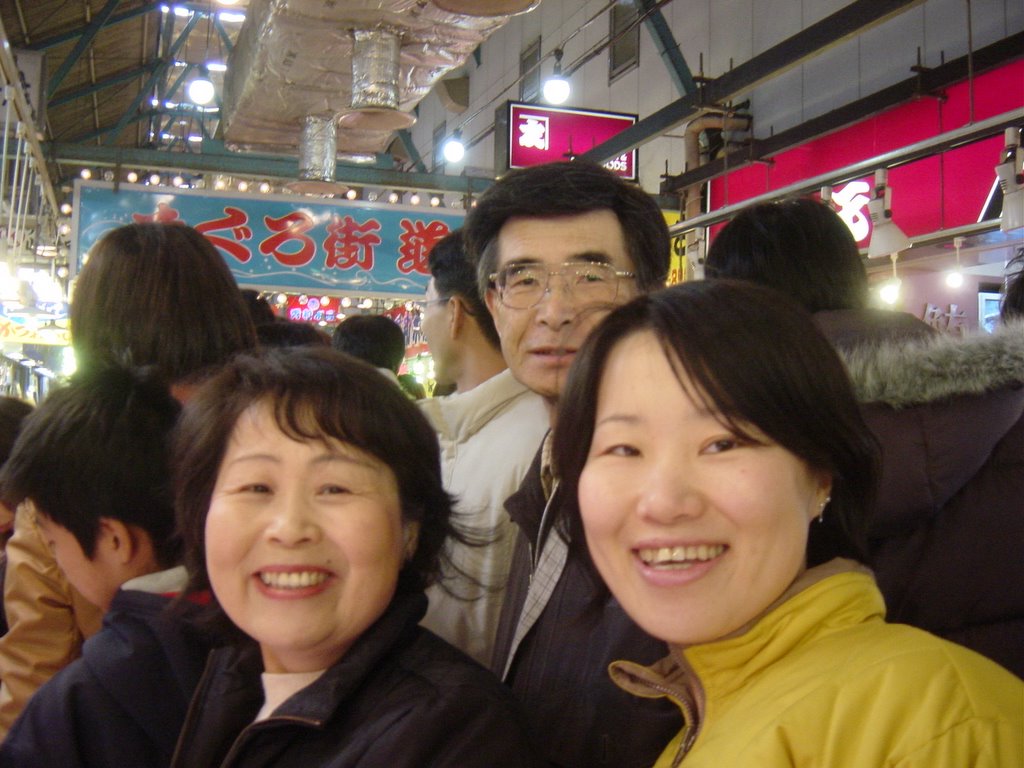
I spent New Year's--a very important and somewhat solemn holiday in Japan--with Mayumi's family in Fujieda. Overall, it was a completely cozy, relaxing, lazy, spiritual, reflective, traditional holiday that I enjoyed very much. Her parents were so sweet and hospitable; her high school buddies were friendly and happy to speak Japanglish with me (their English was quite impressive, but I tried to throw in Japanese whenever I could, so the foreigner wouldn't totally monopolize the language of choice); I ate more rice cakes and home-cooked Japanese food than ever before; I met grandparents and brothers; I rang a temple bell and drank special sake at midnight; I bought very cheap very warm sets of long underwear; I ate my first riceburger (which was actually shrimp and vegetables); I cleaned tombstones and burned incense and prayed; I prayed some more; I watched Japanese dramas from the Edo period; I heard booming fireworks with the rising sun on the first day of the new year; I slept late; and I drank gold-flecked sake with breakfast. Needless to say it was a great welcome to 2006.
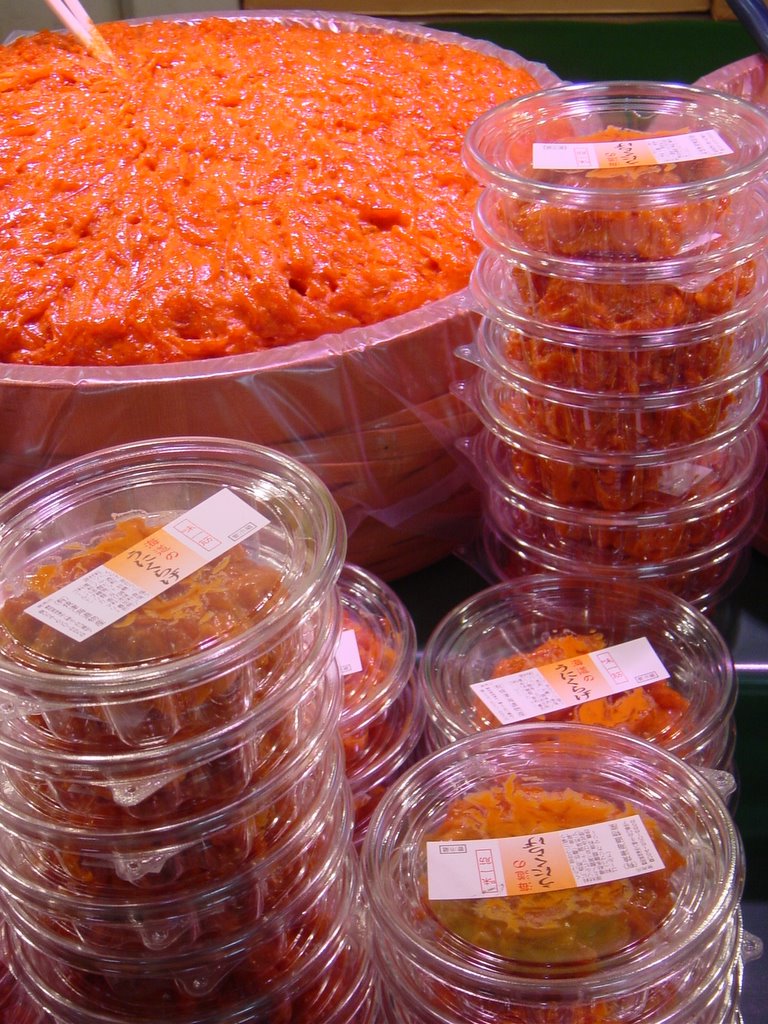
I also visited a famous fish market with Mayumi's family. Here are some pics...the orange stuff is a soupy squid mixture, the green stuff is seaweed, and the rest is self-explanatory. Mayumi's favorite treat was miniature octupii (sp?) mixed with wasabi. Uh, please pass the raw tuna with onions and hold the baby alien-wasabi-octupus. Thank you. :)
29 December 2005


28 December 2005


27 December 2005
Doubles, Anyone?
Not just anyone, because my tennis people seem to have formed a clique. It's always Jun and me ("The Young") against Mr. Yabe and Mr. Iizuka ("The Veterans"). And today was war. We played the longest doubles match I can remember: 5-7, 6-4, 7-5. In one game, we went through 14 deuces. 14!!! All in all, we played for four hours straight.
I think I earned my dinner.
I think I earned my dinner.
26 December 2005
A Very Insufficient Tribute to Robert Doisneau
I admit, I fell for Doisneau's girly black-and-white shots of couples on the cobblestones of Paris (1940s-1950s). But I also fell for the shots working-class people in bars or on dirty street corners, not in the center but on the outskirts of my favorite city. A friend lent me a huge book of Doisneau's work. None of the descriptions were written in English, so reading French and recognizing scenes of Paris made me very nostalgic. But the real kicker came when I read about why Doisneau chose to be a photographer. Because he described exactly why I love to write, in much less than a thousand words:
…ou plus simplement une façon de marquer ma joie d’être au monde et de voir clair.
A very rough translation is:
...or more simply, a way to record my joy to be in the world, and to see clearly.
(The translation is less-than-perfect, but) I couldn't have said it any better.
…ou plus simplement une façon de marquer ma joie d’être au monde et de voir clair.
A very rough translation is:
...or more simply, a way to record my joy to be in the world, and to see clearly.
(The translation is less-than-perfect, but) I couldn't have said it any better.
24 December 2005
Merry Christmas, Re-Stated
I sit here now on Christmas Eve, 14 hours before Christmas Eve on America's east coast. It is my first Christmas alone, yet loneliness is the last thing I feel. I reflect on my experiences with Buddhism, with Judaism, with a country of people who claim to have "no religion," and maybe for the first time I understand Christmas better than all the years before when I was surrounded by people and presents and lights. The real message and meaning of Christmas is simple: joy to the world, for there is the great promise that you are, and will be, loved. And the promise of Love is personified by a baby born in a stable. Is it really important whether or not this baby was the Son of God? ("Of course it is," some people would argue. "That's the whole foundation of Christianity -- Jesus as the Son of God.") But I believe what is most important, beyond any ideas of Trinities or Virgins or gifts of frankincense, is simply what this Day and what this Child represent for ALL people: the hope, and the promise, of being loved. And with true love comes peace--an erosion of barriers if not an erosion of identities--and with peace comes the ability to be content with what has already been given to you, and with contentment comes the inner strength and energy to love someone else.
There were two aspects of Buddhism that were hard for me to embrace. The first was the lack of a God in the Christian sense, the lack of someONE to whom I could specifically address my prayers. The second was a quote from a Buddhist monk, who said there was no need to convert to Buddhism, because I could find everything I needed within myself and within my "current" or "former" religion of practice. I read this and felt like a scolded child, like my efforts and readiness to accept something new were "silly." And for a long time I rejected this idea because I felt like it was rejecting me.
But it was always in the back of my mind, and slowly, I have come not only to accept it, but also to agree with it. I don't feel a need to divorce myself from Christianity, in hopes of finding a simpler, less "cluttered" spirituality. I have only to look past the violence and the complicated family trees of The Bible to find what I originally set out to discover somewhere else -- the message of unity and love. And being alone, in a foreign country of non-Christians on Christmas Eve, has taught me exactly that.
It's not that my family, or all those who celebrate Christmas with me, have not tried to teach me this already. But I think it's a journey you have to make on your own before you can fully appreciate it. Never has there been a more appropriate time for the quote that has almost become cliche:
We shall not cease from exploration
And the end of all our exploring
Will be to arrive where we started
and know the place for the first time.
--T S Eliot
Merry Christmas. A new Merry Christmas; a simple Merry Christmas; one I feel like I am knowing for the first time.
I've never felt more content with God, or with the understanding that there are multiple paths to the same destination.
You are loved, there is hope for peace, and the rest is just details.
There were two aspects of Buddhism that were hard for me to embrace. The first was the lack of a God in the Christian sense, the lack of someONE to whom I could specifically address my prayers. The second was a quote from a Buddhist monk, who said there was no need to convert to Buddhism, because I could find everything I needed within myself and within my "current" or "former" religion of practice. I read this and felt like a scolded child, like my efforts and readiness to accept something new were "silly." And for a long time I rejected this idea because I felt like it was rejecting me.
But it was always in the back of my mind, and slowly, I have come not only to accept it, but also to agree with it. I don't feel a need to divorce myself from Christianity, in hopes of finding a simpler, less "cluttered" spirituality. I have only to look past the violence and the complicated family trees of The Bible to find what I originally set out to discover somewhere else -- the message of unity and love. And being alone, in a foreign country of non-Christians on Christmas Eve, has taught me exactly that.
It's not that my family, or all those who celebrate Christmas with me, have not tried to teach me this already. But I think it's a journey you have to make on your own before you can fully appreciate it. Never has there been a more appropriate time for the quote that has almost become cliche:
We shall not cease from exploration
And the end of all our exploring
Will be to arrive where we started
and know the place for the first time.
--T S Eliot
Merry Christmas. A new Merry Christmas; a simple Merry Christmas; one I feel like I am knowing for the first time.
I've never felt more content with God, or with the understanding that there are multiple paths to the same destination.
You are loved, there is hope for peace, and the rest is just details.
22 December 2005
Picture This
There's a 20-something white girl, brown hair, only about 5 feet tall despite all the milk she drank as a kid. It's 40 degrees outside, and despite being inside a classroom, she's freezing because schools don't actually close the windows or turn on the heat in winter. (Maybe they would, if the heat existed). She's layered in long underwear, windpants, 2 sweaters, a coat, a scarf, and gloves, and she's standing awkwardly at the back of a classroom. There are 30 mentally and/or physically disabled middle school children and 10 teachers in the same room. The noise and movements around her never stop, and the atmosphere borders on insanity. The girl focuses on her breathing so she won't flee right then and there. At the front of the classroom, an older lady is playing the piano, and a younger lady is playing the flute.
Suddenly, there is the sensation of large, dry slugs sliding down the fronts of her thighs. The girl jumps and throws her head down in shock to realize that a boy has just shoved both his hands down her front pockets. She yanks them out and places them firmly by his sides, squeezing them tightly to send a clear message, despite the language barrier. She is the only person in the room who speaks English. Before she has a chance to move away from the distracted student, a young Japanese teacher wraps something around her head. A glance in the window shows her that it's a blue paper flower the size of a basketball. "Dance?" the teacher pleads, and drags her to the front of the classroom. She recognizes a Hawaiian aloha tune from the piano. The girl hesitates at the mini-stage, but someone pushes her to the middle as two more hands drape a lei (?) around her neck, on top of the grey wool scarf. "Dance, dance!?" the teacher begs. So covered in gloves, layers, a big paper flower and a plastic flower necklace, the girl unfolds some very ungraceful aloha moves. And in the middle of dancing, wishing she could blow her nose, or drink a cup of coffee, or be alone, she admits to herself for the first time, "I really, really hate this."
Was it so bad? Nah. In the grand scheme of things, it was nothing. But in that moment, she wanted to be anywhere else, and she still doesn't want to go back.
A few days later: that same girl is still cold. She just drank a very Japanese solution of powdered ginger in warm water, a gift from a friend who said it would "make [her] body hot." Luckily for her, she loves the stuff. She's in her apartment and little puffs of air are visible when she exhales. The music is on for the first time all day, and the volume is loud. She's singing and panting, bent over the tile floor in her shower, scrubbing with a bottle of cleaner that has a sparkling toilet bowl on the front. That toilet bowl is the only part of the packaging she can understand. But the drawn-on twinkles told her enough -- the liquid works wonders. Scrub scrub, hey! that black stuff is gone!
Despite the fact that she's recovering from a cold, her jeans are rolled up to her knees and she wears nothing on her feet (they're getting wet in the shower). The top of her, however, is of course layered in long underwear, sweaters, a scarf, and a wool hat. But this time, alone in her apartment, thinking about the people she loves, reflecting on a fun weekend, and singing, she's pretty damn happy.
And you gotta admit, wearing a hat inside is kind of funny.
Suddenly, there is the sensation of large, dry slugs sliding down the fronts of her thighs. The girl jumps and throws her head down in shock to realize that a boy has just shoved both his hands down her front pockets. She yanks them out and places them firmly by his sides, squeezing them tightly to send a clear message, despite the language barrier. She is the only person in the room who speaks English. Before she has a chance to move away from the distracted student, a young Japanese teacher wraps something around her head. A glance in the window shows her that it's a blue paper flower the size of a basketball. "Dance?" the teacher pleads, and drags her to the front of the classroom. She recognizes a Hawaiian aloha tune from the piano. The girl hesitates at the mini-stage, but someone pushes her to the middle as two more hands drape a lei (?) around her neck, on top of the grey wool scarf. "Dance, dance!?" the teacher begs. So covered in gloves, layers, a big paper flower and a plastic flower necklace, the girl unfolds some very ungraceful aloha moves. And in the middle of dancing, wishing she could blow her nose, or drink a cup of coffee, or be alone, she admits to herself for the first time, "I really, really hate this."
Was it so bad? Nah. In the grand scheme of things, it was nothing. But in that moment, she wanted to be anywhere else, and she still doesn't want to go back.
A few days later: that same girl is still cold. She just drank a very Japanese solution of powdered ginger in warm water, a gift from a friend who said it would "make [her] body hot." Luckily for her, she loves the stuff. She's in her apartment and little puffs of air are visible when she exhales. The music is on for the first time all day, and the volume is loud. She's singing and panting, bent over the tile floor in her shower, scrubbing with a bottle of cleaner that has a sparkling toilet bowl on the front. That toilet bowl is the only part of the packaging she can understand. But the drawn-on twinkles told her enough -- the liquid works wonders. Scrub scrub, hey! that black stuff is gone!
Despite the fact that she's recovering from a cold, her jeans are rolled up to her knees and she wears nothing on her feet (they're getting wet in the shower). The top of her, however, is of course layered in long underwear, sweaters, a scarf, and a wool hat. But this time, alone in her apartment, thinking about the people she loves, reflecting on a fun weekend, and singing, she's pretty damn happy.
And you gotta admit, wearing a hat inside is kind of funny.



21 December 2005
I [heart] Fuji Higashi
Last night teachers held a much-anticipated event, the bonenkai. It's a big party at the end of the year, when everyone eats, drinks, makes fools of themselves, and jumps through traditional hoops and formalities like, "Thank you for a good year; please be kind to me next year."
My school had a big blowout at a traditional inn down the coast. Of course there were hot springs, and the entire floor was tatami, even in the elevators. The best part, though, was that I was completely snug and warm for 24 hours straight. Central heating, big bath, and warm futon blankets. When my "roomies" settled down to sleep we looked like a cozy Japanese family -- 6 people side by side on futons on the floor.
But the important parts happened before we went to bed. Once all 60 teachers got to the hotel, we were like kids on a field trip. Everyone (finally) in casual clothes, running around, checking out the rooms, and playing on the elevator. After a thorough inspection of the place, we threw down our bags, practiced our comedy routine, ate a huge traditional dinner (complete with speeches, toasts, bowing, and raw unidentifiable sea creatures), enjoyed the performances, drank some more, bathed, and finally curled up to sleep. It was such a bonding experience and, even though I've spent time with teachers outside of school, this was the first time everyone has been so relaxed and in the same place. Each teacher has so much personality, and being with them in a different environment was the highlight of the trip.
Here are some random things and explanations of the above pictures. Unfortunately, some of the pictures are too dark because the banquet room was so big. Also, I have no control over the arrangement of pics when I post. But I'll explain the best I can.
My school had a big blowout at a traditional inn down the coast. Of course there were hot springs, and the entire floor was tatami, even in the elevators. The best part, though, was that I was completely snug and warm for 24 hours straight. Central heating, big bath, and warm futon blankets. When my "roomies" settled down to sleep we looked like a cozy Japanese family -- 6 people side by side on futons on the floor.
But the important parts happened before we went to bed. Once all 60 teachers got to the hotel, we were like kids on a field trip. Everyone (finally) in casual clothes, running around, checking out the rooms, and playing on the elevator. After a thorough inspection of the place, we threw down our bags, practiced our comedy routine, ate a huge traditional dinner (complete with speeches, toasts, bowing, and raw unidentifiable sea creatures), enjoyed the performances, drank some more, bathed, and finally curled up to sleep. It was such a bonding experience and, even though I've spent time with teachers outside of school, this was the first time everyone has been so relaxed and in the same place. Each teacher has so much personality, and being with them in a different environment was the highlight of the trip.
Here are some random things and explanations of the above pictures. Unfortunately, some of the pictures are too dark because the banquet room was so big. Also, I have no control over the arrangement of pics when I post. But I'll explain the best I can.
- Everyone draws a number to determine where to sit; all the seats are on the floor along the walls.
- The festivities begin by toasting and everybody takes the first drink at once.
- During the meal the rookies (youngest teachers) hop inside the circle and move around serving, pouring drinks, and making small talk with as many people as possible.
- After all drinking, eating, and performing is finished, the evening comes to an official close when everybody claps once, simultaneously.
- I performed with Mayumi, Migiwa Sensei, and Takayuki Sensei. His costume is crazy because he did an impression of a very famous, very gay Japanese comedian called "Hard Gay Leather Lemon." Mayumi and I impersonated a band called Pink Lady, which was famous about 20 years ago. Migiwa is dressed as a maid, representing this new breed of Japanese dork entertainment, where maids serve weirdo dorky guys in shops that are a combination of arcades, cafes, and comic book stores. I can't explain how dork-serving maids, Pink Lady, and Hard Gay combined to form one 10-minute comedy skit, but trust me, it was absolutely hilarious. They loved us.
- The PE teachers--former national soccer stars--ALSO did an impression of Pink Lady, but their costume interpretation was slightly different from ours. (The picture is really dark, but look closely.)
- I missed Jun's skit because I was preparing my costume, but he did something as a reindeer with a bowtie.
- The principal and vice-principal performed last, pretending to be members of a boy-band, complete with cheesey (cheesy?) boy-band dance moves.
16 December 2005
Japan, Oh Japan
- Today a teacher began toting a new coffee mug. It's covered in a Jamaican flag, a huge 5-pointed leaf, and the declaration, "Marijuana can't be that bad for me."
- The Japan Times ran an article about a Snoopy doll for sale in Tokyo. The beloved cartoon character, cast in platinum and gold, is going for the little tune of 5.5 million dollars.
- Since I'm on my 3rd cold, I needed to buy more tissues. I grabbed the cheapest ones and the packaging says, "Your skin will be touched softly and gently by 100% high quality pulp."
- Oh, Japan. No further comment.
12 December 2005
Why I May Have Gotten the Best School in Japan
Today was Monday. And tonight we had a going-away party for a nice, young teacher who was replacing someone temporarily on maternity leave. I'll be sad to see him go, especially since he was the only one around to help me read power switches in Japanese when I blew my fuse. (I know, I'm such a glutton, using the lights AND the air-conditioner at the same time, gee what was I thinking, to want light AND heat simultaneously? [The air-con puts out hot air, and I wanted to use that instead of kerosene]). Anyway, the guy lives in my apartment complex and he's pretty cool, so I'll miss him next semester.
When my school has an enkai (drinking party), we go all out, heading for the best bars and restaurants in town. Tonight, the vice-principal couldn't make it, but he threw in 100 bucks out of his pocket just so we could have an extra-good time on a school night. I was out with my co-workers but I felt like I was out with my best friends (in Japan, of course). And that, dear readers, is why I am happy in this place. Connections among people.
People make everything.
When my school has an enkai (drinking party), we go all out, heading for the best bars and restaurants in town. Tonight, the vice-principal couldn't make it, but he threw in 100 bucks out of his pocket just so we could have an extra-good time on a school night. I was out with my co-workers but I felt like I was out with my best friends (in Japan, of course). And that, dear readers, is why I am happy in this place. Connections among people.
People make everything.
08 December 2005



.jpg)

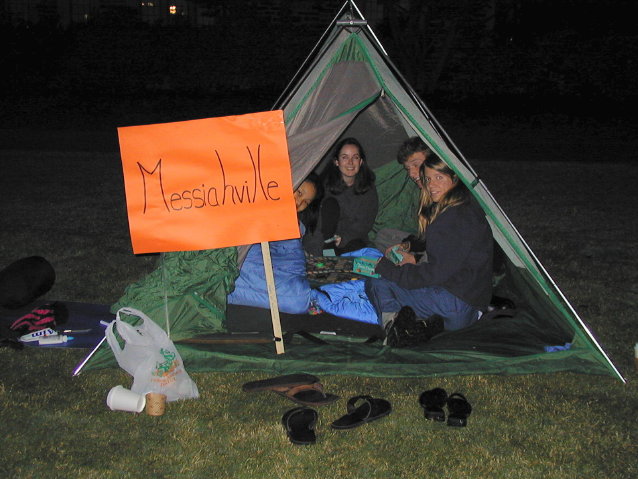
05 December 2005
Weirdness
I feel like so much has happened to me in the past 48 hours -- both good and bad -- I don't even know where to start. For now I'll try the easy stuff and see where this goes.
GOOD
I went to Tokyo with Mayumi and Jun. It was a whirlwind trip. I saw some great sights, bought some new clothes, ate at a great sushi place, and learned some more Japanese.
I was reminded a couple times why Mayumi is such an awesome friend, and why Jun can be such a nice guy.
I tried uni, raw sea urchin ovary. I mustered the guts a lot sooner than I expected. Uni is small, yellow-brown, mushy like firm hummus, and tastes absolutely gross. A pasty, chemical + grossly-biological taste. I'll stick with my raw tuna and seaweed, thanks.
I pushed through some barriers on purpose and had a very interesting discussion on love (and expressions of love) with Mayumi and Jun. Hopefully more on this later.
I ate some authentic-tasting Italian food.
I got an amazing email about the Duke game. I won't spoil it for those of you who may have taped the game without watching it yet.
Mt. Fuji is covered in snow, and all day you can see the wind whisping the flakes into a crowning cloud.
BAD
I tried to keep up the self-sufficient thing, and decided against asking Mayumi for help getting a kerosene refill. (She's my friend, but she still has her own life. It's not her job to cart me around just because I don't have a car. I thought I should do it on my own. Besides, I thought I was being Japanese, by thinking of the "group" and not inconveniencing anyone else.) So, I made it to the gas station in the freezing cold, asked for the correct fuel in Japanese, and dragged that darn thing back to the bus stop. I had to stop every 10 steps to switch hands. The container was HEAVY, and the handle was too small to use 2 hands at once.
The first bus came, and let people off, but for some mysterious reason didn't let me on. I thought the bus driver didn't see me, because it was pitch-black, even though it was only 5pm. I was disappointed but resigned myself to waiting, 20 minutes in 40-degree weather, for the next bus. I had put on extra clothes in preparation for this trip. But there was no way I was making the 30-minute walk home with 50 pounds of kerosene bumping against my thighs. I waited and waited, blew my runny nose, and waited some more. The next bus came, and let people off, but again totally ignored me and did not open the door for me to get on. I was stunned and this time, heartbroken. (Keep in mind I was already having an usually rough day.) Why did he not let me on the bus? Was it the huge jug of kerosene? I had considered this before I left my apartment -- maybe kerosene on a public bus was a safety hazard. But the bus took me TO the gas station, with the jug in full sight. So why wouldn't it take me BACK? Why didn't they even try to speak to me? This was the last frustrating straw in a very emotional day. I wanted to cry. And in fact, I sat on my damn kerosene, in the cold, in the dark, by the side of the rode, and I did just that. I held my head in my hands until the metal in my earrings began to freeze and hurt my earlobes. A few minutes later I stood up, dragged that jug of kerosene down to my school (where I knew Mayumi would still be), and asked for a ride home.
I felt ashamed. But as Mayumi lifted the jug into her car, she squealed, "Are you crazy? Why didn't you ask me for help?" Then I burst into a big story about how I didn't want her to feel used, I wanted to do it myself, and not bother her or depend on her. She was my friend, not my chauffeur. She looked at me and said, "Lauren, sometimes I think you are actually Japanese. But in this case, you don't understand. No one can live a life alone. You don't have a car. So don't be stupid - just ask me for a ride!" I bit my lip but I promised her that next time, I would.
After that Mayumi and I sat in her parked car and talked for a long time. I needed to have that conversation. Lately I've just felt like the shit has begun to hit the fan, if it's possible for that to happen in waves. The whole attempt to assimilate in another country has taken me farther than I expected, faster than I expected. Some of the results are amazing, beautiful, and powerfully transforming. But others are not so pretty. When you enter the JET Program, if you take it seriously, you are signing on to accept an explosion of your social circles. People who never care to keep in touch with friends wouldn't have this problem. But I want to make sure all the people I love really know that I love them. So one leg is running in Japan, so smoothly it scares me. One leg is planted at home in water. By home I mean all the family, friends, and experiences I had before Japan. I say water because you know it's there and it's necessary for life. But water is also something that moves, changes, and takes the shape of its container, yet is impossible to pin down. It's really hard to run with one foot down a new path that you love more and more, and stand in water with the other. However, it should still be possible -- right? Because you have two feet!
But you're forgetting about the JET Program and that third leg you sprouted when you met all the other ALTs! Americans and British and Irish and Australians and Scottish people that, like you, are foreigners in Japan. You think you're in the same boat, and that you should all bond over common struggles in Japan. And you want to maintain good relations, because you think you're supposed to be friends with other people "like you" on the JET Program. The problem is, everyone assimilates at various speeds, to different capacities. Some people hate Japan, or dislike it at least, and you don't want to be around negativity when you're happy. Some people like Japan okay, and don't want to complain, but are clearly uncomfortable with the differences in your experiences. Others just don't care and it's like they never left home. But all of them, somehow (except for 1 or 2), make you feel more out of place than if you were just hanging around with your Japanese friends. And then you feel like a poser, or a traitor or something, for "forgetting your roots," or leaving behind what you know, or becoming too Japanese, or being naive because you're still "in the honeymoon stage."
And the weirdest part of all is when you realize your values are changing, and it begins to affect your everyday life. You gauge your interactions with Japanese by Japanese standards. And then you start to adopt their values, or realize their values match your own, and you can really flesh out your own way of doing things by being in a new culture. But you forget that you are changing! You think it's just you all along! (Maybe it was, and America socialized you into acting a different way!) So when you interact with other ALTs, or people from home, you start gauging your experiences with them by Japanese standards. And then you get so confused, and feel like you're being pulled in so many directions, and wondering what is best for you without rejecting too many things from Japan or too many things from your previous life that the next thing you know, you're sitting on kerosene and crying because the bus driver didn't even try to speak to you in Japanese. And you think, if he had just said, "No toyu on the bus," in any language, you would have understood.
GOOD
I went to Tokyo with Mayumi and Jun. It was a whirlwind trip. I saw some great sights, bought some new clothes, ate at a great sushi place, and learned some more Japanese.
I was reminded a couple times why Mayumi is such an awesome friend, and why Jun can be such a nice guy.
I tried uni, raw sea urchin ovary. I mustered the guts a lot sooner than I expected. Uni is small, yellow-brown, mushy like firm hummus, and tastes absolutely gross. A pasty, chemical + grossly-biological taste. I'll stick with my raw tuna and seaweed, thanks.
I pushed through some barriers on purpose and had a very interesting discussion on love (and expressions of love) with Mayumi and Jun. Hopefully more on this later.
I ate some authentic-tasting Italian food.
I got an amazing email about the Duke game. I won't spoil it for those of you who may have taped the game without watching it yet.
Mt. Fuji is covered in snow, and all day you can see the wind whisping the flakes into a crowning cloud.
BAD
I tried to keep up the self-sufficient thing, and decided against asking Mayumi for help getting a kerosene refill. (She's my friend, but she still has her own life. It's not her job to cart me around just because I don't have a car. I thought I should do it on my own. Besides, I thought I was being Japanese, by thinking of the "group" and not inconveniencing anyone else.) So, I made it to the gas station in the freezing cold, asked for the correct fuel in Japanese, and dragged that darn thing back to the bus stop. I had to stop every 10 steps to switch hands. The container was HEAVY, and the handle was too small to use 2 hands at once.
The first bus came, and let people off, but for some mysterious reason didn't let me on. I thought the bus driver didn't see me, because it was pitch-black, even though it was only 5pm. I was disappointed but resigned myself to waiting, 20 minutes in 40-degree weather, for the next bus. I had put on extra clothes in preparation for this trip. But there was no way I was making the 30-minute walk home with 50 pounds of kerosene bumping against my thighs. I waited and waited, blew my runny nose, and waited some more. The next bus came, and let people off, but again totally ignored me and did not open the door for me to get on. I was stunned and this time, heartbroken. (Keep in mind I was already having an usually rough day.) Why did he not let me on the bus? Was it the huge jug of kerosene? I had considered this before I left my apartment -- maybe kerosene on a public bus was a safety hazard. But the bus took me TO the gas station, with the jug in full sight. So why wouldn't it take me BACK? Why didn't they even try to speak to me? This was the last frustrating straw in a very emotional day. I wanted to cry. And in fact, I sat on my damn kerosene, in the cold, in the dark, by the side of the rode, and I did just that. I held my head in my hands until the metal in my earrings began to freeze and hurt my earlobes. A few minutes later I stood up, dragged that jug of kerosene down to my school (where I knew Mayumi would still be), and asked for a ride home.
I felt ashamed. But as Mayumi lifted the jug into her car, she squealed, "Are you crazy? Why didn't you ask me for help?" Then I burst into a big story about how I didn't want her to feel used, I wanted to do it myself, and not bother her or depend on her. She was my friend, not my chauffeur. She looked at me and said, "Lauren, sometimes I think you are actually Japanese. But in this case, you don't understand. No one can live a life alone. You don't have a car. So don't be stupid - just ask me for a ride!" I bit my lip but I promised her that next time, I would.
After that Mayumi and I sat in her parked car and talked for a long time. I needed to have that conversation. Lately I've just felt like the shit has begun to hit the fan, if it's possible for that to happen in waves. The whole attempt to assimilate in another country has taken me farther than I expected, faster than I expected. Some of the results are amazing, beautiful, and powerfully transforming. But others are not so pretty. When you enter the JET Program, if you take it seriously, you are signing on to accept an explosion of your social circles. People who never care to keep in touch with friends wouldn't have this problem. But I want to make sure all the people I love really know that I love them. So one leg is running in Japan, so smoothly it scares me. One leg is planted at home in water. By home I mean all the family, friends, and experiences I had before Japan. I say water because you know it's there and it's necessary for life. But water is also something that moves, changes, and takes the shape of its container, yet is impossible to pin down. It's really hard to run with one foot down a new path that you love more and more, and stand in water with the other. However, it should still be possible -- right? Because you have two feet!
But you're forgetting about the JET Program and that third leg you sprouted when you met all the other ALTs! Americans and British and Irish and Australians and Scottish people that, like you, are foreigners in Japan. You think you're in the same boat, and that you should all bond over common struggles in Japan. And you want to maintain good relations, because you think you're supposed to be friends with other people "like you" on the JET Program. The problem is, everyone assimilates at various speeds, to different capacities. Some people hate Japan, or dislike it at least, and you don't want to be around negativity when you're happy. Some people like Japan okay, and don't want to complain, but are clearly uncomfortable with the differences in your experiences. Others just don't care and it's like they never left home. But all of them, somehow (except for 1 or 2), make you feel more out of place than if you were just hanging around with your Japanese friends. And then you feel like a poser, or a traitor or something, for "forgetting your roots," or leaving behind what you know, or becoming too Japanese, or being naive because you're still "in the honeymoon stage."
And the weirdest part of all is when you realize your values are changing, and it begins to affect your everyday life. You gauge your interactions with Japanese by Japanese standards. And then you start to adopt their values, or realize their values match your own, and you can really flesh out your own way of doing things by being in a new culture. But you forget that you are changing! You think it's just you all along! (Maybe it was, and America socialized you into acting a different way!) So when you interact with other ALTs, or people from home, you start gauging your experiences with them by Japanese standards. And then you get so confused, and feel like you're being pulled in so many directions, and wondering what is best for you without rejecting too many things from Japan or too many things from your previous life that the next thing you know, you're sitting on kerosene and crying because the bus driver didn't even try to speak to you in Japanese. And you think, if he had just said, "No toyu on the bus," in any language, you would have understood.
02 December 2005
Taking Notes
Just wanted to share some things Japan has "taught" me about myself -- and by "taught" I mean "reiterated, reminded, or reinforced."
-I like chocolate.
By this point, my supervisor and I have had many of what I'd call mini-bonding experiences. One of the best ones by far was the day she brought me a box of Japan's newly-marketed 72% cacao chocolate. I was so delighted I thougt my eyebrows were going to shoot off my forehead. And she was so excited to give it to me, in fact, that her husband complained, "Why did you only buy Lauren a box? Why not one for me too?" Also, when I opened the chocolate Mom and Dad sent I felt such bliss it was like coming home.
-I have a weird little stomach.
I like to eat about every 2-3 hours. Literally. And I like to eat about a handfull at a time. I like a warm, heavier meal for lunch (chicken curry, can't beat that in cold weather), and a small thing for dinner (salad, yogurt, and God forbid - cereal). I have explained my strange eating schedule about as many times as I have consumed food. Aren't you hungry? Don't you like it? Aren't you American? Food at 9:30 in the morning - did you not eat breakfast? Do you cook? And to all of these questions, I very calmly answer, "Yes." I like the food, I cook a lot of it, I'm American, and if I'm still alive you can bet your rear I ate breakfast. If I haven't eaten by the time you see me, I either have a crazy Japanese medical check-up or I'm deathly ill and you should rush me to the ER. Because a huge part of my peace and happiness is based on my eating, I just don't bother trying to conform to the 3 square meals a day social ritual. I go out to eat if friends go out to eat, but other than that, the food thing I do on my own. It makes me much happier. Now I understood what happened in France, eating like I do all day long, wanting very little at night, but always sitting down to a 3-course meal with 3 matching glasses of wine.
-I like feeling self-sufficient.
Living in Japan is often like my image of living on a farm. I say this for two reasons: I don't have a car, and my apartment is old. All the water heaters are gas, including the one for the shower, and if I want to create heat in one room I must do the following:
1) grumble about the lack of central heating
2) force myself to get up and put on 3 more layers of clothing
3) open the kerosene heater trap door and pull out the big metal box
4) lug the big metal box outside, where it is pitch black and cold, to my locker where the small tank of kerosene is stored
5) open the tank, open the box, grab the plastic pump and pretend to perform very crude surgery as I pump, pump, pump the refill kerosene into the empty box
6) pretend it's dawn, instead of pitch-black at 7pm, and that I have gotten up early to go milk the cows and watch my breath form little clouds
7) pump, pump, pump and damn it's cold
8) store the tank and the pump, shut the box lid and lug it back up to my aparment
9) insert box into heater, wait for the glub glub of kerosene refill
10) press START button on heater
12) wait 5 minutes for the warmth
Then I feel totally satisfied with what I "did all by myself," as proud as if I had accomplished all of those steps on brain-power alone. There's something to be said for the little, daily labors slowly eased and erased by technology. I used to take being warm for granted: Cold? Walk to the thermostat and push that dial to the right. Voila. And even though maintaining my previous level of comfort takes a lot more time and effort, I must acknowledge the fact that I am lucky to have an apartment that gets cold in the first place, and I am lucky to have the money to buy the kersone. It's easy to complain, but after I've done something so necessary to my existence, without consulting anybody, I feel so good. And I'm not cold anymore, either.
- I am a frugal big-spender.
For some reason, the more money I make, the more I want to keep. I'll refuse to spend a lot of money on something I need (a new kotatsu, for instance), and go for weeks spending a minimal amount of dough. I bought bath towels, in the exact color I wanted, for 2 bucks at the dollar store. (I happen to prefer thin towels, thank you!) But if I've wanted something for a while, like a specific bottle of perfume that would cost 30 times my bath towels, I feel totally comfortable spending the money. It's all about discrimination -- the good kind, that is.
-I like chocolate.
By this point, my supervisor and I have had many of what I'd call mini-bonding experiences. One of the best ones by far was the day she brought me a box of Japan's newly-marketed 72% cacao chocolate. I was so delighted I thougt my eyebrows were going to shoot off my forehead. And she was so excited to give it to me, in fact, that her husband complained, "Why did you only buy Lauren a box? Why not one for me too?" Also, when I opened the chocolate Mom and Dad sent I felt such bliss it was like coming home.
-I have a weird little stomach.
I like to eat about every 2-3 hours. Literally. And I like to eat about a handfull at a time. I like a warm, heavier meal for lunch (chicken curry, can't beat that in cold weather), and a small thing for dinner (salad, yogurt, and God forbid - cereal). I have explained my strange eating schedule about as many times as I have consumed food. Aren't you hungry? Don't you like it? Aren't you American? Food at 9:30 in the morning - did you not eat breakfast? Do you cook? And to all of these questions, I very calmly answer, "Yes." I like the food, I cook a lot of it, I'm American, and if I'm still alive you can bet your rear I ate breakfast. If I haven't eaten by the time you see me, I either have a crazy Japanese medical check-up or I'm deathly ill and you should rush me to the ER. Because a huge part of my peace and happiness is based on my eating, I just don't bother trying to conform to the 3 square meals a day social ritual. I go out to eat if friends go out to eat, but other than that, the food thing I do on my own. It makes me much happier. Now I understood what happened in France, eating like I do all day long, wanting very little at night, but always sitting down to a 3-course meal with 3 matching glasses of wine.
-I like feeling self-sufficient.
Living in Japan is often like my image of living on a farm. I say this for two reasons: I don't have a car, and my apartment is old. All the water heaters are gas, including the one for the shower, and if I want to create heat in one room I must do the following:
1) grumble about the lack of central heating
2) force myself to get up and put on 3 more layers of clothing
3) open the kerosene heater trap door and pull out the big metal box
4) lug the big metal box outside, where it is pitch black and cold, to my locker where the small tank of kerosene is stored
5) open the tank, open the box, grab the plastic pump and pretend to perform very crude surgery as I pump, pump, pump the refill kerosene into the empty box
6) pretend it's dawn, instead of pitch-black at 7pm, and that I have gotten up early to go milk the cows and watch my breath form little clouds
7) pump, pump, pump and damn it's cold
8) store the tank and the pump, shut the box lid and lug it back up to my aparment
9) insert box into heater, wait for the glub glub of kerosene refill
10) press START button on heater
12) wait 5 minutes for the warmth
Then I feel totally satisfied with what I "did all by myself," as proud as if I had accomplished all of those steps on brain-power alone. There's something to be said for the little, daily labors slowly eased and erased by technology. I used to take being warm for granted: Cold? Walk to the thermostat and push that dial to the right. Voila. And even though maintaining my previous level of comfort takes a lot more time and effort, I must acknowledge the fact that I am lucky to have an apartment that gets cold in the first place, and I am lucky to have the money to buy the kersone. It's easy to complain, but after I've done something so necessary to my existence, without consulting anybody, I feel so good. And I'm not cold anymore, either.
- I am a frugal big-spender.
For some reason, the more money I make, the more I want to keep. I'll refuse to spend a lot of money on something I need (a new kotatsu, for instance), and go for weeks spending a minimal amount of dough. I bought bath towels, in the exact color I wanted, for 2 bucks at the dollar store. (I happen to prefer thin towels, thank you!) But if I've wanted something for a while, like a specific bottle of perfume that would cost 30 times my bath towels, I feel totally comfortable spending the money. It's all about discrimination -- the good kind, that is.
Subscribe to:
Posts (Atom)