If I hold you with my emotions,
you'll become a wished-for companion.
If I hold you with my eyes,
you'll grow old and die.
So I hold you where
we both mix
with the infinite.
--Rumi
29 August 2006


28 August 2006
Versailles
http://www.mairie-versailles.fr/newspage.php?id=1&pg=21&lg=eng
According to the website, 25,000 young people are in Versailles every day, studying architecture, landscaping, perfume, and chemistry.
I'm getting very excited.
According to the website, 25,000 young people are in Versailles every day, studying architecture, landscaping, perfume, and chemistry.
I'm getting very excited.
16 August 2006
Not Their Mothers' Daughters
Not Their Mothers’ Daughters
Japanese Women in Modern Society
Introduction
In Japan, the weather makes the man. Everyone knows that Shizuoka’s mild climate means the people are even-tempered. Farther south, where the winds are strong, the men have short fuses and unpredictable mood swings. “Don’t go south to choose a husband,” my married coworkers advised. I wondered without asking if the same weather precautions applied to women.
From July 2005 to July 2006, I lived by myself in an old paper apartment on the northern side of Fuji City, Shizuoka. Shizuoka is a mountainous region, my neighborhood Fujimidai so named for the view of Mt. Fuji startlingly visible from everywhere on a clear day. I went to Japan as many young people do, an inexperienced English teacher with no Japanese language skills, having graduated from college only two months prior. What I knew of Japanese culture came from coffee table books on Zen Buddhism.
In college I studied French and international culture with a focus on the western world. I lived in Paris for six months and when I returned to America the following semester, I enrolled in a cross-cultural women’s studies course offered to students who had been abroad. I wrote about France while I edited my classmates’ papers about places I had never been before: Spain, Chile, Brazil, Cuba, Japan. One student’s paper stated that, despite Asian stereotypes, Japanese women experienced a full range of emotions, but were not “allowed” to express them in front of men. When I heard that my classmate and professor could locate very little research material on the modern woman in Japanese society, I was intrigued. I thought back to the popular novel Memoirs of a Geisha, and wondered what Japan was really like, not for a geisha but for a “normal” young woman like me. It was then I realized, I had dedicated my college career to learning about the world outside the United States, answering questions about other countries’ values and ideals—but I had never seriously explored the world beyond the West. If you stood from a place outside The West, French and American perspectives could look similar. So how could their differences be that significant? I needed to learn more.
I wanted to explore a culture that had no basis in or relation to my own; a place that would challenge my views on the most fundamental topics. A professor told me about the JET Program, and the rest is now history. I moved to Japan and promised myself that, in order to make the most of this learning opportunity, I would stay in Japan for the duration of my JET contract. No trotting off to Thailand, enticing as a beach vacation would sound. I knew that the best way to learn about Japan was to know the people, and that’s harder to accomplish if you’re always skipping out of the country. I left the US with the plan to squeeze the most out of my 365 days.
What struck me more than anything was the Japanese idea of love. It was, at times, totally incomprehensible to me, making it incredibly difficult to understand the interactions between men and women. This paper is in part an attempt to make sense of the questions I could not answer during my year in this eastern world.
But there are reasons beyond the personal to write such a paper. During my women’s studies course, my classmate noted a significant lack of English material about Japanese women. It was as if Japan, for whatever reason, had been left out of the feminist discussion completely. While plenty of literature appeals to the exoticism of geishas, bar hostesses, and Japanese women pre-World War II, where was the accessible information about women in today’s society? This is my attempt to fill that gap, and give a far-reaching voice to the women I have come to love and admire—not those doing big business in Tokyo or the office ladies pouring tea, but the middle class women in suburban and small-town Japan.
This is hard for me to write. It wasn’t hard for me to write about French women because I wasn’t close to them. (I made friends there but they were all American. I was close to a small number of French adults, but had no friends my age. I was pursued by French men, but not taken seriously by the women). In short, I didn’t know them well, and I was often lonely for a culture in which I wanted to play a role. What unfolded in Japan was completely different. Because of the strict social hierarchy, my role as The Young Friendly American English Teacher was well-defined, and I fell into it easily. I became a mentor to the students, and a friend to my co-workers. Interviews I conducted were not merely question-and-answer sessions, but unprecedented pokes into their private lives. And, generously, they let me in. The people I met opened their hearts, doors, and homes to me, and I will forever be in their debt for such kindness. The Japanese have an (appropriate) reputation for being overly-stoic or formal in public situations, but my relationships with them were anything but. I loved them, and felt loved in return.
When you respect a nation’s people because you love a nation’s individuals, cultural differences becomes hard to judge. Instead of immediate criticism, I first questioned my own views. It was hard to judge right from wrong and to discern black from white. What I learned fascinated and confused me as my own world, now expanded, turned to gray.
For my research I chose to focus on one geographic region (Shizuoka prefecture). But I do believe, from the self-professed homogeneity of Japanese culture, that these ideas may be extrapolated to all of Japan, and that Fuji serves as a microcosm for most of the country. However, please do not confuse my own observations with fact or with the views of Japanese people.
While I would love to organize such a discussion under the neat headings of “Femininity,” “Marriage,” “Sex,” “Motherhood,” etc., it is impossible to write in truly distinct categories. The best way to understand one is in the context of the others. This is my attempt at revealing a whole picture; the real lives of women who balance each category every day —perhaps just as you would do, had you been born a woman on an archipelago in the Pacific Ocean, sixty years ago, or yesterday.
This is a rough (!) introduction to the paper I am writing. I have no idea how long it will be, or when I will finish. But if you would like to read more, please let me know. I won't post the rest on my blog but I can send you a copy.
Japanese Women in Modern Society
Introduction
In Japan, the weather makes the man. Everyone knows that Shizuoka’s mild climate means the people are even-tempered. Farther south, where the winds are strong, the men have short fuses and unpredictable mood swings. “Don’t go south to choose a husband,” my married coworkers advised. I wondered without asking if the same weather precautions applied to women.
From July 2005 to July 2006, I lived by myself in an old paper apartment on the northern side of Fuji City, Shizuoka. Shizuoka is a mountainous region, my neighborhood Fujimidai so named for the view of Mt. Fuji startlingly visible from everywhere on a clear day. I went to Japan as many young people do, an inexperienced English teacher with no Japanese language skills, having graduated from college only two months prior. What I knew of Japanese culture came from coffee table books on Zen Buddhism.
In college I studied French and international culture with a focus on the western world. I lived in Paris for six months and when I returned to America the following semester, I enrolled in a cross-cultural women’s studies course offered to students who had been abroad. I wrote about France while I edited my classmates’ papers about places I had never been before: Spain, Chile, Brazil, Cuba, Japan. One student’s paper stated that, despite Asian stereotypes, Japanese women experienced a full range of emotions, but were not “allowed” to express them in front of men. When I heard that my classmate and professor could locate very little research material on the modern woman in Japanese society, I was intrigued. I thought back to the popular novel Memoirs of a Geisha, and wondered what Japan was really like, not for a geisha but for a “normal” young woman like me. It was then I realized, I had dedicated my college career to learning about the world outside the United States, answering questions about other countries’ values and ideals—but I had never seriously explored the world beyond the West. If you stood from a place outside The West, French and American perspectives could look similar. So how could their differences be that significant? I needed to learn more.
I wanted to explore a culture that had no basis in or relation to my own; a place that would challenge my views on the most fundamental topics. A professor told me about the JET Program, and the rest is now history. I moved to Japan and promised myself that, in order to make the most of this learning opportunity, I would stay in Japan for the duration of my JET contract. No trotting off to Thailand, enticing as a beach vacation would sound. I knew that the best way to learn about Japan was to know the people, and that’s harder to accomplish if you’re always skipping out of the country. I left the US with the plan to squeeze the most out of my 365 days.
What struck me more than anything was the Japanese idea of love. It was, at times, totally incomprehensible to me, making it incredibly difficult to understand the interactions between men and women. This paper is in part an attempt to make sense of the questions I could not answer during my year in this eastern world.
But there are reasons beyond the personal to write such a paper. During my women’s studies course, my classmate noted a significant lack of English material about Japanese women. It was as if Japan, for whatever reason, had been left out of the feminist discussion completely. While plenty of literature appeals to the exoticism of geishas, bar hostesses, and Japanese women pre-World War II, where was the accessible information about women in today’s society? This is my attempt to fill that gap, and give a far-reaching voice to the women I have come to love and admire—not those doing big business in Tokyo or the office ladies pouring tea, but the middle class women in suburban and small-town Japan.
This is hard for me to write. It wasn’t hard for me to write about French women because I wasn’t close to them. (I made friends there but they were all American. I was close to a small number of French adults, but had no friends my age. I was pursued by French men, but not taken seriously by the women). In short, I didn’t know them well, and I was often lonely for a culture in which I wanted to play a role. What unfolded in Japan was completely different. Because of the strict social hierarchy, my role as The Young Friendly American English Teacher was well-defined, and I fell into it easily. I became a mentor to the students, and a friend to my co-workers. Interviews I conducted were not merely question-and-answer sessions, but unprecedented pokes into their private lives. And, generously, they let me in. The people I met opened their hearts, doors, and homes to me, and I will forever be in their debt for such kindness. The Japanese have an (appropriate) reputation for being overly-stoic or formal in public situations, but my relationships with them were anything but. I loved them, and felt loved in return.
When you respect a nation’s people because you love a nation’s individuals, cultural differences becomes hard to judge. Instead of immediate criticism, I first questioned my own views. It was hard to judge right from wrong and to discern black from white. What I learned fascinated and confused me as my own world, now expanded, turned to gray.
For my research I chose to focus on one geographic region (Shizuoka prefecture). But I do believe, from the self-professed homogeneity of Japanese culture, that these ideas may be extrapolated to all of Japan, and that Fuji serves as a microcosm for most of the country. However, please do not confuse my own observations with fact or with the views of Japanese people.
While I would love to organize such a discussion under the neat headings of “Femininity,” “Marriage,” “Sex,” “Motherhood,” etc., it is impossible to write in truly distinct categories. The best way to understand one is in the context of the others. This is my attempt at revealing a whole picture; the real lives of women who balance each category every day —perhaps just as you would do, had you been born a woman on an archipelago in the Pacific Ocean, sixty years ago, or yesterday.
This is a rough (!) introduction to the paper I am writing. I have no idea how long it will be, or when I will finish. But if you would like to read more, please let me know. I won't post the rest on my blog but I can send you a copy.
11 August 2006
Hypnotic...Coincidence
Remember about a month ago, I posted a photo of "the strangest flower" I had ever seen? The plant is called a passion vine but I nicknamed it "the jungle gym." If I remember correctly, I also told you that it was odorless. Evidently I didn't put my nose close enough for fear of inhaling all the ants. But an interesting coincidence taught me that the passion flower does, in fact, have a scent. A marketable one.
About the same time I posted the photo, my friend Em told me about Lancome's new perfume, Hypnose. Japan's perfume market is somewhat behind (because so few Japanese actually wear them), so I couldn't locate Hypnose in Shizuoka. I want to check it out because in my current unprofessional opinion (hah), Lancome consistently sells some of the most gorgeous perfumes out there. The first perfume I ever bought was Lancome's Poeme, which is really too mature for a 6th-grader, but I liked it anyway.
At home in the States, I still haven't found Hypnose in a department store, but I have done the next best thing: I researched its principle notes (or scents) on the net. As soon as I clicked a link, what else popped up on the screen but a huge photo of a passion flower -- my jungle gym -- along with more classic hints of (typical) vanilla, vetiver, and jasmine.
http://www.lancome-usa.com/_us/_en/fragrance/animations/hypnose/notes.aspx?CategoryCode=AXEFragrance&
I hope the above link works!
If you smell this perfume before I do, please leave a comment and tell me what you think.
About the same time I posted the photo, my friend Em told me about Lancome's new perfume, Hypnose. Japan's perfume market is somewhat behind (because so few Japanese actually wear them), so I couldn't locate Hypnose in Shizuoka. I want to check it out because in my current unprofessional opinion (hah), Lancome consistently sells some of the most gorgeous perfumes out there. The first perfume I ever bought was Lancome's Poeme, which is really too mature for a 6th-grader, but I liked it anyway.
At home in the States, I still haven't found Hypnose in a department store, but I have done the next best thing: I researched its principle notes (or scents) on the net. As soon as I clicked a link, what else popped up on the screen but a huge photo of a passion flower -- my jungle gym -- along with more classic hints of (typical) vanilla, vetiver, and jasmine.
http://www.lancome-usa.com/_us/_en/fragrance/animations/hypnose/notes.aspx?CategoryCode=AXEFragrance&
I hope the above link works!
If you smell this perfume before I do, please leave a comment and tell me what you think.
05 August 2006
Miss American Pie 2
More quotes:
May 16
Why is it we work so hard to be interesting to one another? --p.221
HAH!
and
August 22
"Everything comes and goes, just like lovers and styles of clothes. Things you held high and told yourself were true, start changing when it all comes down to you." -- Joni Mitchell
August 23
Jesus wept--because Jesus knew.
August 24
I've failed, but there's a sense of freedom, too. The two emotions overlap. --p.249
--"Miss American Pie"
May 16
Why is it we work so hard to be interesting to one another? --p.221
HAH!
and
August 22
"Everything comes and goes, just like lovers and styles of clothes. Things you held high and told yourself were true, start changing when it all comes down to you." -- Joni Mitchell
August 23
Jesus wept--because Jesus knew.
August 24
I've failed, but there's a sense of freedom, too. The two emotions overlap. --p.249
--"Miss American Pie"
Miss American Pie
I'm reading a book my mother lent me called "Miss American Pie." It was written by a woman who works in Duke's Center for Documentary Studies, but even better, the author grew up in my parents' hometown. The book is basically a collection of her diary entries from middle and high school (in the early '70s). Even more interesting is the fact that my dad briefly dated the author's older sister (in early high school).
The author doesn't seem very close to her older sister, at least not during her years of teenage angst, so there's no way my dad is mentioned in the book. But I think the diary entries are so real and absolutely hilarious. Last night in the middle of reading, I jumped up from my bed and pulled out my own diary from 7th grade. (At one point I had considered burning all my journals, but I'm very glad I decided against it -- not because my journal entries are unusual, just because they are mine). Despite my entries being much longer than the ones in "Miss American Pie," it was frightening how identical some of them were. Especially ones like this:
June 20
Sometimes I [really want a relationship], but then sometimes I feel so peaceful being free.
June 21
Maybe I should become a nun.
June 22
Read up on nuns and I think I'd make a better veterinarian. --p. 92
or this:
March 21
I feel funny right now. Or it's more like I don't know how I feel. --p. 50
or an entry I can't locate that says basically:
Went to youth group at church to see X because I'm in love with him, but then he wasn't even there.*
So 20 years later and 14 hours north, a totally unrelated middle school student wrote the exact same things in her diary. Should this surprise me? No. But does it surprise me anyway? Yes. When Native Americans said that time is not a vertical or horizontal line, but a spiral, I think they were on to something.
*Entries taken from "Miss American Pie" by Margaret Sartor.
The author doesn't seem very close to her older sister, at least not during her years of teenage angst, so there's no way my dad is mentioned in the book. But I think the diary entries are so real and absolutely hilarious. Last night in the middle of reading, I jumped up from my bed and pulled out my own diary from 7th grade. (At one point I had considered burning all my journals, but I'm very glad I decided against it -- not because my journal entries are unusual, just because they are mine). Despite my entries being much longer than the ones in "Miss American Pie," it was frightening how identical some of them were. Especially ones like this:
June 20
Sometimes I [really want a relationship], but then sometimes I feel so peaceful being free.
June 21
Maybe I should become a nun.
June 22
Read up on nuns and I think I'd make a better veterinarian. --p. 92
or this:
March 21
I feel funny right now. Or it's more like I don't know how I feel. --p. 50
or an entry I can't locate that says basically:
Went to youth group at church to see X because I'm in love with him, but then he wasn't even there.*
So 20 years later and 14 hours north, a totally unrelated middle school student wrote the exact same things in her diary. Should this surprise me? No. But does it surprise me anyway? Yes. When Native Americans said that time is not a vertical or horizontal line, but a spiral, I think they were on to something.
*Entries taken from "Miss American Pie" by Margaret Sartor.
SAME Blog Address
Sorry guys, the France blog address was unavailable, so I'll just stick with the original http://laureninjapan.blogspot.com Keeps it simple for everyone.
02 August 2006
Flip It and Reverse It
This post will include a lot of obvious things that weren't so obvious to me until now.
The saddest part of the "real world" adjustment has nothing to do with waking up early. (Put me on a regular schedule and I feel totally whipped into shape, ready to get up and enjoy coffee with the sunrise in the peace and quiet before it gets too hot!) No, the alarm clock does not make me sad. What is difficult, however, is having to make a constant effort to even talk with the people you care about; to carve out time days in advance for a phone conversation with someone you effortlessly saw every day of your life all four years you were in college. And this is the age of mobile phones for crying out loud.
Even though I have spent 21 years of my life in the US and only one of them in Japan, the sudden and complete change in diet is an adjustment I would classify as reverse culture-shock--one of those things you don't expect to feel awkward, which is exactly what makes it difficult. (We may be creatures of habit but I'm not an old dog yet.) When you love American food, Southern food, and your mother's food, you just don't expect returning to it all to be an "adjustment." Not all adjustments are negative, but every change requires that you deal with it. And one week later that is precisely what I am still doing.
Related to food is body image. Not a day passed in Japan that someone didn't tell me I was beautiful. This is quite common for MANY foreigners in Japan, beautiful or not, and it is actually not an accurate reflection of my "stunning good looks." To prove this, people who know me know that I'm basically white as a sheet--or porcelain, or milk, or ghosts, or blinding light, or however you want to describe it. In Japan I would walk by girls shrieking in Japanese about how beautiful my skin was. It was very embarrassing, mainly because I felt like it was undeserved. It's all about conditioning and perspective, after all. In America you're taught to be ashamed of pale skin. One day I turned to some girls and said, "You know, in America, they don't sell bleaching creams like they do here. They sell tanning products so people like me can have darker skin. In America this kind of skin is not beautiful. In fact, people tell me I should look more like you." Naively I thought this would halt the chatter and make me feel less self-conscious. But I just got blank stares in return, as if they hadn't understood a word. They understood alright, but it just didn't matter. It would be like me telling you all, "It's okay that I'm so pasty because in Japan they think it's beautiful." So what? Nobody cares about another country's standard of beauty; it's just as irrelevant to high school girls in Japan as it is to women in America.
My point is, the standards vary greatly from country to country. So to culture-hop successfully, you must have a very solid grip on what makes you happy about your own body. Otherwise I'd be candy-striped white and orange from all that American self-tanner I should be buying.
The other big issue is everyday social interaction. I re-learned how to communicate in Japan and it's totally different from in America. I am still struggling with how to interrupt people (nobody interrupts in Japan, it's more like monologue turn-taking), and maintain a low blood-pressure when everybody talks at once and suddenly you can understand the language everywhere around you instead of it being nothing more than Japanese white noise while trying to remember the fact that people at the next table can understand you no matter what you say or how quickly you blur your words together.
Also, because such value is placed on your presence in Japan, there is less of a need to "perform" socially and project an image of yourself by talking. In America it almost seems like a competition; if you go out but don't talk "enough," people will think you are a weirdo or a loner or that you have "no personality." Coming back to the States, I realize that Americans are constantly working to verbally project an image of themselves, so everybody is just talking constantly. In Japan it's not like that at all. People assume you have personality and don't require you to constantly prove it to be worth their time. What did Mayumi tell me? She said, "We [Japanese] value the moon behind the clouds." You don't have to see the sun to know it can provide sunlight worth waiting for.
So, I am adjusting to home, and appreciating all the luxuries that are a part of my new--yet very old!--equation.
The saddest part of the "real world" adjustment has nothing to do with waking up early. (Put me on a regular schedule and I feel totally whipped into shape, ready to get up and enjoy coffee with the sunrise in the peace and quiet before it gets too hot!) No, the alarm clock does not make me sad. What is difficult, however, is having to make a constant effort to even talk with the people you care about; to carve out time days in advance for a phone conversation with someone you effortlessly saw every day of your life all four years you were in college. And this is the age of mobile phones for crying out loud.
Even though I have spent 21 years of my life in the US and only one of them in Japan, the sudden and complete change in diet is an adjustment I would classify as reverse culture-shock--one of those things you don't expect to feel awkward, which is exactly what makes it difficult. (We may be creatures of habit but I'm not an old dog yet.) When you love American food, Southern food, and your mother's food, you just don't expect returning to it all to be an "adjustment." Not all adjustments are negative, but every change requires that you deal with it. And one week later that is precisely what I am still doing.
Related to food is body image. Not a day passed in Japan that someone didn't tell me I was beautiful. This is quite common for MANY foreigners in Japan, beautiful or not, and it is actually not an accurate reflection of my "stunning good looks." To prove this, people who know me know that I'm basically white as a sheet--or porcelain, or milk, or ghosts, or blinding light, or however you want to describe it. In Japan I would walk by girls shrieking in Japanese about how beautiful my skin was. It was very embarrassing, mainly because I felt like it was undeserved. It's all about conditioning and perspective, after all. In America you're taught to be ashamed of pale skin. One day I turned to some girls and said, "You know, in America, they don't sell bleaching creams like they do here. They sell tanning products so people like me can have darker skin. In America this kind of skin is not beautiful. In fact, people tell me I should look more like you." Naively I thought this would halt the chatter and make me feel less self-conscious. But I just got blank stares in return, as if they hadn't understood a word. They understood alright, but it just didn't matter. It would be like me telling you all, "It's okay that I'm so pasty because in Japan they think it's beautiful." So what? Nobody cares about another country's standard of beauty; it's just as irrelevant to high school girls in Japan as it is to women in America.
My point is, the standards vary greatly from country to country. So to culture-hop successfully, you must have a very solid grip on what makes you happy about your own body. Otherwise I'd be candy-striped white and orange from all that American self-tanner I should be buying.
The other big issue is everyday social interaction. I re-learned how to communicate in Japan and it's totally different from in America. I am still struggling with how to interrupt people (nobody interrupts in Japan, it's more like monologue turn-taking), and maintain a low blood-pressure when everybody talks at once and suddenly you can understand the language everywhere around you instead of it being nothing more than Japanese white noise while trying to remember the fact that people at the next table can understand you no matter what you say or how quickly you blur your words together.
Also, because such value is placed on your presence in Japan, there is less of a need to "perform" socially and project an image of yourself by talking. In America it almost seems like a competition; if you go out but don't talk "enough," people will think you are a weirdo or a loner or that you have "no personality." Coming back to the States, I realize that Americans are constantly working to verbally project an image of themselves, so everybody is just talking constantly. In Japan it's not like that at all. People assume you have personality and don't require you to constantly prove it to be worth their time. What did Mayumi tell me? She said, "We [Japanese] value the moon behind the clouds." You don't have to see the sun to know it can provide sunlight worth waiting for.
So, I am adjusting to home, and appreciating all the luxuries that are a part of my new--yet very old!--equation.
26 July 2006
Unpacking
Unpacking is strange. You put away things from the last year, recent memories that are suddenly a part of your past, tidily blending them into your present, while trying not to forget.
The problem is, I don't want them to blend yet. I want Japan to be real for a long time.
The problem is, I don't want them to blend yet. I want Japan to be real for a long time.
23 July 2006
Tsuyu
I complain about the mold, how the towels are never completely dry, how my hair frizzes, how the buses are late from stopping at every stop, how the sheets are perpetually damp...but I never thought the rainy season could be so romantic.
There is something so soothing about keeping the windows open; about going to sleep with the rain and waking up to the rain and going to sleep again the next night with the eternal splashing and splishing only two feet from your ears; rain with the patience of mountains, whispering and singing you to sleep every night like the one before.
I mentioned this already, but it feels like whatever was brittle before is now being continuously dipped and coated in warm oil. Warm oil that makes you feel clean and refreshed, despite the damp sheets and the towels that never dry.
There is something so soothing about keeping the windows open; about going to sleep with the rain and waking up to the rain and going to sleep again the next night with the eternal splashing and splishing only two feet from your ears; rain with the patience of mountains, whispering and singing you to sleep every night like the one before.
I mentioned this already, but it feels like whatever was brittle before is now being continuously dipped and coated in warm oil. Warm oil that makes you feel clean and refreshed, despite the damp sheets and the towels that never dry.
22 July 2006
Inheriting the Kimono
I have often tried to express, however uneloquently, that I have received so much in the past year it is hard to give it all back. Not just from people in Japan but from so many of the people I love at home. I want to return everything people have given me, but about whether I accomplish that or not, I can't really be the judge. As I like to say, I am trying to do my best and "play the hand I've got." When the cards are all shuffled and redistributed I hope that the hands are even, that they can at least express my gratitude, but ultimately I am not the one who decides if I've succeeded at this.
However, in some cases, I KNOW there is just no adequate thank you I can give for the way I've been touched. And one of those cases involves a school librarian named Hattori Sensei. Not only did she invite me to her home for cooking lessons, take me to one of her harp lessons, and teach me some Japanese by correcting my journal with lots of encouragement, but also she planned a trip to Kyoto to give me the chance to see a maiko dance performance. (Maiko are like mini-geishas, or geishas-in-training, and this opportunity is extremely rare). The dance was beautiful and enchanting, of course, but what really meant a lot to me that weekend was her time. We had a long bus ride and we talked about everything --cultural differences, education, feminism, immigration, relaxation, even romance, which is a pretty unusual discussion to have in Japan with someone 40 years your senior.
At school Hattori Sensei is busy and somewhat formal; I think she strikes people as pretty rigid, with a somewhat "my way or the highway" attitude, which can make you an oddball in Japan. Maybe she saw little bits of herself in me the way I saw little pieces of myself in her. In any case, this exterior is just that -- an exterior. Japan has taught me the value of really being patient with people and trusting that there is so much more inside of them. Not only about their personalities, but also about their feelings for you. And it's earned with time and care and patience and responsiveness, before reaping the joys of really getting to know someone. In America I've had hard lessons of "things are not always what they seem." But in Japan, instead of being a harsh reality, this maxim has been more like a slow-happy-peaceful truth. Quite Buddhist I guess.
In any case, I have valued the time spent with Hattori Sensei because she has taught me so much outside of work. I know that I understand her better than some of other teachers because they don't have a chance to get to know her. And this goes for many teachers at my school -- I've learned that being patient and open and asking little from people can lead to learning so much about them. And the more you know about someone the more likely you are to discover things you have in common, or discover ways you connect, beyond analyzing potential romances or guys or whatever allows women to most easily bond with one another.
For me this really hits a nerve. I used to think the way to understand people was to analyze them. And let me tell you I am good at analyzing. I considered being a psychologist, at many people's urging, for a LONG time. But somewhere along the line, I realized that the way to understand someone is just to wait. Observe and wait, that's it, and that's different from analyzing. Be patient and good things will come to you. And when you respond to the things that ARE given to you, the good will just keep on coming. People will trust you and open up more and your friendships will deepen and when you see the librarian racing through the teachers' room with her jaw set and her lips tight because she's on some undisclosed mission, you'll just smile to yourself because despite the way she may seem uptight, you know her and you love her for a lot more than what everbody else can see in that moment.
This lesson, this personified truth, is the intangible thing Hattori Sensei passed on to me. But the other thing, the tangible inheritance that is actually quite silky, is a kimono.
However, in some cases, I KNOW there is just no adequate thank you I can give for the way I've been touched. And one of those cases involves a school librarian named Hattori Sensei. Not only did she invite me to her home for cooking lessons, take me to one of her harp lessons, and teach me some Japanese by correcting my journal with lots of encouragement, but also she planned a trip to Kyoto to give me the chance to see a maiko dance performance. (Maiko are like mini-geishas, or geishas-in-training, and this opportunity is extremely rare). The dance was beautiful and enchanting, of course, but what really meant a lot to me that weekend was her time. We had a long bus ride and we talked about everything --cultural differences, education, feminism, immigration, relaxation, even romance, which is a pretty unusual discussion to have in Japan with someone 40 years your senior.
At school Hattori Sensei is busy and somewhat formal; I think she strikes people as pretty rigid, with a somewhat "my way or the highway" attitude, which can make you an oddball in Japan. Maybe she saw little bits of herself in me the way I saw little pieces of myself in her. In any case, this exterior is just that -- an exterior. Japan has taught me the value of really being patient with people and trusting that there is so much more inside of them. Not only about their personalities, but also about their feelings for you. And it's earned with time and care and patience and responsiveness, before reaping the joys of really getting to know someone. In America I've had hard lessons of "things are not always what they seem." But in Japan, instead of being a harsh reality, this maxim has been more like a slow-happy-peaceful truth. Quite Buddhist I guess.
In any case, I have valued the time spent with Hattori Sensei because she has taught me so much outside of work. I know that I understand her better than some of other teachers because they don't have a chance to get to know her. And this goes for many teachers at my school -- I've learned that being patient and open and asking little from people can lead to learning so much about them. And the more you know about someone the more likely you are to discover things you have in common, or discover ways you connect, beyond analyzing potential romances or guys or whatever allows women to most easily bond with one another.
For me this really hits a nerve. I used to think the way to understand people was to analyze them. And let me tell you I am good at analyzing. I considered being a psychologist, at many people's urging, for a LONG time. But somewhere along the line, I realized that the way to understand someone is just to wait. Observe and wait, that's it, and that's different from analyzing. Be patient and good things will come to you. And when you respond to the things that ARE given to you, the good will just keep on coming. People will trust you and open up more and your friendships will deepen and when you see the librarian racing through the teachers' room with her jaw set and her lips tight because she's on some undisclosed mission, you'll just smile to yourself because despite the way she may seem uptight, you know her and you love her for a lot more than what everbody else can see in that moment.
This lesson, this personified truth, is the intangible thing Hattori Sensei passed on to me. But the other thing, the tangible inheritance that is actually quite silky, is a kimono.
Last weekend Hattori Sensei gave me a kimono she wore before she got married, including the necessary under-kimono and fittings and attachments and obi and even 2 silk kimono-style jackets. I know that the best way I can thank her is to wear them. To say it was a generous gift is an understatement. The kimono is off-white with a very Japanese-style print pattern of flowers and birds, really quite beautiful. (For some reason I had a mental image of something plain and maroon, so I was delighted when I actually saw the real thing she was giving me.) I stood on Hattori Sensei's tatami mats, her yanking on the silk while yelling at her husband to stay out Lauren's not dressed yet, and when she finished the obligatory pulling and wrapping and tying, she stood back to look at me and I watched her eyes widen.
Lauren, she said, it's like it was made for you. It fits perfectly. Look.
I went over to the mirror and discovered that it did, indeed, fit perfectly.
After 4 hours of dressing and undressing and redressing, in an attempt to teach me the simplest way to wear a kimono so that I can wear it on my own, we moved on to photographs, and ice cream, and finally the lesson on kimono storage. There is a rather complicated way to fold the kimono when you're not wearing it, and giving verbal directions in detail becomes rather ridiculous. Exasperated and laughing, Hattori Sensei said finally,
Just follow the wrinkles. That will show you where to fold.
As we were packing everything for me to take home, I tried to thank her and tell her how honored I was to receive such a gift and that I was excited about wearing it. But her response made me stop. Still folding and not even looking up at me, she said,
Yes. All these years, I was keeping it for you.
Yet another lesson in patience and trusting that good things will come. Hattori Sensei had something beautiful to give away, something that meant a lot to her but that was now better shared with someone else. And the tone in her voice was like "all those years," she never doubted or worried that she would find the right person to give it to. It made me think of falling in love. All the people who worry and scheme and think they have to finagle their way into a worthwhile relationship. Trying to plan and plan, worried that what they have to give might go unnoticed or unused or unwitnessed or wasted. But the combination of her words and tone of voice was so powerful to me it made me feel like I never had to worry about anything. It was, perhaps, how a non-Christian would describe fate; Hattori Sensei is a practicing Buddhist so she wouldn't say, "God has a plan and things work out the way they should," but her message was clearly along the same lines. And it was a message that hit me pretty hard.
You can't see the future, but what's going to happen is what's going to happen. You do your best, and remain patient, and things will fall into place. When Hattori Sensei made that comment, there was no hint of impatience or worry or strain or doubt at all, and no hint that those feelings had EVER been there in the first place. She didn't say, "I was WAITING for you to come along and FINALLY you are here and now I can give it to you!" She said only, "I was keeping it for you," and that was that. I think the difference in those two statements is very powerful. Her obvious faith in fate, or whatever you want to call it, really impressed a lot upon me. Sure, it's just a kimono. But when Hattori Sensei gave it to me, she gave me a lot more than some feminine yards of silk fabric. I'm humbled that she chose to give it to me. But what excited me most of all was her belief that things just work the way they're supposed to work.
JET Journal
Good news!
A teacher gave me a small book of tanka written by Japanese college students. Tanka are similar to haiku but a little longer, with a 5-7-5-7-7 syllable format. They should describe a specific moment in time, an action or something concrete, instead of just an abstract emotion. After reading the book I decided to try writing some myself and put them down in my journal. Later, I saw a call for submissions to the JET Journal, the JET Program annual publication that's distributed to all current and incoming JETs. So I submitted my tanka and some of them were published! Click the link and it should open to page 74.
http://www.jetprogramme.org/e/current/JET_JOURNAL_2006.pdf
A teacher gave me a small book of tanka written by Japanese college students. Tanka are similar to haiku but a little longer, with a 5-7-5-7-7 syllable format. They should describe a specific moment in time, an action or something concrete, instead of just an abstract emotion. After reading the book I decided to try writing some myself and put them down in my journal. Later, I saw a call for submissions to the JET Journal, the JET Program annual publication that's distributed to all current and incoming JETs. So I submitted my tanka and some of them were published! Click the link and it should open to page 74.
http://www.jetprogramme.org/e/current/JET_JOURNAL_2006.pdf
21 July 2006
The Spider
Today I got dressed up for the school's closing ceremony, where I made a teary goodbye speech in Japanese and surprised a lot of people, including myself. My last day at school was extremely emotional, memorable, touching, and humbling. I hope to write more about it later, but for now I'm still trying to process it all.
What I have been thinking about all day is what I saw when I stepped off the bus, my curly hair frizzing and my mascara running in the rain. I stood there in the street, frozen in shock like a deer in headlights, unable to move or open my umbrella because of sheer terror. There, so big that it was actually CROSSING THE STREET, and headed right for ME, was the biggest and most terrifying spider I have ever seen in my life.
It was so big, I swear on the curly locks of my first-born child, its body was half the size of my fist. It was covered in short-haired, soft-looking zig zag stripes of grey and brown. Including the legs the spider was the size of my entire hand. I stood there between a spider and a bus, my mouth open horror, actually debating which option would save me from death: run towards the spider? Or back into the street towards the bus? It was making a BEELINE for me, this spider SO HUGE it was not an arachnid, but more like a small animal. A small, terrifying animal I could not actually believed existed. Much bigger than a tarantula. I could not believe my eyes, and that is probably why I continued to stare without moving -- I could not believe this creature was actually a spider, below rats and other small animals on the species chain. Have I mentioned that this thing was big? It was colossal.
A student got off the bus behind me and relief melted my frozen joints. He could save me! Then I started to talk.
LOOK!!!
I screamed in informal Japanese, much like I had yelled at the gardener when I saw the huge hornet.
LOOK! I repeated. IT'S HUGE!!! I made no attempts to hide anything I was feeling.
The student's eyes widened as he realized the spider was now charging him. But then I saw him shoot a sideways glance in my direction. A mischevious glance. Instead of moving out of the way, the student held his ground, and allowed the spider to crawl up onto his shoe. More disbelief, more screaming in Japanese, more terrified Lauren.
IT'S SO BIG! SCARY! SCARY! IT'S SOOO BIG!
The student started laughing until he began kicking his foot and realized the spider had better grip than he'd anticipated. As the spider continued up his pants leg, I just continued screaming. The student's smile turned into an expression of panic and he began kicking and shaking his leg much harder. Eventually, the spider flew off, in my direction, so I shot off down the street towards the school. When I felt I was at a safe distance, assuming the spider was off battling cars and transfer trucks instead of helpless humans, I felt bold enough to turn around.
SCARY!!
I yelled at the student one more time, and then we smiled at each other.
Good morning, he said.
Good morning.
And we calmly walked into school. I couldn't stop grinning and shaking my head until I walked through the door. My love of Japan involves so many peaceful things, like gardens and kimonos and tea ceremonies. But it also involves a lot of screaming.
What I have been thinking about all day is what I saw when I stepped off the bus, my curly hair frizzing and my mascara running in the rain. I stood there in the street, frozen in shock like a deer in headlights, unable to move or open my umbrella because of sheer terror. There, so big that it was actually CROSSING THE STREET, and headed right for ME, was the biggest and most terrifying spider I have ever seen in my life.
It was so big, I swear on the curly locks of my first-born child, its body was half the size of my fist. It was covered in short-haired, soft-looking zig zag stripes of grey and brown. Including the legs the spider was the size of my entire hand. I stood there between a spider and a bus, my mouth open horror, actually debating which option would save me from death: run towards the spider? Or back into the street towards the bus? It was making a BEELINE for me, this spider SO HUGE it was not an arachnid, but more like a small animal. A small, terrifying animal I could not actually believed existed. Much bigger than a tarantula. I could not believe my eyes, and that is probably why I continued to stare without moving -- I could not believe this creature was actually a spider, below rats and other small animals on the species chain. Have I mentioned that this thing was big? It was colossal.
A student got off the bus behind me and relief melted my frozen joints. He could save me! Then I started to talk.
LOOK!!!
I screamed in informal Japanese, much like I had yelled at the gardener when I saw the huge hornet.
LOOK! I repeated. IT'S HUGE!!! I made no attempts to hide anything I was feeling.
The student's eyes widened as he realized the spider was now charging him. But then I saw him shoot a sideways glance in my direction. A mischevious glance. Instead of moving out of the way, the student held his ground, and allowed the spider to crawl up onto his shoe. More disbelief, more screaming in Japanese, more terrified Lauren.
IT'S SO BIG! SCARY! SCARY! IT'S SOOO BIG!
The student started laughing until he began kicking his foot and realized the spider had better grip than he'd anticipated. As the spider continued up his pants leg, I just continued screaming. The student's smile turned into an expression of panic and he began kicking and shaking his leg much harder. Eventually, the spider flew off, in my direction, so I shot off down the street towards the school. When I felt I was at a safe distance, assuming the spider was off battling cars and transfer trucks instead of helpless humans, I felt bold enough to turn around.
SCARY!!
I yelled at the student one more time, and then we smiled at each other.
Good morning, he said.
Good morning.
And we calmly walked into school. I couldn't stop grinning and shaking my head until I walked through the door. My love of Japan involves so many peaceful things, like gardens and kimonos and tea ceremonies. But it also involves a lot of screaming.
20 July 2006
The Key to Happiness
...my friends, is adaptability.
read & learn:
[Setting: 2 weeks ago, Lauren's bedroom]
LAUREN: (upon seeing cockroach on her ceiling) AHHH! EEEHHH! **)!$?%&!! What are you doing here???? GET OUT!! GET OUUUTTT!!!!
[Setting: 1 week ago, Lauren's kitchen]
LAUREN: (jumping back from her stove as a roach runs out from under her teapot) AHH! %##!?&!! Ferdinand, go away!!
[Setting: this evening, Lauren's bathroom]
LAUREN: (with boredom, watching a roach crawl across her floor) Oh hey, it's you. Listen, I'm leaving in 3 days, but a new ALT is coming. Her name is Emily. But don't worry, she probably won't eat much.
[Setting: 10 minutes later, Lauren's kitchen]
LAUREN: (upon counting no less than 3 roaches, flicks off the lights with continued boredom) Hey guys, beer's in the fridge. Leave me the sake.
read & learn:
[Setting: 2 weeks ago, Lauren's bedroom]
LAUREN: (upon seeing cockroach on her ceiling) AHHH! EEEHHH! **)!$?%&!! What are you doing here???? GET OUT!! GET OUUUTTT!!!!
[Setting: 1 week ago, Lauren's kitchen]
LAUREN: (jumping back from her stove as a roach runs out from under her teapot) AHH! %##!?&!! Ferdinand, go away!!
[Setting: this evening, Lauren's bathroom]
LAUREN: (with boredom, watching a roach crawl across her floor) Oh hey, it's you. Listen, I'm leaving in 3 days, but a new ALT is coming. Her name is Emily. But don't worry, she probably won't eat much.
[Setting: 10 minutes later, Lauren's kitchen]
LAUREN: (upon counting no less than 3 roaches, flicks off the lights with continued boredom) Hey guys, beer's in the fridge. Leave me the sake.
~fin~
19 July 2006
OC II Class

This class of seniors had to be my favorite. (Yes, most of them are bigger than I). No matter what, they always made me feel excited and uplifted. Every day they'd look up at me from their desks, and you could tell from their eager expressions that they expected me to be happy and full of the energy, to give them a good class every time. When good students expect the best from you, you want to give it to them. Yesterday I received thank you notes saying, "I loved this class because you were always happy and smiling. English was always fun." But don't they realize why?
Tea Ceremony Club

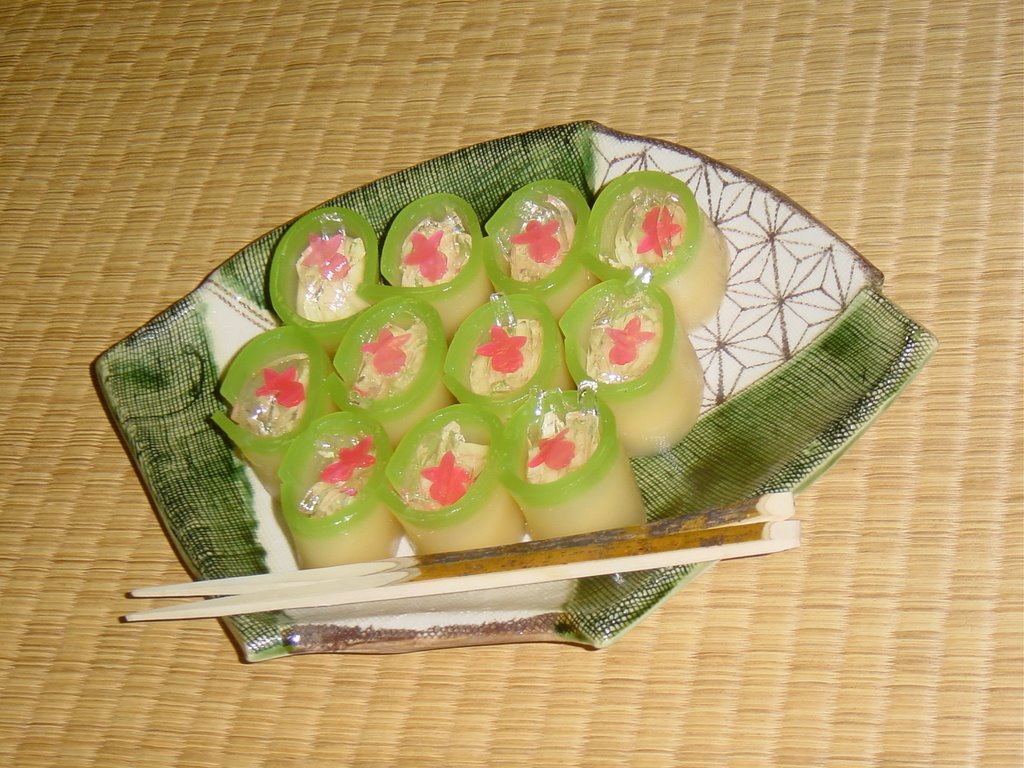

What I WILL most definitely miss is my school, Fuji Higashi High School. The students, the clubs, the teachers -- including SadouBu, or tea ceremony club.
The girls in SadouBu were always so sweet and inclusive and eager to teach me the steps. Every single move during this traditional tea ceremony is choreographed, so much so that it's like a slow dance on your knees. Your steps, posture, angle of your wrists, number of times you sip, method of passing the bowl to the next person, which hand you use to do what -- literally every move must follow a set pattern. The result is that, far from being annoying, the whole process is quite meditative and soothing. I always left tea ceremony club feeling very peaceful.
In the photos:
The man is the tea ceremony "master," and the girl serving tea will become one of the new leaders. She's one of my favorites. All these girls have been my students at one point. Doing something with them outside of class thrills them no end, and makes me very happy. The Japanese sweets are made of white bean paste wrapped in a sticky, firm, jelly-like substance made from seaweed.
16 July 2006
What I WON'T Miss
In an effort to add some sugar to a bittersweet goodbye, here's a list of things that I will not miss about living in Japan.
- mold growing on everything from floors to backpacks to shoes to wooden coasters to the sprouts indepedently growing from my sponge. It is THAT disgustingly humid.
- huge cockroaches I can do nothing about
- NO CENTRAL HEATING or AC anywhere
- "celebrity status," ie total lack of privacy
- having to be overly-conservative about everything because of the teacher reputation I am expected to uphold
- spending too much time in front of the computer
- waiting for late buses and then getting whiplash from crazy drivers
- not having a car or otherwise any access to good transportation
- the high cost of produce
- pollution and ugly smokestacks in my town
- rough washers and dryers = worn-out clothes
- lack of a "real" bed
- complete lack of the "and on day 7 He rested" concept
- always being the object of a stare
- the ramen truck that blares until 11:30 on Thursday nights
- lack of daylight savings in winter
- lack of regular religious services
- instant coffee
Silence is Golden 2
Along those same lines, love is not so much about communication as it is about presence. Because only one of those can replace the other.
Silence is Golden
When you spend a year living in a country where you can only understand 10% of the dialogue, you realize how unnecessary words are. Even for a woman who likes to write.
People talk too much. I talk too much. Since I'm about to make such a big change in lifestyle, I'd like to think of this as a new resolution. I want my life to involve way less talk and much more action.
They say you should marry someone you can talk to, but really, you should marry someone you can be quiet with. Silence is closely linked to happiness. And since actions speak louder than words anyway, what do you really need to say?
People talk too much. I talk too much. Since I'm about to make such a big change in lifestyle, I'd like to think of this as a new resolution. I want my life to involve way less talk and much more action.
They say you should marry someone you can talk to, but really, you should marry someone you can be quiet with. Silence is closely linked to happiness. And since actions speak louder than words anyway, what do you really need to say?
09 July 2006
Mr. Ferdinand, Please Go Home
...to the home you had before you took up residence in mine.
I am sad to leave Japan, but I am not sad to leave (the mold and) the 3-inch cockroaches who, instead of scattering when you turn on the lights, like to hang out confused on the ceiling above your bed, waving their attenaes as if you smell funny to them. As if you are in their spaces; as if you are disturbing their peace.
The biggest one, the one who likes to hang out while I stomp and flail my arms and flick the lights and do everything possible to shoo him back into the walls** so that I may sleep in peace, I have named Mr. Ferdinand. I'm always happy to make a friend, but Mr. Ferdinand is not what I had in mind.
** I've set up no less than 7 roach traps in my 3-room apartment, but they only catch the little guys, not the 3-inch ones. I do love living alone, but after this, I might prefer another person if it would mean a nicer apartment sans roaches.
I am sad to leave Japan, but I am not sad to leave (the mold and) the 3-inch cockroaches who, instead of scattering when you turn on the lights, like to hang out confused on the ceiling above your bed, waving their attenaes as if you smell funny to them. As if you are in their spaces; as if you are disturbing their peace.
The biggest one, the one who likes to hang out while I stomp and flail my arms and flick the lights and do everything possible to shoo him back into the walls** so that I may sleep in peace, I have named Mr. Ferdinand. I'm always happy to make a friend, but Mr. Ferdinand is not what I had in mind.
** I've set up no less than 7 roach traps in my 3-room apartment, but they only catch the little guys, not the 3-inch ones. I do love living alone, but after this, I might prefer another person if it would mean a nicer apartment sans roaches.
Subscribe to:
Posts (Atom)