I gave students a recycling homework assignment. They had to write 1 sentence about how they hurt the environment, and 2 sentences about how they help. Some of them made me laugh out loud:
"I hurt the environment because I breathe air every day."
"I hurt the environment because I eat a lot of vegetables."
"I help the enviroment because one day my friend threw trash on the ground, and I told him to pick it up."
----
I want to be an awesome cook. And I want to look good doing it. And to think, some people would call me a feminisit! :) Tsk, tsk.
Last night I cooked a really good dinner and brought the left-overs in for lunch. To my embarrassment everyone commented on how good my massala chicken smelled. I hope they were being honest.
The wafts from the microwave started a whole discussion of food. Did I like squid? (No.) Octupus? (No.) Sea urchin? (Haven't tried it yet.) Raw salmon eggs? (Yes.) Nato? (So-so.) What did nato taste like to me? (Fermented coffee or cacao beans.) Really? Japanese people don't think so; I do not have Japanese taste!
But, my supervisor understood why nato tastes like coffee -- it's all about the beans. Nato is fermented soy beans that are light brown. If you imagine chocolate or coffee when you eat them, that's exactly what they taste like. Ishii Sensei tried explaining my American sense of taste to everyone else, but I don't think they got it.
"My husband hates nato because it smells like dirty socks." Ishii Sensei said. I laughed.
"It does smell bad, but I'm okay with it because I like French cheese. They smell awful but they taste amazing."
Then Ishii told me how she had seen "Heidi," so when she had the chance, she was thrilled to taste European cheese. When someone offered her goat cheese, she expected it to be really good, so she accepted.
"But when the cheese was one foot away from my nose, I almost fainted! I couldn't taste it, it smelled so bad."
Ishii's re-enactment of her fainting made me crack up. She held a ruler in front of her face, slowly drawing it closer and closer to her nose, whining in mock apprehension. Then when it was a foot away, she fell over in her chair. I almost had tears in my eyes I was laughing so hard.
"Goat cheese is my favorite cheese!" I said. It was true.
"Ohh no!!!" she cried. "But I almost fainted!"
Some tastes can cross borders, but many will remain distinctly Western, and distinctly Japanese.
12 October 2005


11 October 2005
Ghost of a Geisha
For some reason, the photos aren't working, but I will try again another time. Sorry 'bout that.
When I came to Japan I had three goals of what I wanted to see / visit: islands, snow, and Kyoto. What I mainly wanted from Kyoto was temples (solid, predictable) and a geisha sighting (fat chance). "Geisha sighting" makes them sound like rare, wild animals. This is because they are. There are millions of people in Japan and less than 1,000 geishas in the whole country. Hoping to see one is like waiting for an endangered yellow bird to flash through the trees. If you're lucky enough to get a glimpse, you'll remember it for the rest of your life, and at some point you will probably try to write about it.
We just finished a luxurious Japanese dinner, complete with cold sake, and stepped out onto the chilly street of Pontocho. It's a narrow, winding alley packed with a variety of restaurants, adorned with lanterns and banners that many people believe were the world's first advertisements. We were laughing and immortalizing the food that had just passed our lips. The next thing I knew, my bottom jaw shot towards the ground. I feet melded to the cobblestones and I couldn't move. In slow motion I turned to my friends -- both of them had huge eyes and open mouths. We exchanged glances for a millisecond before we spun around and began walking in the opposite direction.
A geisha had appeard from nowhere, right in front of us. Despite the heavy wooden clogs on her feet, her movement was absolutely silent. She moved as smoothly and as quickly as a deer. Although we had immediately turned to follow her, we had to jog to keep pace.
Her kimono was made of thick silk and mostly white. Her inky hair was impossibly styled, a dash of red fabric visible through a slit in her bun. There was an unexpected, reddish-brown arch painted on the nape of her neck. Except for this, I saw no flesh that was not transformed to porcelain by thick, white makeup. Not even her hands remained flesh. Her lips were slicked with red. And she was moving so fast.
The three of us were silent. We were shocked into awe; her grace and presence was like nothing we had ever seen before. I wasn't even embarrassed that we were following her -- who cares if people talk about the silly gaijins? It was then I realized that everyone around us, even the Japanese, were reacting the same way. Japanese girls dropped their jaws and turned to stare, whispering to each other. Men began to follow her. In a few minutes, my friends and I were the caboose of a train led by 5 Japanese men in suits. All trying to keep up with this silent white deer. I was afraid that if I took my eyes off of her for a second, she'd vanish. Her speed and her all-white kimono made her like an apparition, not a flesh-and-blood woman like the rest of us, clicking our heels on the Pontocho cobblestones. We didn't even care how far she would walk or where she would take us -- we just wanted to follow.
At one point, the geisha looked over her shoulder, and I could see the tension around her eyes and mouth. She knew the men were following her, and it made her nervous. My friends and I were too far away. I felt a brief flash of sympathy, the kind of pity you'd feel if roses cried when they were plucked and stuck in vases. I considered backing off a little, but before I could make up my mind, she was gone. She disappeared so quickly I didn't realize it until after. There were no corners, no turns in the street -- but she threw aside an unlabled bamboo door, and was gone. The businessmen were equally surprised by her disappearance, and they gathered at the door awkwardly, like pigeons begging for crumbs. My friends and I continued walking at the same speed, looking straight ahead, disguising our intentions much better than the Japanese men. You'd think they'd be skilled at this by now. But this was one thing I learned: geisha appearances are just as rare for the Japanese as for foreigners.
When we could finally speak again, Natasha said, "Was that real? Was I dreaming?" Our thoughts spoken aloud. "Could there have been a more perfect ending to this night?" Kath asked.
She was just a lady, in a white robe, wearing white make-up. What's so special about that? Were we horrible Westerners for getting so excited about it? For exoticizing someone like that?
I don't think so.
Even Africans are afraid of lions. And even Japanese are astonished by the ghost of a geisha.
When I came to Japan I had three goals of what I wanted to see / visit: islands, snow, and Kyoto. What I mainly wanted from Kyoto was temples (solid, predictable) and a geisha sighting (fat chance). "Geisha sighting" makes them sound like rare, wild animals. This is because they are. There are millions of people in Japan and less than 1,000 geishas in the whole country. Hoping to see one is like waiting for an endangered yellow bird to flash through the trees. If you're lucky enough to get a glimpse, you'll remember it for the rest of your life, and at some point you will probably try to write about it.
We just finished a luxurious Japanese dinner, complete with cold sake, and stepped out onto the chilly street of Pontocho. It's a narrow, winding alley packed with a variety of restaurants, adorned with lanterns and banners that many people believe were the world's first advertisements. We were laughing and immortalizing the food that had just passed our lips. The next thing I knew, my bottom jaw shot towards the ground. I feet melded to the cobblestones and I couldn't move. In slow motion I turned to my friends -- both of them had huge eyes and open mouths. We exchanged glances for a millisecond before we spun around and began walking in the opposite direction.
A geisha had appeard from nowhere, right in front of us. Despite the heavy wooden clogs on her feet, her movement was absolutely silent. She moved as smoothly and as quickly as a deer. Although we had immediately turned to follow her, we had to jog to keep pace.
Her kimono was made of thick silk and mostly white. Her inky hair was impossibly styled, a dash of red fabric visible through a slit in her bun. There was an unexpected, reddish-brown arch painted on the nape of her neck. Except for this, I saw no flesh that was not transformed to porcelain by thick, white makeup. Not even her hands remained flesh. Her lips were slicked with red. And she was moving so fast.
The three of us were silent. We were shocked into awe; her grace and presence was like nothing we had ever seen before. I wasn't even embarrassed that we were following her -- who cares if people talk about the silly gaijins? It was then I realized that everyone around us, even the Japanese, were reacting the same way. Japanese girls dropped their jaws and turned to stare, whispering to each other. Men began to follow her. In a few minutes, my friends and I were the caboose of a train led by 5 Japanese men in suits. All trying to keep up with this silent white deer. I was afraid that if I took my eyes off of her for a second, she'd vanish. Her speed and her all-white kimono made her like an apparition, not a flesh-and-blood woman like the rest of us, clicking our heels on the Pontocho cobblestones. We didn't even care how far she would walk or where she would take us -- we just wanted to follow.
At one point, the geisha looked over her shoulder, and I could see the tension around her eyes and mouth. She knew the men were following her, and it made her nervous. My friends and I were too far away. I felt a brief flash of sympathy, the kind of pity you'd feel if roses cried when they were plucked and stuck in vases. I considered backing off a little, but before I could make up my mind, she was gone. She disappeared so quickly I didn't realize it until after. There were no corners, no turns in the street -- but she threw aside an unlabled bamboo door, and was gone. The businessmen were equally surprised by her disappearance, and they gathered at the door awkwardly, like pigeons begging for crumbs. My friends and I continued walking at the same speed, looking straight ahead, disguising our intentions much better than the Japanese men. You'd think they'd be skilled at this by now. But this was one thing I learned: geisha appearances are just as rare for the Japanese as for foreigners.
When we could finally speak again, Natasha said, "Was that real? Was I dreaming?" Our thoughts spoken aloud. "Could there have been a more perfect ending to this night?" Kath asked.
She was just a lady, in a white robe, wearing white make-up. What's so special about that? Were we horrible Westerners for getting so excited about it? For exoticizing someone like that?
I don't think so.
Even Africans are afraid of lions. And even Japanese are astonished by the ghost of a geisha.
10 October 2005
Kyoto Station
After a weekend in Kyoto, I feel restored by the good food and company, but tired from the walking, talking, and general tourist activities -- the result of any truly good vacation. When Kath, Natasha and I arrived at Kyoto station Friday night, the city bustle was slowing down instead of picking up. We grabbed a drink at a little locals' bar, and later as we walked to the hostel through the station, we were shocked: it was only 1 am, but the station was completely deserted! Not only was it empty, but it was also DARK. If you knew about Kyoto's architecture, you would realize why this was so scary.
Most of Kyoto, despite popular belief, is not beautiful. The majority of Kyoto looks like the outskirts of Paris: large, blah, post-post-modernist architecture, mainly apartments and office buildings. Except for a few treasures IN the city, like Nijo Castle and the Pontocho / Gion area, most of Kyoto's attractions are on the outskirts. You can visit a temple and feel like you are in a small mountain town. The air is fresh, the hills are green, the streets are charming and steep, the temples are humongous, beautiful, and thousands of years old... Then, you walk only 30 minutes to reach Kyoto station, which looms like the freakish offspring of a skyscraper and a metal spiderweb. It's one of the largest and strangest buildings I've ever seen. All this time, we believed Star Wars was filmed using a miniaturized, hand-crafted set! No way! It was totally filmed inside Kyoto Station. At 1 am, when all the lights were off and it was deserted, Darth Vader made an appearance and we all ran screaming from the station.
During the day, Kyoto Station is an attraction in itself. It swarms with people and offers interesting views of the city. The maze of walkways led us up 6 large flights of stairs because we tried taking a "shortcut." What we discovered on the grey "rooftop" was a veritable Lovers' Lane. Archways and columns formed small crannies and every space was claimed by a couple. Every 5 steps we intruded on lovebirds parked on the floor. One girl was even sitting on her guy's lap. Aside from men reading porn on the train, it was the most shocking display I've seen in Japan. There is SO little contact between ANYONE that this tiny display (seen everywhere in Paris) seemed almost raunchy in Japan. I guess people thought they'd find privacy there, thanks to the huge and endless flights of stairs.
Most of Kyoto, despite popular belief, is not beautiful. The majority of Kyoto looks like the outskirts of Paris: large, blah, post-post-modernist architecture, mainly apartments and office buildings. Except for a few treasures IN the city, like Nijo Castle and the Pontocho / Gion area, most of Kyoto's attractions are on the outskirts. You can visit a temple and feel like you are in a small mountain town. The air is fresh, the hills are green, the streets are charming and steep, the temples are humongous, beautiful, and thousands of years old... Then, you walk only 30 minutes to reach Kyoto station, which looms like the freakish offspring of a skyscraper and a metal spiderweb. It's one of the largest and strangest buildings I've ever seen. All this time, we believed Star Wars was filmed using a miniaturized, hand-crafted set! No way! It was totally filmed inside Kyoto Station. At 1 am, when all the lights were off and it was deserted, Darth Vader made an appearance and we all ran screaming from the station.
During the day, Kyoto Station is an attraction in itself. It swarms with people and offers interesting views of the city. The maze of walkways led us up 6 large flights of stairs because we tried taking a "shortcut." What we discovered on the grey "rooftop" was a veritable Lovers' Lane. Archways and columns formed small crannies and every space was claimed by a couple. Every 5 steps we intruded on lovebirds parked on the floor. One girl was even sitting on her guy's lap. Aside from men reading porn on the train, it was the most shocking display I've seen in Japan. There is SO little contact between ANYONE that this tiny display (seen everywhere in Paris) seemed almost raunchy in Japan. I guess people thought they'd find privacy there, thanks to the huge and endless flights of stairs.
06 October 2005
A Morning in the Life
I still haven't gone to Kyoto yet because I'm leaving right after school today. Plan to return on Monday. But I couldn't resist another post or two before I go...
A Morning in the Life of Lauren, in Japan. I wake up a few minutes before my 6:15 alarm. I stretch a couple times. I pretend it's the weekend and that I could doze all day long if I pleased. In fact, I do just that, and manage to fall back asleep before my alarm, so that I am finally awakened to an incessant beep.
Slap the alarm. Pad to the bathroom. Say good morning to the 3-inch long cockroach I have trapped under a plastic cup. After I greet him I apologize for trapping him. Normally this plastic cup is used for tossing bugs off my balcony, instead of holding them hostage. But once I managed to trap the cockroach, I decided he was too big and too angry to toss off the balcony with only two hands. I was afraid he'd escape and fly in my face before I could get him outside. So I need help granting him an exit other than death. (He is WAY too big to kill -- I refuse to end the life of something that would squish, crunch, or exhale significantly upon death. It's just too cruel.) So I procrastinate his liberation.
Now, you may be asking yourself, "Does she really think a plastic cup is going to hold a 3 - inch cockroach?" No, silly, of course not. On top of this cup, I have constructed a minor Sears Tower of Listerine, shampoo, and hair gel. When he knocks around on the cup, I add fingernail polish to the top. So in the morning, as I avoid knocking over the tallest tower in Japan, I apologize to the cucaracha for his tiny cell. I feel sorry for him only long enough to remember his dire mistake: he flew at my face while I was sitting on the toilet. The result wasn't pretty for either of us.
After I get ready for work/school, I pass at least 6 skinks (blue-tailed lizards) sunning themselves on the walk. These creatures are so predictable. I appreciate the stability, so I say good morning to them all. Then I take my place at the bus stop and wait for The Pink Lady. I know that when I see The Pink Lady, the bus is on its way. If there is no Pink Lady then I have missed my bus (which by the way, never happens, because the bus is always 2 - 15 minutes late). The Pink Lady is a woman who drives a PINK motorcycle/motorbike. It must have been expensive, because it's the ONLY one in Japan. If it is raining, then she wears a pink, full-body, raincoat-jumpsuit getup. If it's not raining, then she wears a pink jacket to shield her (pink?) blouse from the wind. The Pink Lady always brings a big (pink?) smile to my lips, and it is then that I decide today will be a good day.
A Morning in the Life of Lauren, in Japan. I wake up a few minutes before my 6:15 alarm. I stretch a couple times. I pretend it's the weekend and that I could doze all day long if I pleased. In fact, I do just that, and manage to fall back asleep before my alarm, so that I am finally awakened to an incessant beep.
Slap the alarm. Pad to the bathroom. Say good morning to the 3-inch long cockroach I have trapped under a plastic cup. After I greet him I apologize for trapping him. Normally this plastic cup is used for tossing bugs off my balcony, instead of holding them hostage. But once I managed to trap the cockroach, I decided he was too big and too angry to toss off the balcony with only two hands. I was afraid he'd escape and fly in my face before I could get him outside. So I need help granting him an exit other than death. (He is WAY too big to kill -- I refuse to end the life of something that would squish, crunch, or exhale significantly upon death. It's just too cruel.) So I procrastinate his liberation.
Now, you may be asking yourself, "Does she really think a plastic cup is going to hold a 3 - inch cockroach?" No, silly, of course not. On top of this cup, I have constructed a minor Sears Tower of Listerine, shampoo, and hair gel. When he knocks around on the cup, I add fingernail polish to the top. So in the morning, as I avoid knocking over the tallest tower in Japan, I apologize to the cucaracha for his tiny cell. I feel sorry for him only long enough to remember his dire mistake: he flew at my face while I was sitting on the toilet. The result wasn't pretty for either of us.
After I get ready for work/school, I pass at least 6 skinks (blue-tailed lizards) sunning themselves on the walk. These creatures are so predictable. I appreciate the stability, so I say good morning to them all. Then I take my place at the bus stop and wait for The Pink Lady. I know that when I see The Pink Lady, the bus is on its way. If there is no Pink Lady then I have missed my bus (which by the way, never happens, because the bus is always 2 - 15 minutes late). The Pink Lady is a woman who drives a PINK motorcycle/motorbike. It must have been expensive, because it's the ONLY one in Japan. If it is raining, then she wears a pink, full-body, raincoat-jumpsuit getup. If it's not raining, then she wears a pink jacket to shield her (pink?) blouse from the wind. The Pink Lady always brings a big (pink?) smile to my lips, and it is then that I decide today will be a good day.
05 October 2005
Kyoto
Just a quick post to let you know that I'll be in Kyoto for a 3-day weekend. (Whoo hoo!!) Of course, the blog will continue when I return. Hope everybody has a good one.
Riddle
In my advanced English class today, students had to discuss a riddle or philosophical problem. Basically, six people are marooned on a deserted island: a Buddhist priest, a high school boy, a sick man in his 60s, a famous doctor, a politician, and a 3-month pregnant woman. A rescue plane can only take one person back. Which person should the pilot save?
Students were told to choose the "most important" person, and then arrange all 6 people in order of importance, or priority for being rescued.
Students were told to choose the "most important" person, and then arrange all 6 people in order of importance, or priority for being rescued.
(If you're interested, decide your order before reading on).
Students worked in groups to make their choices, and then wrote the results on the board. I was surprised to find that each group selected the SAME person to be rescued first. Likewise, each group selected the SAME person to be rescued last. Which people do you think they chose? None of their answers coincided with mine. I was intrigued.
Each student believed that the sick man in his 60s should be the first person rescued, because he was most immediately in need of help. When they had to prioritize, each student chose the Buddhist priest as the one to be saved last. Explanations for the Buddhist priest were all similar, but each student had a unique--and fascinating--translation of the idea. One said, "because he is best prepared to receive destiny;" or in this case, death on a deserted island. Another said, "because his spirit is strong." Yup, there's plenty of time for zazen on a deserted island. But sadly, no one to beat you with a stick.
(Joking aside, I have an enormous amount of respect for Buddhism and anyone who makes a genuine effort to practice it).
My goal was to maximize life. So, I chose the famous doctor as the first person to be rescued. Hopefully, many lives could be saved if the doctor returned to society. Following this model, my 2nd choice was the pregnant woman, because one rescued pregnant woman can mean 2 saved lives. For last place, I chose the sick man in his 60s, because he had the smallest chance of survival no matter where he was.
My students seemed really shocked by my choices, so it turned out to be quite a cultural lesson for all of us. Of course, the more I considered it, the more confused I became. Japanese people usually consider the group before the individual. Americans usually put the individual before society. But it seemed that we had done just the opposite: by saving the old man, the students were focused on individual needs. By saving the doctor, I was focused on societal needs. Why the switch?
The only explanation I could come up with is that I examined the problem from outside the group, and the students examined it from inside the group. It should not be surprising that the American set herself apart, while the Japanese were inclusive of everyone, even themselves. Ultimately I was trying to benefit myself. I thought I was trying to benefit society, but in this case, society = me. The students were trying to benefit only the group, by saving the person most in need, regardless of the people outside.
What do you think?
30 September 2005
"Teaching" in Japan: From Tennis to Drinking Parties
Around 4 o’clock on Thursday, I changed into tennis clothes and awkwardly made my way to the tennis courts. I waited for the girls’ team to find me as every other sports team strolled past and stared at my legs, bare for the first time at school. Many of the students stopped to chat, often double-checking their English with each other before speaking to me. I would a whisper behind me (Do you play tennis?) before a student would approach me from the front and say nervously, but clearly, “Do you play tennis?” “Only a little,” I would repeat, and smile.
I was already a little nervous because the whole school was watching my every move. That morning, two people had seen me with a tennis racket. An hour later, the entire teachers’ room knew I was going to play tennis that afternoon. Now as I sat waiting for the girls to rescue me, every student stared at me in my un-professional sports gear. I knew I stuck out like a sore thumb (which I often forget in this country) but I still felt unworthy of all the positive attention I got all the time. One group of girls stopped just to stare at my legs. “You’re so white!” one of them said. “It’s so beautiful!” Those are two phrases I’d never hear together in the States. I was huddled in a ball, because the wind was rather chilly, but I felt like I had hung myself up for display. Where were the tennis girls?
Finally the girls found me and took me to the courts. They politely struggled with their English while I struggled with my Japanese. Imitation was the best action in this case. I followed them and copied what I saw…and soon we were warming up at the net. I was a little stiff and out of practice, but I felt myself slipping back into something I loved in high school: practicing with your teammates. No competition, no killer instincts, just the simple joy of working together to hit the ball. I felt the endorphins kick in and I was really happy. At one point the guys’ soccer team ran past, and a boy called out, “Lauren, I love you!!” I was so surprised by this that I immediately burst into laughter. In fact I was so shocked to even hear the phrase “I love you” in Japan that I couldn’t quit laughing. I don’t know why, but the personal expression used in such an impersonal situation was so foreign, but so close to home at the same time. It was strange.
All the girls were very sweet and patient and I hit with quite a few of them, rotating out so as not to disrupt their usual routine too much. We practiced for about 2 hours and I think my ability level was pretty much on par with theirs. I wasn’t necessarily making anyone a better player, but I definitely wasn’t bringing them down, either. There are no lights on the courts so we stopped when it got dark. I followed suit as we gathered in a circle. There was some incomprehensible Japanese and then we all said “thank you” and bowed in unison. More incomprehensible Japanese and my name stood out in the middle. The coach can’t speak much English so the students translated, “We enjoyed playing with you and are looking forward to next time. Monday at 4 o’clock.” Whoa! Did I just join the tennis team? But still it made me happy, and I smiled. The exercise was fun and good for me. I decided I would talk to the coach later, when I had a better translator, and see if I could join the team every Monday and Thursday. On other days I had tea ceremony club and English club…and on Fridays, I am just plain ready to go home.
The next day was field trip day (yay!) and since I’m a full-time teacher, I got to go for free (YAY!). I rode the bus with my supervisor and her 9th-grade homeroom class to Hakone. We went to a large lake with a beautiful view of Mt. Fuji, and I was psyched because this was what I wanted to see in Japan – lakes and mountains. The most beautiful places on earth, tied with Japanese gardens.
The ride up the mountain was smooth and warm, so it was hard not to fall asleep. When all 8 buses of 400 students got to the lake, we swarmed through the tourist shop and eventually landed on a large boat for a scenic ride. I think I had my picture taken with every student on board. I was so pissed that I had forgotten my camera. The weather was beautiful and there were many red Shinto shrines at the water’s edge. Mt. Fuji stood majestically with clouds gathered at its base – making it look absolutely huge. Eventually the boat reached the “hiking” trail, which was a wide, paved path through the woods. The hills were pretty decent but it was cool under the trees, and we reached the destination about 40 minutes later. My back was sore from playing tennis so the walk felt good.
Then the teachers gathered in the soba shop for a quiet lunch while the students ate bento boxes outside. The soba shop smelled of –what else—soba, and something else strange and unidentifiable. The atmosphere was beautiful, incredibly Japanese and minimalist, with large circular windows that made me feel like I was in a piece of artwork. The round windows were slightly unsettling. I was either in a Japanese DaVinci painting, or below deck on a large ship.
I ordered cold soba with mushrooms and pasted yams. The mushrooms were strange and the yam paste had no apparent flavor but a really weird texture. I didn’t like it at all, but I tried to suck down the noodles anyway. (I do like soba.) A teacher asked me if I was okay, and my “Mmm-hmm!” reply sounded so tight and high-pitched that they all knew I was lying. They laughed, and I continued to slurp the soba. When someone produced huge purple grapes I was grateful for the familiar food. But the grapes turned out to be unlike grapes I had tasted before. The skin was very dark purple, almost bitter, and it dried out your mouth the same way a red wine might. Tannins, I guess? Underneath the leathery skin, the grapes smelled and tasted like ripe flowers. They were the biggest and most delicious grapes I’d ever eaten.
On the bus ride back down the mountain, my supervisor and I fell asleep. When I woke up at the high school, I was groggy and felt the beginning of a sinus headache. The teachers were supposed to party at a sushi place that night, but I didn’t want to go. The awkwardness at lunch seemed like enough cultural stimulation for one day. I tried to assess how bad I felt, and whether or not I could really get out of going…but I knew I couldn’t. I was tired, dirty from hiking, and I wanted to be alone, but I went to the party anyway.
When I arrived at the small, hole-in-the-wall sushi place, I was surprised to find one of the cleanest and most beautiful Japanese dining rooms I’ve seen yet. The dining space was one room on the 2nd floor, with one large table. (The kitchen was an even smaller room on the 1st floor. So we teachers were the only customers.) I put my things against the wall and waited to be told where to sit (I read somewhere that sitting first is extremely rude, and that there is always a seat of honor that should be declined many times before you actually accept it…) Anyway, I was surprised because this time there was no seat of honor. The table was set with numbered chopsticks, and each teacher drew a straw to determine his place was at the table. As a left-hander I was happy to be at the end of the table, but I was surrounded by teachers who couldn’t speak English. Great. Not much talking for Lauren tonight, I thought. That was fine by me, because I was tired. I looked around the room, admiring the beautiful flower arrangements and scrolls on the walls, and then I studied the strange appetizer at my place. Unidentifiable raw fish, something that looked like crab salad, grilled tuna, little fish with eyeballs and all parts still included, whole raw shrimp, a giant slug/snail thing still left in its shell (to be extracted with a toothpick), and the one “safe” dish: a tiny saucer of soy sauce.
When everybody got to the table, the waitress loaded us with bottles of Asahi beer and everyone poured drinks for everyone else (you never pour your own drink; it’s rude. Instead, you wait for someone to fill your glass. Then you turn around and refill theirs. So everybody has a full glass of alcohol for pretty much the entire meal, because everyone is pouring and pouring when they’re not pulling raw slug-things out of shells.)
After a toast the meal began rather quietly, and I was surprised by how tame the drinking party seemed. At first I didn’t like the food, and it made me uncomfortable. The crab salad was okay, and the tuna was good, but I didn’t touch the snail thing. The whole fish with eyeballs were soaked in a tasty sauce, so I ate those, but I was still eating whole fish with eyeballs, and it made me a little queasy. I was also nervous because I was chasing everything I ate with the beer, to wash down weird tastes, which meant my glass was continuously refilled…and I knew my alcohol tolerance was extremely low, because I was hungry. Next they brought us dishes of sushi. I grabbed something I thought was salmon, which I like, but the flesh was held together by membranes that I had to chew and chew and chew. Then I saw some raw white fish. Good, I thought. Plain white fish – this is safe. But I quickly realized that what I had eagerly popped into my mouth was not fish, but squid. Again, I chewed and chewed and chewed. I wanted to spit it out but I had nothing to spit it into. And besides that, everyone would see me doing it. I chewed some more. My saliva turned the rubbery squid into a nauseatingly mealy piece of flesh. I chewed some more. A teacher asked me a question and I answered him with squid in my mouth. Still chewing. Finally, unable to take it any longer, I moved the squid to the back of my mouth and swallowed it whole. I quickly threw back the rest of my beer, to get a different taste in my mouth. Someone refilled my glass.
The beginning of the night was rough. But surprisingly, each course got better and better. By the end of the night I decided the meal was absolutely delicious, one of the best I’ve had in Japan. I had daikon, salmon eggs, cooked lobster, grilled white fish stuffed with egg, raw tuna rolls, cucumber rolls, cooked spinach, some of the most delicious, tender meat I’ve ever eaten in my life, and one more really interesting dish: the waitress lit small fires at each of our places, then placed little teapots on top of the fires. I asked someone if it was tea and they all laughed. “English teacher!” they yelled. “English teacher, come explain this to Lauren!” An English teacher, who I like very much, came over and explained that it was like a soup, “made with a very, very expensive mushroom. We Japanese love this mushroom fragrance, so it is very expensive.” As if to say, “You’re lucky to get a taste of this.” He showed me how to pour the soup into a little saucer and drink it straight from the dish. “Then, when you finish the soup,” he said, “you open up the teapot and eat the mushrooms.” I poured the light yellow, oily soup and waited a bit for it too cool. When I drew the saucer to my lips all eyes turned to me in anticipation. Oh man, I hope it’s good, I thought, not wanting to disappoint anyone.
It was delicious. “Mmm!” I said, almost involuntarily. Then the silence turned to laughter and talking, and they were happy I was enjoying myself. When I drank all the soup I opened teapot but found more than mushrooms: some pieces of chicken, some shrimp, and some spinach – all delicious. There was also a small egg that came from some kind of bird, but not a hen. I skipped the egg and moved on to something else delicious.
I was also surprised by how much I enjoyed the time with the teachers. We all got louder and louder as the evening went on. Everyone was laughing. I realized I knew more Japanese than I thought, and they made huge efforts to speak more English. They were absolutely thrilled I liked the food, and they laughed when I refused to eat the snail. Every now and then a teacher would come sit at my end of the table just to talk with me and watch me eat. They were stunned to learn that I like sake more than beer, and they were shocked that I like cold sake. I don’t know what the big deal was but they were so excited that they stopped the beer orders so we could all drink sake. It tasted delicious, especially with the food. The teachers’ kindness continues to amaze me. To give you an idea, at one point someone looked directly at me and rattled off Japanese. I looked to an English teacher for help. The first guy repeated himself, and then the English teacher said, “Ahh, yes, you are very popular. Everybody here likes you.” I blushed and muttered something I can’t remember. Then later (this one tops the cake) another teacher said, “Oh, you are a strong drinker!” What! Okay, now we know they’re lying. J
At one point, a man began to hum an old American tune and he was thrilled when I joined him. He didn’t know the words, so when I started singing the whole table got quiet to listen to me. “Old Susanna, now don’t you cry for me…for I come from Alabama with a banjo on my knee…” Who knows where they heard this song, but they were really excited I knew it. Then, a teacher said my name sounded like the Rawhide song. Remember, Japanese often confuse Ls and Rs. So when he said “Lauren,” it came out sounding like “Rollin’.” And he started singing, “Rollin’ rollin’ rollin,’ keep them doggies rollin’, rawhide!” I cracked up.
The whole dinner lasted about two hours, which was perfect for me. It ended on a good note, before anyone got too tired or too drunk, and everyone was happy. I felt so satisfied and I was so glad I went. I scolded myself for trying to get out of the party. This comeraderie and socializing with coworkers was a duty, and part of my job description – almost as important as teaching classes. I reminded myself that I was lucky and quite privileged to be a part of it all—shame on me for wanting to avoid it!
I never felt such a level of acceptance, or like I was part of a group, when I was in France. I don’t feel Japanese, but I never expected to feel Japanese. I am a foreigner, but I am still overwhelmed by the generosity and kindness of these people. If you show an appreciation for their world, they are willing to take you in. And that makes me really lucky.
I was already a little nervous because the whole school was watching my every move. That morning, two people had seen me with a tennis racket. An hour later, the entire teachers’ room knew I was going to play tennis that afternoon. Now as I sat waiting for the girls to rescue me, every student stared at me in my un-professional sports gear. I knew I stuck out like a sore thumb (which I often forget in this country) but I still felt unworthy of all the positive attention I got all the time. One group of girls stopped just to stare at my legs. “You’re so white!” one of them said. “It’s so beautiful!” Those are two phrases I’d never hear together in the States. I was huddled in a ball, because the wind was rather chilly, but I felt like I had hung myself up for display. Where were the tennis girls?
Finally the girls found me and took me to the courts. They politely struggled with their English while I struggled with my Japanese. Imitation was the best action in this case. I followed them and copied what I saw…and soon we were warming up at the net. I was a little stiff and out of practice, but I felt myself slipping back into something I loved in high school: practicing with your teammates. No competition, no killer instincts, just the simple joy of working together to hit the ball. I felt the endorphins kick in and I was really happy. At one point the guys’ soccer team ran past, and a boy called out, “Lauren, I love you!!” I was so surprised by this that I immediately burst into laughter. In fact I was so shocked to even hear the phrase “I love you” in Japan that I couldn’t quit laughing. I don’t know why, but the personal expression used in such an impersonal situation was so foreign, but so close to home at the same time. It was strange.
All the girls were very sweet and patient and I hit with quite a few of them, rotating out so as not to disrupt their usual routine too much. We practiced for about 2 hours and I think my ability level was pretty much on par with theirs. I wasn’t necessarily making anyone a better player, but I definitely wasn’t bringing them down, either. There are no lights on the courts so we stopped when it got dark. I followed suit as we gathered in a circle. There was some incomprehensible Japanese and then we all said “thank you” and bowed in unison. More incomprehensible Japanese and my name stood out in the middle. The coach can’t speak much English so the students translated, “We enjoyed playing with you and are looking forward to next time. Monday at 4 o’clock.” Whoa! Did I just join the tennis team? But still it made me happy, and I smiled. The exercise was fun and good for me. I decided I would talk to the coach later, when I had a better translator, and see if I could join the team every Monday and Thursday. On other days I had tea ceremony club and English club…and on Fridays, I am just plain ready to go home.
The next day was field trip day (yay!) and since I’m a full-time teacher, I got to go for free (YAY!). I rode the bus with my supervisor and her 9th-grade homeroom class to Hakone. We went to a large lake with a beautiful view of Mt. Fuji, and I was psyched because this was what I wanted to see in Japan – lakes and mountains. The most beautiful places on earth, tied with Japanese gardens.
The ride up the mountain was smooth and warm, so it was hard not to fall asleep. When all 8 buses of 400 students got to the lake, we swarmed through the tourist shop and eventually landed on a large boat for a scenic ride. I think I had my picture taken with every student on board. I was so pissed that I had forgotten my camera. The weather was beautiful and there were many red Shinto shrines at the water’s edge. Mt. Fuji stood majestically with clouds gathered at its base – making it look absolutely huge. Eventually the boat reached the “hiking” trail, which was a wide, paved path through the woods. The hills were pretty decent but it was cool under the trees, and we reached the destination about 40 minutes later. My back was sore from playing tennis so the walk felt good.
Then the teachers gathered in the soba shop for a quiet lunch while the students ate bento boxes outside. The soba shop smelled of –what else—soba, and something else strange and unidentifiable. The atmosphere was beautiful, incredibly Japanese and minimalist, with large circular windows that made me feel like I was in a piece of artwork. The round windows were slightly unsettling. I was either in a Japanese DaVinci painting, or below deck on a large ship.
I ordered cold soba with mushrooms and pasted yams. The mushrooms were strange and the yam paste had no apparent flavor but a really weird texture. I didn’t like it at all, but I tried to suck down the noodles anyway. (I do like soba.) A teacher asked me if I was okay, and my “Mmm-hmm!” reply sounded so tight and high-pitched that they all knew I was lying. They laughed, and I continued to slurp the soba. When someone produced huge purple grapes I was grateful for the familiar food. But the grapes turned out to be unlike grapes I had tasted before. The skin was very dark purple, almost bitter, and it dried out your mouth the same way a red wine might. Tannins, I guess? Underneath the leathery skin, the grapes smelled and tasted like ripe flowers. They were the biggest and most delicious grapes I’d ever eaten.
On the bus ride back down the mountain, my supervisor and I fell asleep. When I woke up at the high school, I was groggy and felt the beginning of a sinus headache. The teachers were supposed to party at a sushi place that night, but I didn’t want to go. The awkwardness at lunch seemed like enough cultural stimulation for one day. I tried to assess how bad I felt, and whether or not I could really get out of going…but I knew I couldn’t. I was tired, dirty from hiking, and I wanted to be alone, but I went to the party anyway.
When I arrived at the small, hole-in-the-wall sushi place, I was surprised to find one of the cleanest and most beautiful Japanese dining rooms I’ve seen yet. The dining space was one room on the 2nd floor, with one large table. (The kitchen was an even smaller room on the 1st floor. So we teachers were the only customers.) I put my things against the wall and waited to be told where to sit (I read somewhere that sitting first is extremely rude, and that there is always a seat of honor that should be declined many times before you actually accept it…) Anyway, I was surprised because this time there was no seat of honor. The table was set with numbered chopsticks, and each teacher drew a straw to determine his place was at the table. As a left-hander I was happy to be at the end of the table, but I was surrounded by teachers who couldn’t speak English. Great. Not much talking for Lauren tonight, I thought. That was fine by me, because I was tired. I looked around the room, admiring the beautiful flower arrangements and scrolls on the walls, and then I studied the strange appetizer at my place. Unidentifiable raw fish, something that looked like crab salad, grilled tuna, little fish with eyeballs and all parts still included, whole raw shrimp, a giant slug/snail thing still left in its shell (to be extracted with a toothpick), and the one “safe” dish: a tiny saucer of soy sauce.
When everybody got to the table, the waitress loaded us with bottles of Asahi beer and everyone poured drinks for everyone else (you never pour your own drink; it’s rude. Instead, you wait for someone to fill your glass. Then you turn around and refill theirs. So everybody has a full glass of alcohol for pretty much the entire meal, because everyone is pouring and pouring when they’re not pulling raw slug-things out of shells.)
After a toast the meal began rather quietly, and I was surprised by how tame the drinking party seemed. At first I didn’t like the food, and it made me uncomfortable. The crab salad was okay, and the tuna was good, but I didn’t touch the snail thing. The whole fish with eyeballs were soaked in a tasty sauce, so I ate those, but I was still eating whole fish with eyeballs, and it made me a little queasy. I was also nervous because I was chasing everything I ate with the beer, to wash down weird tastes, which meant my glass was continuously refilled…and I knew my alcohol tolerance was extremely low, because I was hungry. Next they brought us dishes of sushi. I grabbed something I thought was salmon, which I like, but the flesh was held together by membranes that I had to chew and chew and chew. Then I saw some raw white fish. Good, I thought. Plain white fish – this is safe. But I quickly realized that what I had eagerly popped into my mouth was not fish, but squid. Again, I chewed and chewed and chewed. I wanted to spit it out but I had nothing to spit it into. And besides that, everyone would see me doing it. I chewed some more. My saliva turned the rubbery squid into a nauseatingly mealy piece of flesh. I chewed some more. A teacher asked me a question and I answered him with squid in my mouth. Still chewing. Finally, unable to take it any longer, I moved the squid to the back of my mouth and swallowed it whole. I quickly threw back the rest of my beer, to get a different taste in my mouth. Someone refilled my glass.
The beginning of the night was rough. But surprisingly, each course got better and better. By the end of the night I decided the meal was absolutely delicious, one of the best I’ve had in Japan. I had daikon, salmon eggs, cooked lobster, grilled white fish stuffed with egg, raw tuna rolls, cucumber rolls, cooked spinach, some of the most delicious, tender meat I’ve ever eaten in my life, and one more really interesting dish: the waitress lit small fires at each of our places, then placed little teapots on top of the fires. I asked someone if it was tea and they all laughed. “English teacher!” they yelled. “English teacher, come explain this to Lauren!” An English teacher, who I like very much, came over and explained that it was like a soup, “made with a very, very expensive mushroom. We Japanese love this mushroom fragrance, so it is very expensive.” As if to say, “You’re lucky to get a taste of this.” He showed me how to pour the soup into a little saucer and drink it straight from the dish. “Then, when you finish the soup,” he said, “you open up the teapot and eat the mushrooms.” I poured the light yellow, oily soup and waited a bit for it too cool. When I drew the saucer to my lips all eyes turned to me in anticipation. Oh man, I hope it’s good, I thought, not wanting to disappoint anyone.
It was delicious. “Mmm!” I said, almost involuntarily. Then the silence turned to laughter and talking, and they were happy I was enjoying myself. When I drank all the soup I opened teapot but found more than mushrooms: some pieces of chicken, some shrimp, and some spinach – all delicious. There was also a small egg that came from some kind of bird, but not a hen. I skipped the egg and moved on to something else delicious.
I was also surprised by how much I enjoyed the time with the teachers. We all got louder and louder as the evening went on. Everyone was laughing. I realized I knew more Japanese than I thought, and they made huge efforts to speak more English. They were absolutely thrilled I liked the food, and they laughed when I refused to eat the snail. Every now and then a teacher would come sit at my end of the table just to talk with me and watch me eat. They were stunned to learn that I like sake more than beer, and they were shocked that I like cold sake. I don’t know what the big deal was but they were so excited that they stopped the beer orders so we could all drink sake. It tasted delicious, especially with the food. The teachers’ kindness continues to amaze me. To give you an idea, at one point someone looked directly at me and rattled off Japanese. I looked to an English teacher for help. The first guy repeated himself, and then the English teacher said, “Ahh, yes, you are very popular. Everybody here likes you.” I blushed and muttered something I can’t remember. Then later (this one tops the cake) another teacher said, “Oh, you are a strong drinker!” What! Okay, now we know they’re lying. J
At one point, a man began to hum an old American tune and he was thrilled when I joined him. He didn’t know the words, so when I started singing the whole table got quiet to listen to me. “Old Susanna, now don’t you cry for me…for I come from Alabama with a banjo on my knee…” Who knows where they heard this song, but they were really excited I knew it. Then, a teacher said my name sounded like the Rawhide song. Remember, Japanese often confuse Ls and Rs. So when he said “Lauren,” it came out sounding like “Rollin’.” And he started singing, “Rollin’ rollin’ rollin,’ keep them doggies rollin’, rawhide!” I cracked up.
The whole dinner lasted about two hours, which was perfect for me. It ended on a good note, before anyone got too tired or too drunk, and everyone was happy. I felt so satisfied and I was so glad I went. I scolded myself for trying to get out of the party. This comeraderie and socializing with coworkers was a duty, and part of my job description – almost as important as teaching classes. I reminded myself that I was lucky and quite privileged to be a part of it all—shame on me for wanting to avoid it!
I never felt such a level of acceptance, or like I was part of a group, when I was in France. I don’t feel Japanese, but I never expected to feel Japanese. I am a foreigner, but I am still overwhelmed by the generosity and kindness of these people. If you show an appreciation for their world, they are willing to take you in. And that makes me really lucky.
29 September 2005
Tempura: Food for Thought
A couple weekends ago I went to Hattori Sensei's house for lunch. She is the school librarian, tea ceremony club manager, AND speech contest manager, so we work together in many capacities. Luckily for me, she enjoys teaching people about Japanese culture, so she invited me to her home for a relaxed cooking lesson...and a subsequent feast of miso soup, shrimp and veggie tempura, Japanese pickles, some little raw silvery fishes (only thing I didn't like), green tea, and ice cream. I was quite overwhelmed by the generosity of it all.
Hattori Sensei kindly picked me up at the train station and took me to her beautiful, spotless home. It was probably the cleanest house I've ever visited. When I first arrived, I chatted with her husband, who also speaks very good English (again, lucky for me!). He seemed thrilled to discover my last name, because Salisbury was a British prime minister who helped Japan and Russia sign a peace treaty in the early 1900s. So I had an unfair advantage, but I felt instantly liked and comfortable in this couple's home.
Hattori Sensei gave the cooking lessons while her husband made conversation. He is quite the history buff, and also has a thing for country music. At the dinner table he broke out into songs by Johnny Cash and LeAnn Rhimes (spelling?) which delighted me but didn't seem to please his wife too much. Johnny Cash reminded me of friends from school, and even though an older Japanese man was singing, an invisible connection formed between my close friends in America and this new "friend" in Japan. It made me happy. I want to make Mr. Hattori a James Taylor CD since I'm from NC.
When he stopped singing, to his wife's visible relief, the three of us discussed more serious topics: differences in Japanese and American culture, how the Japanese language is changing, tea ceremony, and how all of these things are affected by the media and advertising. It was a very intellectual conversation, but the Hattoris were so warm and genuinely interested in my thoughts that I felt comfortable voicing my opinions. They asked me what I studied in college, and when I told them "International Studies and Globalization," I decided to open a can of worms that had been squirming for quite some time. I'll try to summarize without going into too much detail.
You'd think that when you study something, you'd understand it. And when you understand something, you can grow to like it. But after 4 years of studying globalization, I still don't understand it completely, and I am not convinced it's a good or positive thing (however much a moral judgment can be made -- and I think one can). Hattori Sensei was troubled by Japan's changing advertising, because Katakana English is often used when there is "already a perfectly good Japanese expression." She saw the loss of Kanji as a sad erosion of her culture, which she is working hard to maintain. Her husband, on the other hand, stated simply that all languages change, and that it was no big deal. My feelings rest somewhere between these two ideas. And when they asked me why I came to Japan, I tried telling them something I hadn't discussed with anyone before.
I came to Japan to learn about Japanese culture, whatever "traditional" culture is, before it becomes more "eroded" by Western ideals and globalization. "Eroded" definitely has a negative connotation, but just hear me out. In truth, I think many aspects of globalization are bad. But I can't logically explain why that is -- just a gut feeling that I don't like. (The cheap explanation is that if the whole world thinks alike, it will become boring for me.) Yet, my presence in Japan contributes to the very changes of globalization that seem bad. So that would make me a hypocrite, and selfish, for coming to Japan in the first place. But I chose to come anyway, bringing all my Western ideas with me to learn about Japanese culture. In the meantime, I think Japan is changing and doesn't quite know where it's going, because different generations don't agree on what it means to be Japanese.
So I feel confused about being in Japan, how it's affecting me, but more importantly, how it's affecting those around me. I'm not saying that as an individual I have the power to change everyone around me. But little by little, more things from the outside become acceptable. Do I contribute to the Katakana English at the 7/11? I'm teaching English, for crying out loud! But is that for Japan's benefit, or America's? What about how I (voluntarily) make coffee for the teachers every day, instead of tea? Sure, it's just a drink, but that snowballs into purchases, and advertising, and what appeals to whom, and what language is used to advertise what, and who ends up reading and buying everything...and that leads to other products people want to buy, and more advertising...do you get the picture?
In short, I'm not sure if I'm doing the right thing or not. And I told them this. And what made me feel so...happy...was that they seemed to understand. The Hattoris got very quiet but there was such a feeling of acceptance in the room. I knew I had shared my thoughts with the right people, and I was grateful to have such an appropriate outlet. For better or for worse, I made a connection, and I was just happy that they understood, instead of telling me, "Lauren, you think too much."
Hattori Sensei kindly picked me up at the train station and took me to her beautiful, spotless home. It was probably the cleanest house I've ever visited. When I first arrived, I chatted with her husband, who also speaks very good English (again, lucky for me!). He seemed thrilled to discover my last name, because Salisbury was a British prime minister who helped Japan and Russia sign a peace treaty in the early 1900s. So I had an unfair advantage, but I felt instantly liked and comfortable in this couple's home.
Hattori Sensei gave the cooking lessons while her husband made conversation. He is quite the history buff, and also has a thing for country music. At the dinner table he broke out into songs by Johnny Cash and LeAnn Rhimes (spelling?) which delighted me but didn't seem to please his wife too much. Johnny Cash reminded me of friends from school, and even though an older Japanese man was singing, an invisible connection formed between my close friends in America and this new "friend" in Japan. It made me happy. I want to make Mr. Hattori a James Taylor CD since I'm from NC.
When he stopped singing, to his wife's visible relief, the three of us discussed more serious topics: differences in Japanese and American culture, how the Japanese language is changing, tea ceremony, and how all of these things are affected by the media and advertising. It was a very intellectual conversation, but the Hattoris were so warm and genuinely interested in my thoughts that I felt comfortable voicing my opinions. They asked me what I studied in college, and when I told them "International Studies and Globalization," I decided to open a can of worms that had been squirming for quite some time. I'll try to summarize without going into too much detail.
You'd think that when you study something, you'd understand it. And when you understand something, you can grow to like it. But after 4 years of studying globalization, I still don't understand it completely, and I am not convinced it's a good or positive thing (however much a moral judgment can be made -- and I think one can). Hattori Sensei was troubled by Japan's changing advertising, because Katakana English is often used when there is "already a perfectly good Japanese expression." She saw the loss of Kanji as a sad erosion of her culture, which she is working hard to maintain. Her husband, on the other hand, stated simply that all languages change, and that it was no big deal. My feelings rest somewhere between these two ideas. And when they asked me why I came to Japan, I tried telling them something I hadn't discussed with anyone before.
I came to Japan to learn about Japanese culture, whatever "traditional" culture is, before it becomes more "eroded" by Western ideals and globalization. "Eroded" definitely has a negative connotation, but just hear me out. In truth, I think many aspects of globalization are bad. But I can't logically explain why that is -- just a gut feeling that I don't like. (The cheap explanation is that if the whole world thinks alike, it will become boring for me.) Yet, my presence in Japan contributes to the very changes of globalization that seem bad. So that would make me a hypocrite, and selfish, for coming to Japan in the first place. But I chose to come anyway, bringing all my Western ideas with me to learn about Japanese culture. In the meantime, I think Japan is changing and doesn't quite know where it's going, because different generations don't agree on what it means to be Japanese.
So I feel confused about being in Japan, how it's affecting me, but more importantly, how it's affecting those around me. I'm not saying that as an individual I have the power to change everyone around me. But little by little, more things from the outside become acceptable. Do I contribute to the Katakana English at the 7/11? I'm teaching English, for crying out loud! But is that for Japan's benefit, or America's? What about how I (voluntarily) make coffee for the teachers every day, instead of tea? Sure, it's just a drink, but that snowballs into purchases, and advertising, and what appeals to whom, and what language is used to advertise what, and who ends up reading and buying everything...and that leads to other products people want to buy, and more advertising...do you get the picture?
In short, I'm not sure if I'm doing the right thing or not. And I told them this. And what made me feel so...happy...was that they seemed to understand. The Hattoris got very quiet but there was such a feeling of acceptance in the room. I knew I had shared my thoughts with the right people, and I was grateful to have such an appropriate outlet. For better or for worse, I made a connection, and I was just happy that they understood, instead of telling me, "Lauren, you think too much."
28 September 2005
June Bug Joke
Last night, in an unexpected twist of events, Jun Sensei and John joined me for dinner. Jun, Mayumi and I are the youngest teachers at my high school (all in our twenties) and although Jun can't speak much English, the 3 of us joke around in between classes and lesson-planning. At the beginning of the year, before I knew Jun's name, a dead June Bug ended up on my desk after cleaning time. Suspecting a student placed it there as a "gift," and wanting someone to laugh about it with me, I tapped Jun on the shoulder and pointed at the insect. "June Bug," I said, and smiled. Looking confused and serious, Jun promptly disposed of the dead bug by dropping him outside the window, handling the matter like a mature father looking after his young. It was only afterwards, when Mayumi told me his name was Jun, that I realized why he was so confused when I said "June Bug" over and over. That day we called him "June Bug" and the name has stuck ever since. Jun has an odd sense of humor and is always cracking jokes in Japanese (that Mayumi has to translate for me), but often they're so off-the-wall that even Mayumi doesn't understand them. So usually, Jun will rattle something off, and Mayumi will look at me and shrug, "June Bug joke." And then the two of us crack up.
Anyway -- last night, Jun came over for dinner. I made Japanese curry and salad, and it turned out to be the best I've cooked so far. Also, thanks to Mom's decorating help, my apartment now looks fabulous. While I wasn't initially thrilled about having guests, it turned out to be a fun evening. Somehow we laughed a lot even though I know Jun and I have a lot of trouble communicating. I was impressed he would attempt a dinner with two foreigners who can't speak Japanese. Yay for June Bug.
Dancing with Mom
Things have been crazy lately, hence the lack of posts. There's a lot on my mind but it's hard to find the time and energy to create worthy blog entries. But I miss writing, so I'll give it a shot tonight.
The main thing is that Mom was here recently and left for home today. She stayed about a week and overall we had a blast. We went to Ito for the dance festival, like I mentioned before, and it was crazy. All these foreigners (Americans, British, Chinese, Russian, Irish, etc.) crammed into a tiny rental shop somewhere near downtown Ito (which has a pretty coastline and quite a scenic train ride. It strikes me as a cross between the Mediterranean and Costa Rica. It's really weird to think that I look out to the ocean and I'm staring in the direction of California). Anyway, I was led up a steep set of stairs to a tiny room crammed full of kimonos, wide-eyed foreign women, and Japanese ladies yelling and grabbing and tying and wrapping and bending over and hanging up and pinning and re-pinning...the usual, standard scene when 5 Japanese women are trying to dress 20 foreigners in 6 layers of kimonos in a space that is about 15 ft X 5 ft. I hooked on my starched, white toe socks (for thong sandals), and then was told to take of my clothes, which were promptly lost under the carpet of kimono layers that were tossed on the floor. For reasons unclear to me, I was dressed and re-dressed 3 times by 3 different ladies. But all I had to do was stand there in front of a mirror while the rental shop ladies did the work. If this was just a kimono, I wondered what the wedding gear was like.
While I was being dressed, I asked Mom to locate my clothes. By now she was looking great in a green kimono that had the same flower design as my red one. We then realized that bending over in a kimono is a nearly impossible task, because they are tied so tightly and so much fabric is looped, wrapped, and stuffed around your waist. Mom managed to snag my clothes with her toe. (Rescued!) Meanwhile the ladies were pinning my hair with kitchen rubber bands. As far as using the bathroom, well, suffice it to say that no one went.
The main thing is that Mom was here recently and left for home today. She stayed about a week and overall we had a blast. We went to Ito for the dance festival, like I mentioned before, and it was crazy. All these foreigners (Americans, British, Chinese, Russian, Irish, etc.) crammed into a tiny rental shop somewhere near downtown Ito (which has a pretty coastline and quite a scenic train ride. It strikes me as a cross between the Mediterranean and Costa Rica. It's really weird to think that I look out to the ocean and I'm staring in the direction of California). Anyway, I was led up a steep set of stairs to a tiny room crammed full of kimonos, wide-eyed foreign women, and Japanese ladies yelling and grabbing and tying and wrapping and bending over and hanging up and pinning and re-pinning...the usual, standard scene when 5 Japanese women are trying to dress 20 foreigners in 6 layers of kimonos in a space that is about 15 ft X 5 ft. I hooked on my starched, white toe socks (for thong sandals), and then was told to take of my clothes, which were promptly lost under the carpet of kimono layers that were tossed on the floor. For reasons unclear to me, I was dressed and re-dressed 3 times by 3 different ladies. But all I had to do was stand there in front of a mirror while the rental shop ladies did the work. If this was just a kimono, I wondered what the wedding gear was like.
While I was being dressed, I asked Mom to locate my clothes. By now she was looking great in a green kimono that had the same flower design as my red one. We then realized that bending over in a kimono is a nearly impossible task, because they are tied so tightly and so much fabric is looped, wrapped, and stuffed around your waist. Mom managed to snag my clothes with her toe. (Rescued!) Meanwhile the ladies were pinning my hair with kitchen rubber bands. As far as using the bathroom, well, suffice it to say that no one went.
Downstairs the Chinese girls were doing a much better job of dancing than the Americans. An old Japanese man in a kimono hummed a tune while we awkwardly tried to pick up the steps. After an eternity, and me realizing I couldn't even sit down in my kimono (much less bend over), we were handed shoes and walked through town to the "starting line" of the parade. Luckily an older Japanese lady was in line in front of me, so I had a skilled dancer to demonstrate the moves. Once the parade started I was able to pick it up pretty quickly. It was a rather short routine that repeated over and over. We had about 3 water breaks total and I think we danced / paraded for about 1.5 miles. I've never had so many action shots snapped by strangers in my life. I was exhausted by the end of the night, so the fancy outdoor onsen was a welcome respite after being shrink-wrapped in thick silk. After a hot bath I collapsed into bed. What a cool experience.
But the relaxation didn't last long. Mom and I had to leave our lovely hotel for the speech contest in Numazu, an inconvenient 1.5 hours away on a private train line (oops!). However! That also turned out to be fun, because I saw other ALTs, and most importantly my student won 2nd place! So she will continue to the state / prefectural rounds, and I will continue coaching her after school. The next contest is on October 15.
Unfortunately, with all the commotion I didn't have a chance to take photos. But Mom did, so if she emails me pics I will post them.
19 September 2005
If You Read No Other Posts, READ THIS ONE!
(But please read them all, especially the ones I'm in the process of writing!)
The opportunity to visit a Buddhist temple was very unexpected, but something I have wanted for a long time. So I gladly joined other ALTs and the friendly monk at his beautiful home.
The temple entrance was absolutely breathtaking. If you can't tell from my photos, I'm obsessed with Japanese gardens. Sunlight glowing through lacey leaves is one of the most beautiful sights on earth, and gardens are full of them. Usually I'm not one for fantasy (I didn't like "Lord of the Rings" and "The Never-Ending Story" gave me the creeps), but something about Japanese gardens feels so fantastic, magical, and other-worldly that entering them is like stepping into heaven. Adding to the fantasy effect, the garden was chock-full of dragonflies gracefully zooming back and forth. They were so large, and there were so many of them, it felt like you were under water surrounded by fish. There must have been 40 dragonflies in the air at any given time, and they looked like fairies. So before I even entered the temple, I felt far removed from my everyday reality. How you can be in that environment and not feel something...incredible and worthy of enormous respect, I will never know.
So we slowly entered the temple and were ushered to a tatami room. We were given small, sweet "cakes" made out of a chalky substance, and green tea. "To help with zazen," the monk told us in Japanese, which was quickly translated by a nice host father. Now I'm no expert in Buddhism, Zen, or zazen, so please keep that in mind for the remainder of the post. My understanding is that Zen Buddhists practice zazen: sitting on cushions in a lotus-style position and meditating. Your head faces forward, eyes stare at a spot on the floor about one meter in front of you. So your eyes are half-closed, but you remain alert. Your hands are folded in a certain way and placed down in your lap. Focus on breathing. Other than breathing deeply, you don't move. At all. Monks do this for hours at a time, and this monk told us that during his training, he would sit in zazen for at least 3 hours a day. One week of every month, he would do nothing all day but sit in zazen. He paused only to eat and use the bathroom. But he was not allowed to sleep.
The Westerners, however, in our too-tight jeans and t-shirts, sat in awkward zazen poses for 20 minutes. The monk burned a stick of incense to mark the time. Also to begin zazen, he smacked two wooden blocks together, and rang a bell four times. To end zazen, he smacked the blocks once and rang the bell once more. It was like transporting you to another world and then calling you back into this one. I thought my biggest concerns were maintaining the position, clearing my head, and staying alert enough not to slouch or sleep. I was eager to begin.
But then the terrifying part came. If you look down in the "Temple" photos, you will see a picture of a small altar, the the monk's feet, and a long, flat stick. Once we were seated in zazen and our ankles were beginning to ache, the monk explained the purpose of the stick. In short, it was used to keep us alert. If we slouched, or fell asleep, or moved AT ALL, he would hit us on the back. However, if we were sitting especially well, he would also hit us, for encouragement. The monk placed two cushions in the middle of our circle to demonstrate the amount of force he would use to hit us. It was the same either way -- if we did poorly or if we did well, we got hit with the same amount of force. Now, I cannot begin to describe to you how hard he hit the pillows. It was not a smack, bump, hit, or even a whack -- none of these words accurately convey how hard and fast the stick came down. He used his whole body and the whip came from his shoulders and back muscles. And the stick moved so quickly that it made a high-pitched whistle as it cut through the air. I am not exaggerating. Many girls gasped when they saw his demonstration. Cheerfully, he told us not to worry, that he would go easier on the girls. As soon as we sighed with relief, he said, "I'm only kidding. Distinctions are wrong, so if I distinguish between male and female, I will go to hell. So, I will also hit girls like this." The cushions jumped as he gave them two more whips. Then he encouraged us to request the stick, because it would "clear our heads," and he showed us how to bow to make our request clear. (You were to place your hands together in front of your heart, and bow low while sitting so that he could hit your back. Four times. The right and left sides of your spine, then again -- right and left. He would walk around the circle as we meditated, and hit someone when he deemed appropriate, or when we asked for it.
I was so confused and began to panic in my silence. Was there a mis-translation? Was he joking about hitting girls so hard? Hitting any of us that hard? How would we know if we had done a good or poor job? What if I sneezed? What if a dime-sized mosquito landed on my cheek? What if I didn't want to be hit? The American girl beside me, my friend Courtney, whined to herself, "What is going on? We don't hit people like this in my culture." I didn't agree with her attitude, but I was terrified all the same. I have never felt so far away from home in my life. What had I gotten myself in to? I was in another country, practicing something from another religion, under the complete control of a bald man who could go for a week without sleeping and didn't speak my language. Now I understood how girls went to other countries and got tangled in situations that looked so stupid and easily preventable from the outside. I understood how curiosity killed the cat.
When the monk clacked the blocks, my body went rigid. Nobody moved. I forced myself to breathe slowly and there was no way I was going to fall asleep. My entire body was focused on where the monk was in the cirlce, and how long he paused each time he stood in front of me. I had to swallow every time he passed because I was so nervous that he might hit me. And then I worried that such a big swallow would be considered "moving." The adrenaline gave me a headache and the incense burned my eyes. Was I allowed to blink? I tried blinking only when the monk was facing the other direction.
When the monk turned and bowed to someone down the line, I heard a girl gasp. Out of the corner of my eye, I could see him gently place his hands on someone's back, to guide him/her closer to the ground. First he gave two light taps, I assume to inform the ALT of where exactly he would be hit. And then the monk whipped the person's back four times, with all the force he exerted earlier on the pillows. He had not been joking. After, the gently guided the person back to sitting position, and the "teacher" and "student" bowed to each other slowly. I didn't dare move, so I had no idea if the person had asked to be hit, or who the person was.
The monk continued to circle. After about 10 minutes I could feel myself slumping, but I was afraid to straighten my back and catch the monk's eye. So I prayed the slump was only perceptible to me. How could this be good meditation? I wasn't focused on clearing my head. I was only focused on the monk's movement, my own breathing, and my pointless will to not endure pain. I had a very brief taste of what torture might be like -- having no control over anything, seeing others around you being hurt and not being able to do anything about it for fear that the same thing would happen to you. A person would most definitely go insane feeling like that for too long. I decided that if the monk stopped to hit me, I would look up at him and back away. Quickly. I wouldn't allow it to happen --and too bad if it wrecked everyone else's zazen.
Over the course of 20 minutes, the monk hit about 5 or 6 people. He did not hit me. It turns out only one person who got hit did not ask for it. Right before time was up, the girl beside me (who complained earlier) asked to be hit. I couldn't believe it. I was in awe and total disbelief. Why did she feel she needed that experience? It was nothing I had a desire to try -- I just wanted to meditate, in peace, for goodness sake. When the stick came down on my friend's back, I heard her skin and the organs under it flaten out under the pressure.
Shortly after that, the monk ended the zazen, and I felt like I was alive again. I was rejoicing. I looked around me, but nobody else looked how I felt. I turned to John with huge eyes but he looked totally calm. He had a lazy smile on his face. "Why weren't you terrified?" I asked him. I was almost, but not quite, angry he seemed to take it so lightly. He just shrugged. "I don't know. If you get hit, you get hit. I couldn't really do anything about it. Of course it would hurt like hell, but nothing lasts forever."
The experience made me realize a lot of things. I was shocked into silence for the rest of the day, and had a hard time being genki with my host family because I couldn't stop thinking about the temple. I'd never been so out of control in my life, and I was frustrated to finally realize how much control I need to feel comfortable. I was also frustrated because no one else seemed as afraid as I did. They were just like, "Yeah, it was hard, and now I have four red welts down my back, but I had to try it, you know?" What were these people talking about?! It made me feel crazy, like I was the only one who wanted to avoid it. Why was I a control freak because I didn't want a stranger to beat me with a big wooden stick? A few hours later, I spoke to John again about how strange and nervous I felt. He smiled and said, almost sarcastically, "Was it everything you hoped and dreamed it would be?" (He knew I had wanted to visit a temple for a while.) I glared at him, speechless. Why did I feel like no one on the planet understood me when it came to religion or spirituality? I felt like I was always on a different religious plane. Most of the time I couldn't even articulate my thoughts to myself, so how could someone else understand me well enough to have a real conversation about it? I felt miles away from John and everyone else, and like I had more in common with the dragonflies outside. At least they wouldn't whip me or piss me off, and joke about it afterwards.
The thing that surprised me even more was how good I felt after zazen. My head DID feel clear. To make a really bad analogy, if my brain were a toilet, it was like someone dumped in tons of adrenaline and then flushed. My head, my whole body really, felt totally empty and clear. If it were a toilet bowl it would have been white and gleaming. I was seeing things for what they were. And I was so glad to be alive and healthy.
At this point, I'm not sure where to go with this story. It's not over for me, as I'm still thinking about the possible consequences of the situation...what it says about me, what it says about the rest of the world, etc. I just know that this was an unexpected landmark for me, and usually my landmarks are premeditated. I have this idea that I draw my own maps, and mark my own spots. But really they are drawn by some other hand, and I'm just along for the ride.
The opportunity to visit a Buddhist temple was very unexpected, but something I have wanted for a long time. So I gladly joined other ALTs and the friendly monk at his beautiful home.
The temple entrance was absolutely breathtaking. If you can't tell from my photos, I'm obsessed with Japanese gardens. Sunlight glowing through lacey leaves is one of the most beautiful sights on earth, and gardens are full of them. Usually I'm not one for fantasy (I didn't like "Lord of the Rings" and "The Never-Ending Story" gave me the creeps), but something about Japanese gardens feels so fantastic, magical, and other-worldly that entering them is like stepping into heaven. Adding to the fantasy effect, the garden was chock-full of dragonflies gracefully zooming back and forth. They were so large, and there were so many of them, it felt like you were under water surrounded by fish. There must have been 40 dragonflies in the air at any given time, and they looked like fairies. So before I even entered the temple, I felt far removed from my everyday reality. How you can be in that environment and not feel something...incredible and worthy of enormous respect, I will never know.
So we slowly entered the temple and were ushered to a tatami room. We were given small, sweet "cakes" made out of a chalky substance, and green tea. "To help with zazen," the monk told us in Japanese, which was quickly translated by a nice host father. Now I'm no expert in Buddhism, Zen, or zazen, so please keep that in mind for the remainder of the post. My understanding is that Zen Buddhists practice zazen: sitting on cushions in a lotus-style position and meditating. Your head faces forward, eyes stare at a spot on the floor about one meter in front of you. So your eyes are half-closed, but you remain alert. Your hands are folded in a certain way and placed down in your lap. Focus on breathing. Other than breathing deeply, you don't move. At all. Monks do this for hours at a time, and this monk told us that during his training, he would sit in zazen for at least 3 hours a day. One week of every month, he would do nothing all day but sit in zazen. He paused only to eat and use the bathroom. But he was not allowed to sleep.
The Westerners, however, in our too-tight jeans and t-shirts, sat in awkward zazen poses for 20 minutes. The monk burned a stick of incense to mark the time. Also to begin zazen, he smacked two wooden blocks together, and rang a bell four times. To end zazen, he smacked the blocks once and rang the bell once more. It was like transporting you to another world and then calling you back into this one. I thought my biggest concerns were maintaining the position, clearing my head, and staying alert enough not to slouch or sleep. I was eager to begin.
But then the terrifying part came. If you look down in the "Temple" photos, you will see a picture of a small altar, the the monk's feet, and a long, flat stick. Once we were seated in zazen and our ankles were beginning to ache, the monk explained the purpose of the stick. In short, it was used to keep us alert. If we slouched, or fell asleep, or moved AT ALL, he would hit us on the back. However, if we were sitting especially well, he would also hit us, for encouragement. The monk placed two cushions in the middle of our circle to demonstrate the amount of force he would use to hit us. It was the same either way -- if we did poorly or if we did well, we got hit with the same amount of force. Now, I cannot begin to describe to you how hard he hit the pillows. It was not a smack, bump, hit, or even a whack -- none of these words accurately convey how hard and fast the stick came down. He used his whole body and the whip came from his shoulders and back muscles. And the stick moved so quickly that it made a high-pitched whistle as it cut through the air. I am not exaggerating. Many girls gasped when they saw his demonstration. Cheerfully, he told us not to worry, that he would go easier on the girls. As soon as we sighed with relief, he said, "I'm only kidding. Distinctions are wrong, so if I distinguish between male and female, I will go to hell. So, I will also hit girls like this." The cushions jumped as he gave them two more whips. Then he encouraged us to request the stick, because it would "clear our heads," and he showed us how to bow to make our request clear. (You were to place your hands together in front of your heart, and bow low while sitting so that he could hit your back. Four times. The right and left sides of your spine, then again -- right and left. He would walk around the circle as we meditated, and hit someone when he deemed appropriate, or when we asked for it.
I was so confused and began to panic in my silence. Was there a mis-translation? Was he joking about hitting girls so hard? Hitting any of us that hard? How would we know if we had done a good or poor job? What if I sneezed? What if a dime-sized mosquito landed on my cheek? What if I didn't want to be hit? The American girl beside me, my friend Courtney, whined to herself, "What is going on? We don't hit people like this in my culture." I didn't agree with her attitude, but I was terrified all the same. I have never felt so far away from home in my life. What had I gotten myself in to? I was in another country, practicing something from another religion, under the complete control of a bald man who could go for a week without sleeping and didn't speak my language. Now I understood how girls went to other countries and got tangled in situations that looked so stupid and easily preventable from the outside. I understood how curiosity killed the cat.
When the monk clacked the blocks, my body went rigid. Nobody moved. I forced myself to breathe slowly and there was no way I was going to fall asleep. My entire body was focused on where the monk was in the cirlce, and how long he paused each time he stood in front of me. I had to swallow every time he passed because I was so nervous that he might hit me. And then I worried that such a big swallow would be considered "moving." The adrenaline gave me a headache and the incense burned my eyes. Was I allowed to blink? I tried blinking only when the monk was facing the other direction.
When the monk turned and bowed to someone down the line, I heard a girl gasp. Out of the corner of my eye, I could see him gently place his hands on someone's back, to guide him/her closer to the ground. First he gave two light taps, I assume to inform the ALT of where exactly he would be hit. And then the monk whipped the person's back four times, with all the force he exerted earlier on the pillows. He had not been joking. After, the gently guided the person back to sitting position, and the "teacher" and "student" bowed to each other slowly. I didn't dare move, so I had no idea if the person had asked to be hit, or who the person was.
The monk continued to circle. After about 10 minutes I could feel myself slumping, but I was afraid to straighten my back and catch the monk's eye. So I prayed the slump was only perceptible to me. How could this be good meditation? I wasn't focused on clearing my head. I was only focused on the monk's movement, my own breathing, and my pointless will to not endure pain. I had a very brief taste of what torture might be like -- having no control over anything, seeing others around you being hurt and not being able to do anything about it for fear that the same thing would happen to you. A person would most definitely go insane feeling like that for too long. I decided that if the monk stopped to hit me, I would look up at him and back away. Quickly. I wouldn't allow it to happen --and too bad if it wrecked everyone else's zazen.
Over the course of 20 minutes, the monk hit about 5 or 6 people. He did not hit me. It turns out only one person who got hit did not ask for it. Right before time was up, the girl beside me (who complained earlier) asked to be hit. I couldn't believe it. I was in awe and total disbelief. Why did she feel she needed that experience? It was nothing I had a desire to try -- I just wanted to meditate, in peace, for goodness sake. When the stick came down on my friend's back, I heard her skin and the organs under it flaten out under the pressure.
Shortly after that, the monk ended the zazen, and I felt like I was alive again. I was rejoicing. I looked around me, but nobody else looked how I felt. I turned to John with huge eyes but he looked totally calm. He had a lazy smile on his face. "Why weren't you terrified?" I asked him. I was almost, but not quite, angry he seemed to take it so lightly. He just shrugged. "I don't know. If you get hit, you get hit. I couldn't really do anything about it. Of course it would hurt like hell, but nothing lasts forever."
The experience made me realize a lot of things. I was shocked into silence for the rest of the day, and had a hard time being genki with my host family because I couldn't stop thinking about the temple. I'd never been so out of control in my life, and I was frustrated to finally realize how much control I need to feel comfortable. I was also frustrated because no one else seemed as afraid as I did. They were just like, "Yeah, it was hard, and now I have four red welts down my back, but I had to try it, you know?" What were these people talking about?! It made me feel crazy, like I was the only one who wanted to avoid it. Why was I a control freak because I didn't want a stranger to beat me with a big wooden stick? A few hours later, I spoke to John again about how strange and nervous I felt. He smiled and said, almost sarcastically, "Was it everything you hoped and dreamed it would be?" (He knew I had wanted to visit a temple for a while.) I glared at him, speechless. Why did I feel like no one on the planet understood me when it came to religion or spirituality? I felt like I was always on a different religious plane. Most of the time I couldn't even articulate my thoughts to myself, so how could someone else understand me well enough to have a real conversation about it? I felt miles away from John and everyone else, and like I had more in common with the dragonflies outside. At least they wouldn't whip me or piss me off, and joke about it afterwards.
The thing that surprised me even more was how good I felt after zazen. My head DID feel clear. To make a really bad analogy, if my brain were a toilet, it was like someone dumped in tons of adrenaline and then flushed. My head, my whole body really, felt totally empty and clear. If it were a toilet bowl it would have been white and gleaming. I was seeing things for what they were. And I was so glad to be alive and healthy.
At this point, I'm not sure where to go with this story. It's not over for me, as I'm still thinking about the possible consequences of the situation...what it says about me, what it says about the rest of the world, etc. I just know that this was an unexpected landmark for me, and usually my landmarks are premeditated. I have this idea that I draw my own maps, and mark my own spots. But really they are drawn by some other hand, and I'm just along for the ride.
Osuka
First, I was very happy to hear that a student took the kitten. He was tired of his box by the 3rd day, mewing constantly, so I'm glad someone could give him a home.
Okay. First there were pictures. Now there are words They say a picture is worth a thousand words, but I don't always know if that's an even trade.
At the community reception hall in Osuka, we had traditional Japanese food in the tatami room. Most of it was familiar but I did try one new thing -- a cup filled with warm, liquified red beans and mochi. Mochi is a rice cake, which is basically a smooth, gooey-chewy blob of rice substance. It's not little pieces, like a ball of rice; instead it's all one texture that is clear-white and somewhat starchy. Sometimes mochi is so chewy it's hard to break apart and you end up swallowing big chunks. I don't care for this kind. But if the mochi is sweetened, it's usually a little more refined (easier to chew) and then I like it. If unsweetened, downing one is a significant task. Anyway, my host mom brought me a warm cup of reddish-brown pulpy liquid, and I thought it was a drink. Turns out it was purified, sweetened red beans with mochi hidden inside. It was pretty good but I didn't ask for seconds.
After lunch we were treated to a private drum performance. We watched older ladies twirl and stomp battons, and the rhythm (spelling?) was soothing. The beat combined with a full stomach made me sleepy, so I was surprised when they told us to learn the routine in 15 minutes and then perform for the city newspaper. None of the ALTs really believed we had to get up on stage and do it...and we groaned about sitting in traditional Japanese style (you can see in the photos, by the time we performed, my knees were killing me and I had to sit to the side). But actually, it turned out to be tons of fun and everybody was laughing when the battons weren't flying into people's heads. It was definitely a work-out -- I must say I had more respect for the ladies afterwards!
Okay. First there were pictures. Now there are words They say a picture is worth a thousand words, but I don't always know if that's an even trade.
At the community reception hall in Osuka, we had traditional Japanese food in the tatami room. Most of it was familiar but I did try one new thing -- a cup filled with warm, liquified red beans and mochi. Mochi is a rice cake, which is basically a smooth, gooey-chewy blob of rice substance. It's not little pieces, like a ball of rice; instead it's all one texture that is clear-white and somewhat starchy. Sometimes mochi is so chewy it's hard to break apart and you end up swallowing big chunks. I don't care for this kind. But if the mochi is sweetened, it's usually a little more refined (easier to chew) and then I like it. If unsweetened, downing one is a significant task. Anyway, my host mom brought me a warm cup of reddish-brown pulpy liquid, and I thought it was a drink. Turns out it was purified, sweetened red beans with mochi hidden inside. It was pretty good but I didn't ask for seconds.
After lunch we were treated to a private drum performance. We watched older ladies twirl and stomp battons, and the rhythm (spelling?) was soothing. The beat combined with a full stomach made me sleepy, so I was surprised when they told us to learn the routine in 15 minutes and then perform for the city newspaper. None of the ALTs really believed we had to get up on stage and do it...and we groaned about sitting in traditional Japanese style (you can see in the photos, by the time we performed, my knees were killing me and I had to sit to the side). But actually, it turned out to be tons of fun and everybody was laughing when the battons weren't flying into people's heads. It was definitely a work-out -- I must say I had more respect for the ladies afterwards!

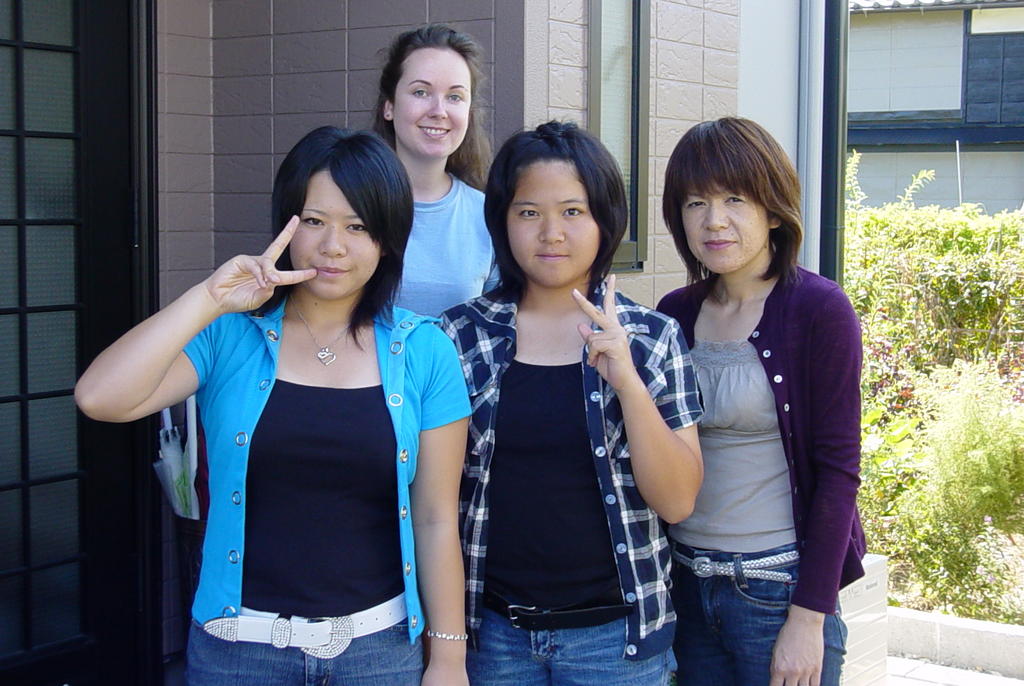
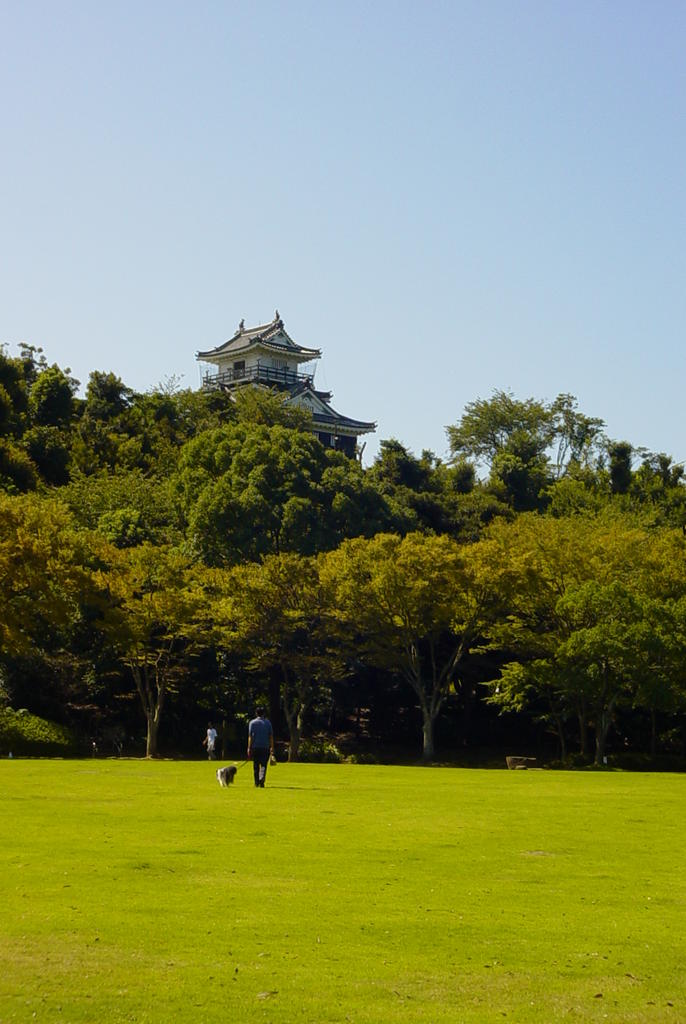


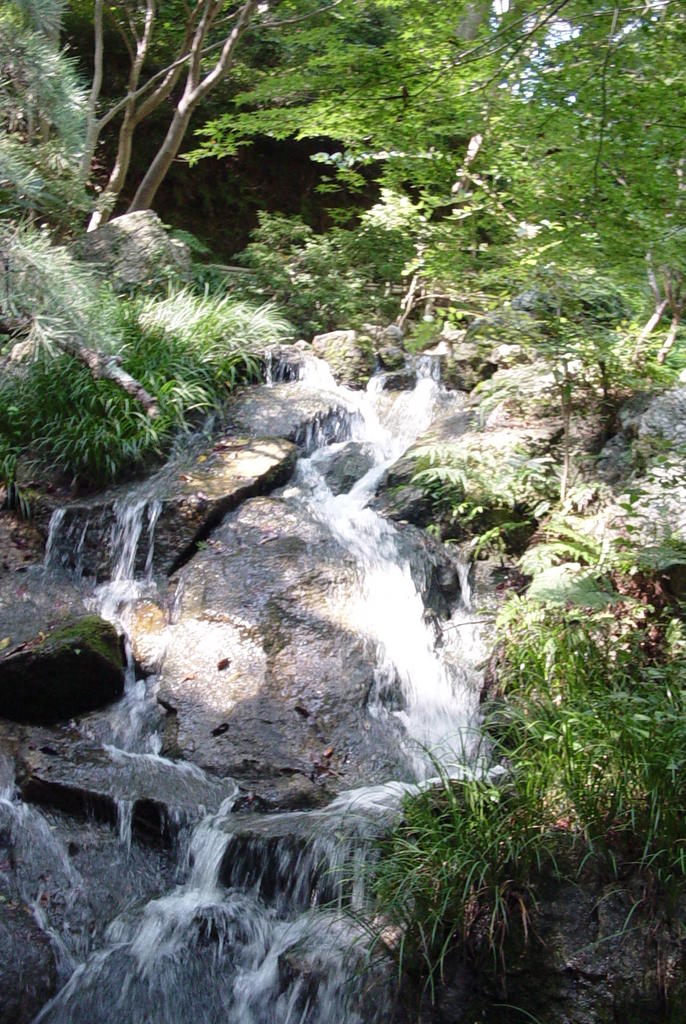


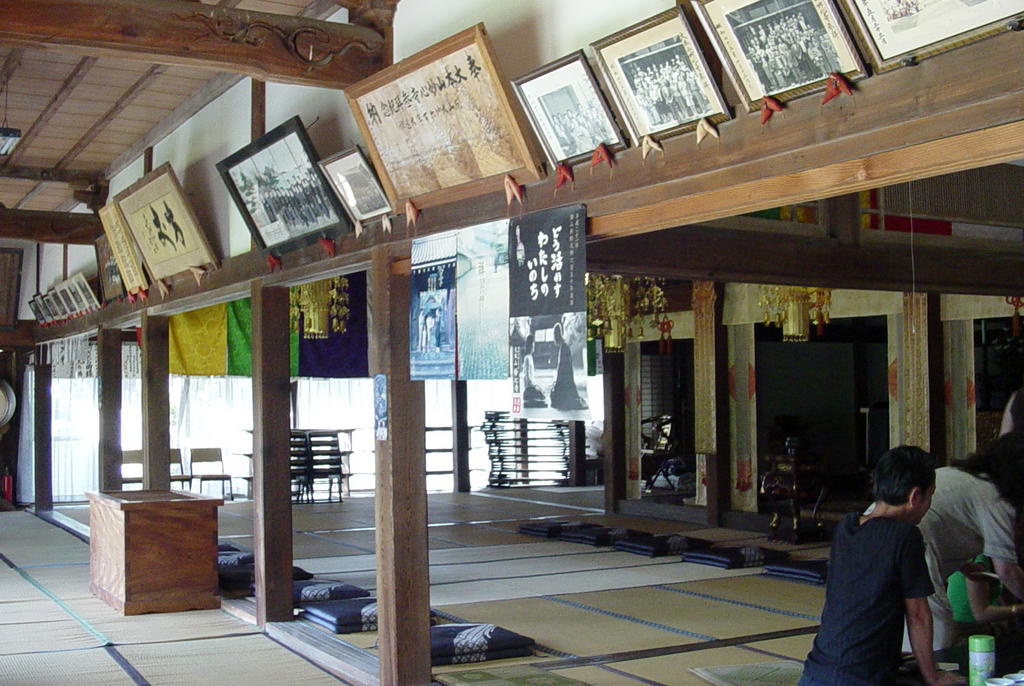

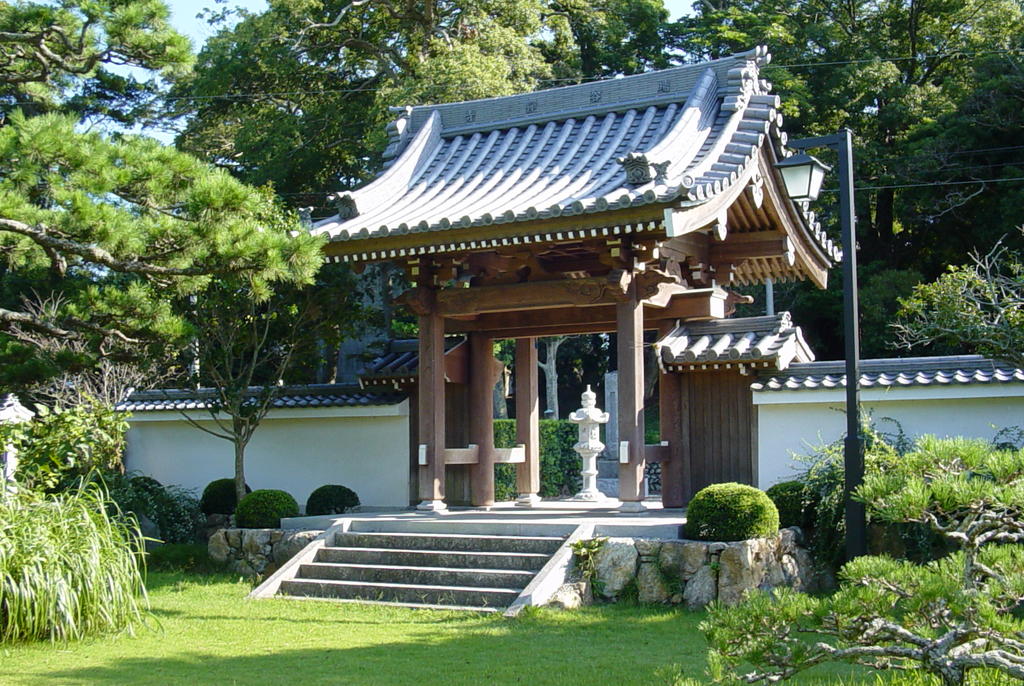


Welcome to Osuka

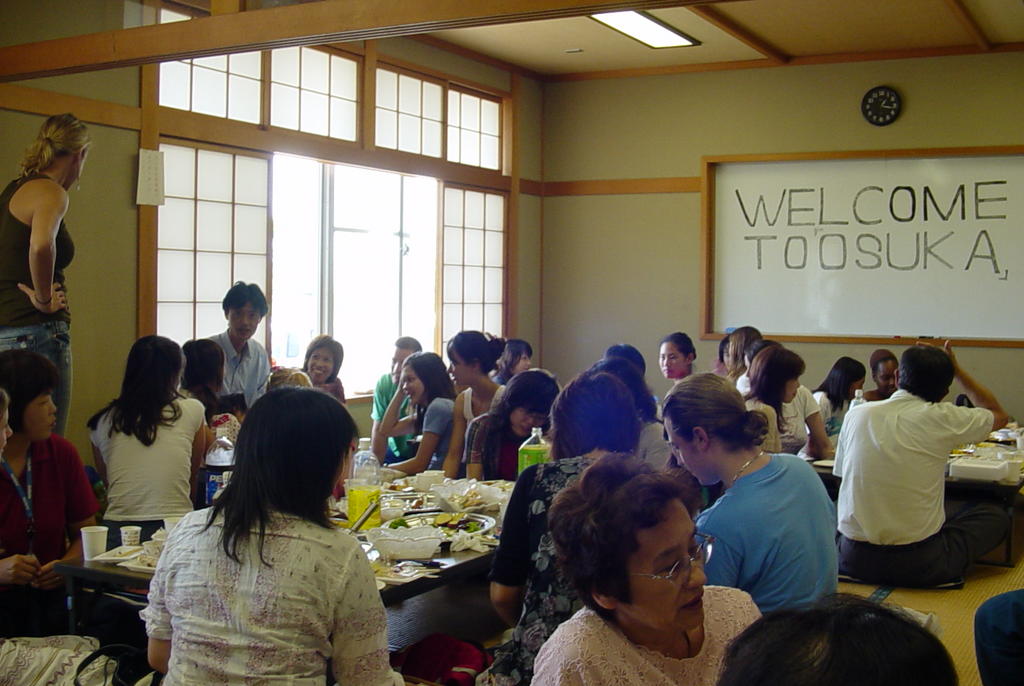


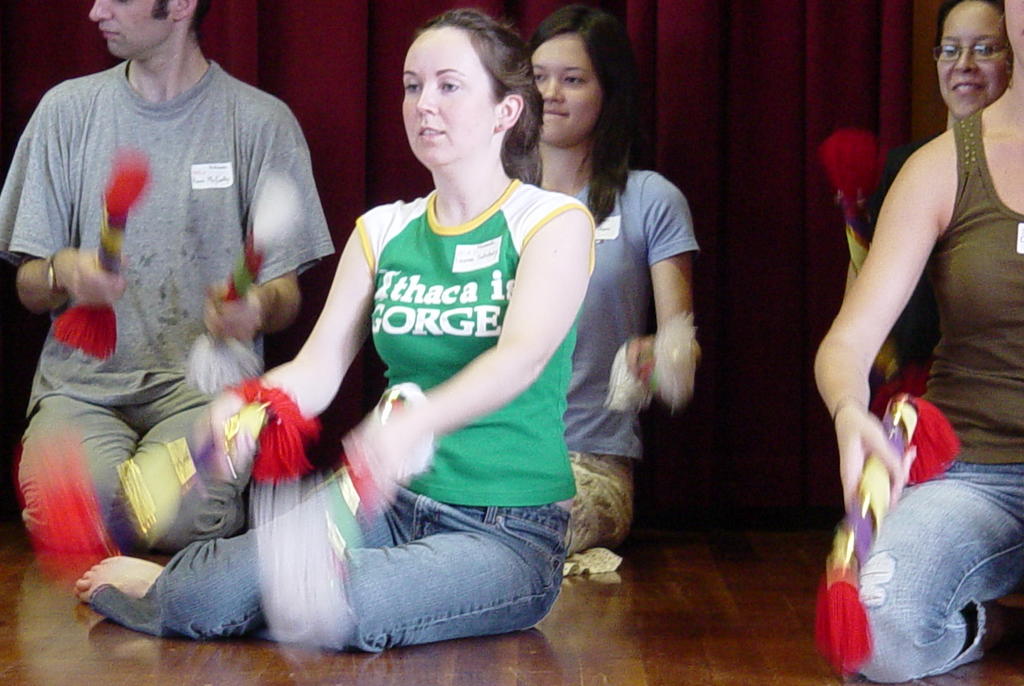
The past weekend was the most challenging I've spent in Japan so far. I went with other ALTs to Osuka, where we stayed with host families. We learned a traditional drum performance, and then went to a Buddhist temple where we sat in zazen. It was probably the most terrifying 20 minutes of my life -- at least, nothing immediately comes to mind that has scared me more. The next day, my host family took me to see a castle, Japanese garden, and kite festival museum in Hamamatsu.
I'll post photos now, because I took quite a few, but I will elaborate when I have more time. The pictures should be interesting but I think what I have to say will be just as valuable. Hope you enjoy.
14 September 2005
Engrish
If you have ever heard a Japanese person speaking English (so much better than I can speak Japanese, I will add), you will realize that they often confuse "L" and "R." This goes for both spelling and pronuncation. They also have trouble ending syllables with consonants, so they often add vowel sounds to the ends of words. In class this week, students played a game that required them to write words on the board about America. I gave 1 point for each word, 2 for each one spelled correctly. If the spelling is incorrect, I can usually decipher the meaning. But today I was stumped. In very clear, capital letters, a student had written,
" ROSANZERUSU."
(answer is below!)
After class I was looking at the website www.engrish.com . This chronicles many Japanese-English mistakes, and they made me laugh so hard that 3 Japanese people came over to see what was so hilarious. Immediately I was embarrassed, but I tried to explain some of the jokes, and by the end I had them laughing. Most of the errors are hard to explain, because they turn out to be rude or vulgar in English. Take a look at the website; it's hilarious.
Despite all these funny mistakes, I encourage students to try and not worry about messing up. In one class the Japanese teacher was talking to the students to reinforce the idea. Eventually he promised everyone, "Yes, mistakes are wonderful!"
In one sense, yes...but I doubt that will carry over on test day.
(What the student meant to write was, "Los Angeles.")
" ROSANZERUSU."
(answer is below!)
After class I was looking at the website www.engrish.com . This chronicles many Japanese-English mistakes, and they made me laugh so hard that 3 Japanese people came over to see what was so hilarious. Immediately I was embarrassed, but I tried to explain some of the jokes, and by the end I had them laughing. Most of the errors are hard to explain, because they turn out to be rude or vulgar in English. Take a look at the website; it's hilarious.
Despite all these funny mistakes, I encourage students to try and not worry about messing up. In one class the Japanese teacher was talking to the students to reinforce the idea. Eventually he promised everyone, "Yes, mistakes are wonderful!"
In one sense, yes...but I doubt that will carry over on test day.
(What the student meant to write was, "Los Angeles.")
13 September 2005
Explosion
Nothing dangerous, just my social calendar. Suddenly it's packed! My Mom arrives in Japan today (TODAY!) but she will travel around before meeting me in Fuji City next Tuesday. She'll stay for a few days, maybe a week, and I'll show her around my setup in Japan.
(Last night I had some friends over for dinner and we stayed up late talking, so I'm tired. Hence the bullet-style blog.)
Today will be my first day with the tea ceremony club after school. I'm REALLY excited and looking forward to learning something peaceful. Maybe I can use my yukata now (a yukata is like a summer kimono).
Thursday night John and I will go to Mayumi's house for dinner! She'll teach us how to make gyoza so I'm really looking forward to it. Mayumi is my friend and fellow teacher, who lives in our apartment complex, and hanging out with her is always fun.
Saturday I'm going to another town to see a children's festival that has been celebrated for hundreds of years. I'm going with other ALTs and we'll stay with different families who live in the small town, so that should be an interesting cultural experience to say the least.
Monday is a holiday and the school librarian invited me to her house for dinner. This is a big deal and I am really looking forward to it. She'll teach me how to make tempura and I think how to roll/prepare sushi as well. Very exciting.
Then Mom arrives Tuesday and I'm taking her to the traditional neighborhood restaurant. The owner loves John and me by now and her face lights up when she sees us. We love her food and her sake.
Thursday Mom and I are having dinner with my supervisor at a nice Italian restaurant. I'm interested in seeing what Japanese Italian food is like!!
Friday is another holiday, and Mom and I are joining other ALTs in Ito for a dance festival. We'll get fitted for kimonos, learn a traditional Japanese dance, and then participate in another festival that "celebrates the happiness of the people."
We'll spend the night in Ito, then hop on a train the next day to Numazu (beach town), but for academic reasons: one of my students is in a speech contest! (An English speech contest, of course.) I'm helping her practice after school, and on Saturday we'll watch and support her in the actual competition.
Then at some point Mom leaves. :(
September 30th my school is going on a hike, and that night the teachers will go out for a party (enkai!). A much-anticipated event so hopefully I'll have good stories.
And at some point after that, I think Mike is coming! :) And the weekend after that, I'm going to Kyoto!!
The point of regurgitating my calendar is to let you know why there may not be any posts for a while...I hope you all are doing well. EMAIL ME and tell me what's going on in Amerika!
(Last night I had some friends over for dinner and we stayed up late talking, so I'm tired. Hence the bullet-style blog.)
Today will be my first day with the tea ceremony club after school. I'm REALLY excited and looking forward to learning something peaceful. Maybe I can use my yukata now (a yukata is like a summer kimono).
Thursday night John and I will go to Mayumi's house for dinner! She'll teach us how to make gyoza so I'm really looking forward to it. Mayumi is my friend and fellow teacher, who lives in our apartment complex, and hanging out with her is always fun.
Saturday I'm going to another town to see a children's festival that has been celebrated for hundreds of years. I'm going with other ALTs and we'll stay with different families who live in the small town, so that should be an interesting cultural experience to say the least.
Monday is a holiday and the school librarian invited me to her house for dinner. This is a big deal and I am really looking forward to it. She'll teach me how to make tempura and I think how to roll/prepare sushi as well. Very exciting.
Then Mom arrives Tuesday and I'm taking her to the traditional neighborhood restaurant. The owner loves John and me by now and her face lights up when she sees us. We love her food and her sake.
Thursday Mom and I are having dinner with my supervisor at a nice Italian restaurant. I'm interested in seeing what Japanese Italian food is like!!
Friday is another holiday, and Mom and I are joining other ALTs in Ito for a dance festival. We'll get fitted for kimonos, learn a traditional Japanese dance, and then participate in another festival that "celebrates the happiness of the people."
We'll spend the night in Ito, then hop on a train the next day to Numazu (beach town), but for academic reasons: one of my students is in a speech contest! (An English speech contest, of course.) I'm helping her practice after school, and on Saturday we'll watch and support her in the actual competition.
Then at some point Mom leaves. :(
September 30th my school is going on a hike, and that night the teachers will go out for a party (enkai!). A much-anticipated event so hopefully I'll have good stories.
And at some point after that, I think Mike is coming! :) And the weekend after that, I'm going to Kyoto!!
The point of regurgitating my calendar is to let you know why there may not be any posts for a while...I hope you all are doing well. EMAIL ME and tell me what's going on in Amerika!
Subscribe to:
Posts (Atom)