
05 December 2005

Weirdness

I feel like so much has happened to me in the past 48 hours -- both good and bad -- I don't even know where to start. For now I'll try the easy stuff and see where this goes.

GOOD
I went to Tokyo with Mayumi and Jun. It was a whirlwind trip. I saw some great sights, bought some new clothes, ate at a great sushi place, and learned some more Japanese.

I was reminded a couple times why Mayumi is such an awesome friend, and why Jun can be such a nice guy.

I tried uni, raw sea urchin ovary. I mustered the guts a lot sooner than I expected. Uni is small, yellow-brown, mushy like firm hummus, and tastes absolutely gross. A pasty, chemical + grossly-biological taste. I'll stick with my raw tuna and seaweed, thanks.

I pushed through some barriers on purpose and had a very interesting discussion on love (and expressions of love) with Mayumi and Jun. Hopefully more on this later.

I ate some authentic-tasting Italian food.

I got an amazing email about the Duke game. I won't spoil it for those of you who may have taped the game without watching it yet.

Mt. Fuji is covered in snow, and all day you can see the wind whisping the flakes into a crowning cloud.

BAD
I tried to keep up the self-sufficient thing, and decided against asking Mayumi for help getting a kerosene refill. (She's my friend, but she still has her own life. It's not her job to cart me around just because I don't have a car. I thought I should do it on my own. Besides, I thought I was being Japanese, by thinking of the "group" and not inconveniencing anyone else.) So, I made it to the gas station in the freezing cold, asked for the correct fuel in Japanese, and dragged that darn thing back to the bus stop. I had to stop every 10 steps to switch hands. The container was HEAVY, and the handle was too small to use 2 hands at once.

The first bus came, and let people off, but for some mysterious reason didn't let me on. I thought the bus driver didn't see me, because it was pitch-black, even though it was only 5pm. I was disappointed but resigned myself to waiting, 20 minutes in 40-degree weather, for the next bus. I had put on extra clothes in preparation for this trip. But there was no way I was making the 30-minute walk home with 50 pounds of kerosene bumping against my thighs. I waited and waited, blew my runny nose, and waited some more. The next bus came, and let people off, but again totally ignored me and did not open the door for me to get on. I was stunned and this time, heartbroken. (Keep in mind I was already having an usually rough day.) Why did he not let me on the bus? Was it the huge jug of kerosene? I had considered this before I left my apartment -- maybe kerosene on a public bus was a safety hazard. But the bus took me TO the gas station, with the jug in full sight. So why wouldn't it take me BACK? Why didn't they even try to speak to me? This was the last frustrating straw in a very emotional day. I wanted to cry. And in fact, I sat on my damn kerosene, in the cold, in the dark, by the side of the rode, and I did just that. I held my head in my hands until the metal in my earrings began to freeze and hurt my earlobes. A few minutes later I stood up, dragged that jug of kerosene down to my school (where I knew Mayumi would still be), and asked for a ride home.

I felt ashamed. But as Mayumi lifted the jug into her car, she squealed, "Are you crazy? Why didn't you ask me for help?" Then I burst into a big story about how I didn't want her to feel used, I wanted to do it myself, and not bother her or depend on her. She was my friend, not my chauffeur. She looked at me and said, "Lauren, sometimes I think you are actually Japanese. But in this case, you don't understand. No one can live a life alone. You don't have a car. So don't be stupid - just ask me for a ride!" I bit my lip but I promised her that next time, I would.

After that Mayumi and I sat in her parked car and talked for a long time. I needed to have that conversation. Lately I've just felt like the shit has begun to hit the fan, if it's possible for that to happen in waves. The whole attempt to assimilate in another country has taken me farther than I expected, faster than I expected. Some of the results are amazing, beautiful, and powerfully transforming. But others are not so pretty. When you enter the JET Program, if you take it seriously, you are signing on to accept an explosion of your social circles. People who never care to keep in touch with friends wouldn't have this problem. But I want to make sure all the people I love really know that I love them. So one leg is running in Japan, so smoothly it scares me. One leg is planted at home in water. By home I mean all the family, friends, and experiences I had before Japan. I say water because you know it's there and it's necessary for life. But water is also something that moves, changes, and takes the shape of its container, yet is impossible to pin down. It's really hard to run with one foot down a new path that you love more and more, and stand in water with the other. However, it should still be possible -- right? Because you have two feet!

But you're forgetting about the JET Program and that third leg you sprouted when you met all the other ALTs! Americans and British and Irish and Australians and Scottish people that, like you, are foreigners in Japan. You think you're in the same boat, and that you should all bond over common struggles in Japan. And you want to maintain good relations, because you think you're supposed to be friends with other people "like you" on the JET Program. The problem is, everyone assimilates at various speeds, to different capacities. Some people hate Japan, or dislike it at least, and you don't want to be around negativity when you're happy. Some people like Japan okay, and don't want to complain, but are clearly uncomfortable with the differences in your experiences. Others just don't care and it's like they never left home. But all of them, somehow (except for 1 or 2), make you feel more out of place than if you were just hanging around with your Japanese friends. And then you feel like a poser, or a traitor or something, for "forgetting your roots," or leaving behind what you know, or becoming too Japanese, or being naive because you're still "in the honeymoon stage."

And the weirdest part of all is when you realize your values are changing, and it begins to affect your everyday life. You gauge your interactions with Japanese by Japanese standards. And then you start to adopt their values, or realize their values match your own, and you can really flesh out your own way of doing things by being in a new culture. But you forget that you are changing! You think it's just you all along! (Maybe it was, and America socialized you into acting a different way!) So when you interact with other ALTs, or people from home, you start gauging your experiences with them by Japanese standards. And then you get so confused, and feel like you're being pulled in so many directions, and wondering what is best for you without rejecting too many things from Japan or too many things from your previous life that the next thing you know, you're sitting on kerosene and crying because the bus driver didn't even try to speak to you in Japanese. And you think, if he had just said, "No toyu on the bus," in any language, you would have understood.

02 December 2005

Taking Notes

Just wanted to share some things Japan has "taught" me about myself -- and by "taught" I mean "reiterated, reminded, or reinforced."

-I like chocolate.
By this point, my supervisor and I have had many of what I'd call mini-bonding experiences. One of the best ones by far was the day she brought me a box of Japan's newly-marketed 72% cacao chocolate. I was so delighted I thougt my eyebrows were going to shoot off my forehead. And she was so excited to give it to me, in fact, that her husband complained, "Why did you only buy Lauren a box? Why not one for me too?" Also, when I opened the chocolate Mom and Dad sent I felt such bliss it was like coming home.

-I have a weird little stomach.
I like to eat about every 2-3 hours. Literally. And I like to eat about a handfull at a time. I like a warm, heavier meal for lunch (chicken curry, can't beat that in cold weather), and a small thing for dinner (salad, yogurt, and God forbid - cereal). I have explained my strange eating schedule about as many times as I have consumed food. Aren't you hungry? Don't you like it? Aren't you American? Food at 9:30 in the morning - did you not eat breakfast? Do you cook? And to all of these questions, I very calmly answer, "Yes." I like the food, I cook a lot of it, I'm American, and if I'm still alive you can bet your rear I ate breakfast. If I haven't eaten by the time you see me, I either have a crazy Japanese medical check-up or I'm deathly ill and you should rush me to the ER. Because a huge part of my peace and happiness is based on my eating, I just don't bother trying to conform to the 3 square meals a day social ritual. I go out to eat if friends go out to eat, but other than that, the food thing I do on my own. It makes me much happier. Now I understood what happened in France, eating like I do all day long, wanting very little at night, but always sitting down to a 3-course meal with 3 matching glasses of wine.

-I like feeling self-sufficient.
Living in Japan is often like my image of living on a farm. I say this for two reasons: I don't have a car, and my apartment is old. All the water heaters are gas, including the one for the shower, and if I want to create heat in one room I must do the following:
1) grumble about the lack of central heating
2) force myself to get up and put on 3 more layers of clothing
3) open the kerosene heater trap door and pull out the big metal box
4) lug the big metal box outside, where it is pitch black and cold, to my locker where the small tank of kerosene is stored
5) open the tank, open the box, grab the plastic pump and pretend to perform very crude surgery as I pump, pump, pump the refill kerosene into the empty box
6) pretend it's dawn, instead of pitch-black at 7pm, and that I have gotten up early to go milk the cows and watch my breath form little clouds
7) pump, pump, pump and damn it's cold
8) store the tank and the pump, shut the box lid and lug it back up to my aparment
9) insert box into heater, wait for the glub glub of kerosene refill
10) press START button on heater
12) wait 5 minutes for the warmth

Then I feel totally satisfied with what I "did all by myself," as proud as if I had accomplished all of those steps on brain-power alone. There's something to be said for the little, daily labors slowly eased and erased by technology. I used to take being warm for granted: Cold? Walk to the thermostat and push that dial to the right. Voila. And even though maintaining my previous level of comfort takes a lot more time and effort, I must acknowledge the fact that I am lucky to have an apartment that gets cold in the first place, and I am lucky to have the money to buy the kersone. It's easy to complain, but after I've done something so necessary to my existence, without consulting anybody, I feel so good. And I'm not cold anymore, either.


- I am a frugal big-spender.
For some reason, the more money I make, the more I want to keep. I'll refuse to spend a lot of money on something I need (a new kotatsu, for instance), and go for weeks spending a minimal amount of dough. I bought bath towels, in the exact color I wanted, for 2 bucks at the dollar store. (I happen to prefer thin towels, thank you!) But if I've wanted something for a while, like a specific bottle of perfume that would cost 30 times my bath towels, I feel totally comfortable spending the money. It's all about discrimination -- the good kind, that is.

30 November 2005

Talk & Lit

It may sound obvious, but I decided now would be a great time to learn about Japanese literature, and I mean more modern stuff than Basho. So I checked out a few women writers at the library (English translations of course). All this is generalization, because I've only read 2 books so far. But even though there is a 20-year difference in their publication dates, each book had a similar tone: dark and mysterious, with the main characters feeling trapped and melancholy from some force you can't quite pin down. At the same time, though, the characters are fully aware of all the beauty in life and love. Each author said things that immediately made me think, "I want to write that down and remember it forever." (I have read "Kitchen" and "Betty-San.")

One quote in particular I really wanted to share. A Japanese woman and her husband moved to Australia, and the way she describes the language barrier is EXACTLY the way I feel:

"How strange it was to hear words emerge in a language not that of her thoughts...[but] at the same time she made surprising discovery: that for most day-to-day purposes she really didn't need language, for her lack of English posed few difficulties. How oddly insubstantial words turned out to be! The remarks exchanged regularly over tea or cocktails weren't words, she concluded, but a succession of polite noises. When she lived in Tokyo, her everyday conversations had had just as little weight, and yet it wasn't until she'd encountered them in a different language that she noticed how slight -- and monotonous -- they could be." ~ "Betty-San," Michiko Yamamoto

I didn't feel this in France because, well, I could speak in that country.

And then an (American) friend shared this Japanese proverb with me: "Words are the root of all evil." Really, I think fear is the root of all evil. But unless you're trying to create something (literature), usually words just spew out and make a big mess. Despite how much I like to write, and blab on this blog, I'm starting to think that actions are much more elegant. Maybe that's why I wanted to join Maxwell. You didn't have to make small-talk at the parties, you just danced.

28 November 2005

Omiyage

I decided to conduct an interesting study: save all the omiyage I receive, instead of eating them.

This is no small task, as I could already fill a closet in my well-designed + ample storage-space apartment. But just think how rewarding it would be, to size-up your enormous stash of desserts at the end of the year, and say to yourself, "Damn, I could have eaten all that." Then instead of eating them, you examine the little packages to relive the time and event, as if the frosted cakes were actually dusty photos, documenting all the good and bad things that happened to people you care about.

In the past two days I've received about 7 omiyage, some western and some very Japanese. They all came from people I know fairly well, and they were all given for meaningful reasons: a thank-you for helping a student pass her English exam, a symbol because someone's mother-in-law passed away, a token of friendship after visiting a family in another town, a gift to keep me warm during the winter...etc. etc. In other words, people don't just throw gifts around in Japan because it's tradition and they can't remember why they started in the first place. There's always a reason behind it. For the average American this is still overwhelming, because I want to pay it all back. I want to do nice things for all these people. But I don't know when they learned to keep up!

It may sound strange, to say that getting a pear tart or getting a blanket from someone is enough to change your mindset. But the circumstances are so broad, yet so intricate...that you just get confused and begin to realize you are changing somehow, without really knowing where you're going. Relationships have so many dimensions, and cultures have so many ways of expressing them.

21 November 2005

Kimono Day #2

There is a new, young, (unfortunately) temporary teacher at my school called Migiwa Sensei. She doesn't speak much English but Mayumi and I have hung out with her and, thanks to Mayumi's translating skills, things are going pretty well. She gave us a Japanese cooking lesson last week and then she decided to share her kimonos with us. (She is only 28 but recently divorced because she married the oldest son who traditionally has to live with his parents -- evidently the mother-in-law was so awful she couldn't live there anymore. Plus, Migiwa wanted to continue teaching, but her husband wanted her to stay at home. I don't know why she didn't know these things before she married him, but I think it's quite unusual for a Japanese woman to get divorced, so young, for such "modern" reasons. But I have to save that for another discussion.)

Anyway. Because of her brief alliance with this very traditional family, she learned a lot of traditional Japanese arts: how to cook, how to knit, how to wear a kimono. She offered to teach Mayumi and me, and we gladly accepted. So next year, right after New Year's, she'll dress us in her (silk!!) kimonos, and we'll go pray at a shrine, and then have tea in a garden. This is all worth mentioning because: the time we chose to get dressed was very important. Because kimonos are tied so tightly around your waist, we had to carefully coordinate an eating, meeting, and dressing schedule, to give our stomachs ample time to shrink back down to acceptable, traditional, Japanese women-sized stomachs that will stay obediently contained by silk kimono sashes. The scene was just really interesting to me: three 20-something women discussing when and how much to eat so they can properly fit into a centuries-old style of dress. And agreeing on what time we would simultaneously, but independently, eat lunch was the most important and difficult part of the planning.

Japanese Communication, Lesson 1

By "communication" I mean HOW TO USE THE WORDS. I do not mean WHAT THE WORDS ARE IN THE FIRST PLACE. (That you gotta' learn on your own.) But if you want to sound Japanese even while speaking English, start with a simple example:

What you want to communicate: That smells horrible/rank/disgusting/worse than gym socks mixed with camembert left outside on a Fuji City summer day.

What you say: That kind of doesn't really smell too good.

This kind of indirectness is one of the most fascinating things about Japanese culture...just because it's so different from my own. In America, it takes guts to be direct, guts that are usually admired. In Japan, it's just rude and tasteless. I thought writing was the only art form with words, but it turns out speaking is an art as well. I'm trying to improve my skills.

!!*&@?!#?!

The internet mystery has been solved: John forgot to pay the bill. See title for my feelings on that one.
I still don't know when it will work again.

But I found a free hour at work and wanted to update on some random things:

-The guy rules are totally different in Japan. I guess America is always homophobic compared to other countries...but Japanese guys have no qualms touching, or standing with arms around each others' waists, shoulders, etc. The most unusual one is that they will massage each other in class. There's always a leader, and the guys around him will take turns massaging his hands or calves WHILE class is going on! I seem to be the only one who thinks it's weird. Even if I walk up to them in class, to check their work or answer a question, they just look up at me innocently, one hand on the pencil and one hand on someone else's shoulder, back, hand, etc. Sometimes it makes me uncomfortable, but it's completely normal for them. When I first saw this I thought the guy was hurt, so I asked if he was okay, and it was clear they had no idea why I thought he might be injured. This also happens at John's school, so it's not just my students. Hmm.

-A couple weekends ago, a teacher I met at the disabled/special school invited me to play tennis with her family. (Dad, Mom, Coach Crump, thank you thank you -- you have no idea how many friends I've made from tennis). She picked me up at 9am. I expected to meet her parents, play for a couple hours, then return home. Ohhhh, no. We met at a tennis club and played rounds of doubles with 15 - 20 other people for about 3 hours. (I still have the blisters to prove it.) "So now," I thought, exhausted, "it must be time to go home." Wrong! They invited me for lunch, and I was thrilled, because I was starving. I thought lunch = restaurant. Wrong again. The people spread tarps and blankets on the ground, made tables out of cement blocks and 2 X 4s, and hooked up mini gas stoves to cook a parking-lot feast of: yakisoba, seafood curry, salad, more salad, rice, and tons and tons of alcohol, from red wine and beer to cold sake and hot sake (served from a pitcher with a fish inside, so that when you poured the hot sake little flakes of fish skin were deposited in your cup. It was actually pretty good). So, lunch was a huge production, and the people were incredibly friendly, and everyone offered me their best dishes. It was delicious. When I was full, tired, sweaty, tipsy, and sleepy, I thought, "So now...it really must be time to go home." NOPE! These die-hard tennis people, after drinking 3 times the beer I did, got back out there TO PLAY MORE TENNIS! I couldn't believe my eyes! I was so tired and tipsy -- how on earth did they hit the ball?? Luckily, my teacher friend was tired as well. After 3 hours of tennis and 2 hours of eating, we went back to her place for a nap while her PARENTS continued to play. Then we met them again for a "light" dinner of various fried foods. They said "light," I kid you not. What they meant by "light" was "small." And...after that, we went home. So my day was about 10 times crazier than I expected, but the food and exercise were great and I was happy to have made another friend.

On Monday, another teacher asked how I spent the weekend. He's one of my "tennis buddies," so I proudly said, "I played tennis -- for SO long!"
"Oh really?" he asked, genuinely intrigued. "How long?"
"Three hours!" I said, with such finality, and I waited for him to be impressed.
"Only three hours?" he said. "That's not so long!"

If I had a tail, it would have been between my legs.


17 November 2005

Fuji-San, Take 2

Here's an edited version of a recent post. It's about 350 words, but I want to submit it for a JET publication that has a cap of 250 words. If you have suggestions on what to cut, please let me know.

Fuji – San

I have lived in Fuji City a mere four months. But I don’t think it’s brash to claim that I already know how to love Mt. Fuji.

When I photocopy lesson plans, when I struggle to recall the name of a sea urchin’s ovary but confuse it with the word for raw salmon eggs, when my students’ eyes light up because they have made me laugh, when I’m thinking about something so hard all I see is my right foot, my left foot, and my right foot again on the sidewalk…in any of these moments, I might happen to look up. And there is Mt. Fuji.

Just there, like she was the day before. So stereotypically huge, yet so freshly unimposing – unaware that she exists, much less that she is beautiful. (I say “she” because my friend Mayumi insists that Mt. Fuji is a woman. And without asking for an explanation, I agree.)

I realize that I have a lot in common with her. Maybe the humidity reflects so much light that she is invisible – the clouds are an illusion that look not like the shroud of an ancient volcano, but like an open gap in the landscape. Maybe at dusk she is blushing in the naked wink of the sun. Maybe you can barely discern the vague trace of her shape, and in the dark you are left to wonder about the living texture of her body. Maybe the snow, shocking in its purity, has crept to the tree-line that is finally visible after the haze of summer.


Every day there is something new to learn, but every day I know that she remains. Perhaps the spirit of Mt. Fuji is not really a woman. But I think within every woman, there is the spirit of Mt. Fuji. Unlike the Japanese word for salmon egg, this understanding need not be taught.


16 November 2005

Fuji-San

Japan is still “new” for me after a mere four months, whereas others have lived in and defined this land for thousands of years. So it would seem brash to claim that I understand some parts of Japan beyond translation. But I don’t think I oversimplify when I say that I know how to love Mt. Fuji.

When I photocopy lesson plans, when I wave good-bye to the cross-country team, when I struggle to recall the name of a sea urchin’s ovary but confuse it with the word for raw salmon eggs, when my students’ eyes light up because their American teacher is laughing, when I’m thinking about something so hard all I see is my right foot, my left foot, and my right foot again on the sidewalk…in any of these given moments, I might happen to look up. And there is Mt. Fuji.

Just there, like she was the day before. So stereotypically huge and majestic, yet so freshly modest and unimposing – unaware that she exists, much less that she is beautiful. (I say “she” because Mayumi insists Mt. Fuji is a woman. And without asking for an explanation, I agree with her). Every day Fuji changes, but every day she is there. When I notice this, I realize that I have a lot in common with her.

Maybe the humid Fuji sky reflects so much light that she is invisible – the clouds have become an illusion that look not like the shroud of an ancient volcano, but like an open, empty gap in the landscape. Maybe you can barely discern the vague trace of her shape, and you are left to wonder about the living texture of her body. Maybe the snow, shocking in its purity, has crept to the tree-line that is finally visible after the haze of summer. Maybe at dusk she is blushing, embarrassed by the naked wink of the sun.

Every day I learn something new about her. But as time reveals her changes, I always learn that she remains. Perhaps the spirit of Mt. Fuji is not really a woman. But I think within every woman there is the spirit of Mt. Fuji. Unlike the Japanese word for salmon egg, it is an understanding that needs not be taught.

10 November 2005

Endangered Species

Some of my fellow teachers are undeniably cool. There's one in particular who's about 50, and I always enjoy talking with him because his English is incredible and we have the same sense of humor. Nothing like a good laugh to make you feel connected. This is the same teacher who previously asked me to explain the "Can you make me one with everything?" hot-dog vendor/Buddhist joke. Since then, we've been on the same page.

Anyway, this guy spent his college days in America in the 70s. As a result, he loves (American) 70s music, which is kind of a novelty in Japan. When we talk about Lynyrd Skynyrd or CCR I feel like we're speaking a language no one else understands. He boasted about his collection of 1200 CDs, and today he brought in some Lynyrd Skynyrd albums for me to borrow -- all 6 of them.

Tsunoda Sensei saw Lynyrd Skynyrd in concert, in America, one month before their plane crash. He said this as we both happened to be staring at the album entitled, "Endangered Species." We noticed it at the same time, looked at each other, and cracked up.

I don't think anyone else I know in Japan would have gotten that joke. It felt good.

Sweet Burger Bliss

(Wait, will I die if I eat one of those in Asia? No, that's just the Japanese media yelling about imported American beef and BSE. So it must be okay, because all burgers I'd eat here originally came from my own country. Right? Or is it the chicken that's imported? Oh yeah. It's the chicken that could kill me. Phew.)

So I pulled open the door and stepped into Mos Burger.

Welcome to the McDonald's of Japan, and for now please ignore the fact that no one would appreciate that comparison. It's a chain burger joint, where the chicken nuggets are seafood tempura and the milkshakes are 5 times smaller (and 5 times better) than the ones at McDonald's. Just right.

I ordered a cheeseburger and a coffee shake. I considered my stack of newly-acquired library books: The History of Sake; Body Language (I know, but I can't help myself); and Interpreter of Maladies. The library had a decent collection of foreign books. And I was pretty satisfied because that transaction had occured completely in Japanese, without any hang-ups.

My burger skills, however, weren't so hot. Right before I paid, the cashier asked me something totally incomprehensible. A cook had to come around the corner to help.

"Here?" he asked in Japanese. "You eat here?"

Of course! "For here or to go?" -- what else would they ask at a fast-food place? Hah.

I smiled, paid, and sat down at the corner table by the window. I opened a book and a few minutes later the food arrived. Maybe it's because I was starving, or maybe it's because I don't remember the last time I ate a hamburger. But it was good. Nihon burger bliss.

05 November 2005

What a Semi-Modern, Semi-Traditional, Semi-Romantic, Semi-Feminist (Young) Woman Wants

Or, "The Ideal Life as fantasized and described by a female in her 20s who is happily bringing home the bacon and can do as she pleases, yet doesn't feel old enough to describe herself as a full-fledged 'WOMAN' because she believes that you're not really a woman until you're 30, or until you give birth, whichever might befall you sooner."

Disclaimer:
1) Some people will disagree with this post. That's lovely.
2) I am not pretending to fully understand all the ideas that I'm about to throw out.
3) I do not speak for every other woman on the planet -- just me.

I just received my recontracting papers in the mail. In short, I must decide whether or not to leave Japan after one year, or stay for two. John, the other ALT, is decidedly staying for two. I was discussing with him the possibility of leaving after only one year, telling him about my goals for Japan and my goals for the rest of my life. After hitting on many subjects, most of which were not related to love or romance, he snickered, turned his head to one side, looked at me shrewdly from the corner of his eyes and said accusingly,

"You just want to get married."

I don't remember how I responded, but I can promise you, I was pissed off.

The first time I played a friendly game of doubles at my high school, Jun was my partner like he has been every time since. We were paired against two older men and, despite the differences in age, sex, and serving ability, we were well-matched for an exciting game of tennis. For some reason, though, I had trouble keeping score. I felt like an idiot because the three men had to correct me constantly when I called out the points. Not until the game was over did I realize why I had been confused: without informing me, they all decided that Jun and I should get a 2 - game handicap, because I was a woman. "But," they told me, "we think you are more skilled than most women, so next time you won't get the handicap." (Jun and I won the match.) Oh, joy. Then one teacher rattled of Japanese, and the other two men laughed. "What'd he say?" I asked. An English teacher hesitated before translating, "He said your volleys are better than his. He doesn't like it."

This reminds me of the time I played Halo with a bunch of Maxwell guys, and it wasn't until after the game they told me why I managed to stay alive for so long: they had all agreed to the rule that no one was allowed to shoot at me unless I engaged first. Unlike tennis, I really did suck at Halo, but this still pissed me off. I asked to play with them because I wanted to play with them. I didn't want special treatment.

Going back to John's "you just want to get married" comment. First of all, why does he say it like he's accusing me of something? Most guys act like this, and many women do, too: it's wrong, weak, old-fashioned, dependent, unadventurous and shrewish to desire marriage. Not to mention, everyone knows that marriage is a trap into which all women try to lure all unsuspecting men, with the single goal of making them feel miserable, trapped, and bored for the rest of their lives. In my experience, all guys seem to think all women want this. Guys want to sleep with you, and they have no qualms voicing these desires. But if you let on that what you prefer to a string of meaningless, soon-to-be-boring-if-not-confusing hookups is a real, intimate and fulfulling relationship with one person...well then by God, "you just want to get maried," and men should avoid you and your traps at all costs.

Second, what John "accused" me of is simply not true. My young-womanhood fantasy does not involve me running back to the US, spending my spare time curling my hair and reading Cosmo, desperately bar- and/or church-hopping to find Mr. Right, who will then propose to me and solve all my "single gal problems." No. Listen-up, fellas, this is what I really want. This is my fantasy:

Return to the States and live in an exciting, relatively traffic-free city with cultural events aplenty and fast, easy access to a pristine lake in the mountains where a shell awaits me constantly and in excellent condition. I will live --newflash!-- not under the same roof as a fiance or husband, but alone. I will happily and ambitiously pursue my dream job as a successful novelist and creator of real literature, not a columnist or blogger or any of the other forms of writing I see as the "junk food" of literature. I will get regular exercise and be a fantastic cook. Then, unexpectedly and without trying, I will meet a man and we will fall madly in love. He, in turn, will live alone, and he will also ambitiously pursue his dream-job that allows him to be financially independent. He will have his circle of guy friends with whom he can go out drinking, bowling, rock-climbing, or whatever it is he enjoys doing. And I of course will have my circle of girl friends, with whom I can talk about everything, shop, exchange cooking recipes and yoga routines. Our lives will be full and exciting, with the comfort of knowing that my significant other is there for me. And I, in turn, will be there for him. We will spend our time together relaxing--not bitching or complaining about work or stupid people--but visiting museums, going hiking, checking out new restaurants and bars, having intellectual discussions, watching college basketball, going on romantic picnics, reading in parks, playing tennis, going to hear quartets, staying on the couch all night to watch movies, grilling steaks and drinking red wine. Sometimes we'll cook together and then do dishes together. But the laundry, the vacuuming, the picking-up and the money-earning will be done on our own, independently, because we ultimately live in our own spaces. We'll have the comfort of loving and being loved enough to marry the other person, but we will also have the freedom and the space necessary to be truly happy in such a close, committed relationship.

Then maybe, when I'm about 30, I'd like to marry this man, and take a brief hiatus from my career to raise our two beautiful children. I refuse to be one of those women who insists she can "have it all" and do everything at once, because that just triples her workload and makes her more tired, stressed, resentful, and frazzled than I ever care to be. One thing at a time, and I will make the most of everything.

Happily unwed until the day that I am wed.

Hopefully this is as "Carrie Bradshaw" as I get. :) Now she's an adjective.

PS -- There is nothing in here to suggest I cannot have all this with a man I've already met.
By the time...

By the time you swear you're his
Shivering and sighing,
And he vows his passion is
Infinite, undying --
Lady, make a note of this:

One of you is lying.


-- Dorothy Parker

02 November 2005

Crazy 24 Hours

After explaining Halloween to a group of beautiful, wide-eyed Japanese girls who understood about 20% of my language, my team-teaching partner decided we had to plan the rest of the semester in one day. So I didn't leave work until about 7 pm, when my work hours end technically at 4 pm. But no big deal.

Then John insisted we hike to the grocery store in the freezing wind. I cursed him then but thanked him later when I had real food to cook.

After that, I was swept away by some Japanese friends who took me to the top of an unnamed mountain in an undisclosed location for a night-view of our city from many miles away. Very romantic. But the evening would not be complete without an arcade visit, where we spent most of the time taking those ridiculous tiny pictures kids like to stick on notebooks. We put so many fake stars, hearts, bubbles, and cherry blossoms on the digital printous that you can hardly see us. But if you're in Japan, you can't pass up the chance to play in a photo booth -- especially one big enough for three people. I came home happy and exhausted.

Then I got up for a day I'd been dreading for a long time. I'm not proud of that statement, but it is true nonetheless. I had to teach at a school for mentally and physically handicapped children. I will visit 9 more times before the end of the year, teaching kids of various ages with various disabilities. I have no clue what I'm doing.

This morning I was surprised to enter a beautiful, gleaming facility that was 5 times cleaner (and larger) than my own. Students clean my school, like most places in Japan...so you can imagine how humbling it was to learn that the handicapped kids are the ones responsible for their school, too. It was incredible.

Like almost all my experiences in Japan, I arrived unsure of what to expect, but was immediately comforted by the warmth and friendliness of Japanese people. The other teachers were so kind and appreciative of my time (once again, a humbling experience) and the children seemed thrilled to see me. They were so beautiful. I don't remember the last time I saw such raw, genuine, unguarded smiles. One little girl couldn't speak to me, so I timidly reached out to touch her hand. (The teachers were encouraging me to shake hands, "English-style.") I was afraid she'd withdraw because 1) I don't look Japanese, 2) I was a stranger, and 3) my hands were incredibly cold. But when I touched her hand, the smile that melted across her face made me burst into tears. I was so embarrassed and angry at myself for thinking that these children were so different and so less fortunate than I am. Before I met them, I pitied them. Many of them lead difficult lives, yes. But so many of them were happy, and responsive, and so real they couldn't have been anything but beautiful. The elementary kids were thrilled to shout out numbers and even more excited when I gave them stickers for it. I even got to use some Japanese and speak with them during lunch. ("What are you doing tomorrow? Is that delicious? Mine is delicious too! Do you like school? Do you like soccer?") And after that, I went outside to watch them ride bikes on the playground. They organized races by themselves, and I helped them count down to "blast off!" in English...

All in all, my day was tense and definitely exhausting. But the way I felt was so different from what I expected: I didn't feel sorry for these kids. I felt grateful because they were making me smile.

And if there were ever any doubts in my mind, today just reinforced the fact that if I have children, I'm gonna be one fierce mother. I'm terrified that I'll love my kids so much I just won't know what to do with myself.

Phew! I've got a while. :)

31 October 2005

You Get What You Settle For

For some reason, this quote gives me a lot of trouble. Just in case you breezed over my title, I'll repeat the famous line from Thelma & Louise:

You get what you settle for.

Or, for the English critics, "You get that for which you settle." Yes, I am aware of the preposition rule.

I saw this on a Maxwell friend's profile about 4 months ago, and it's been nagging me ever since. Why? I have tried to live my whole life knowing full and well why I do the things I do, going for what I really want, and never settling for anything. Living like this does not come without consequences (people saying you're too picky, too uptight, or you struggle to maintain a balance between achievement and contentment, etc.) But perhaps I just hit the nail on the head: the balance between achievement and contentment is something I've been trying to figure out ever since a great conversation in Norway about 3 years ago. I can't see where my life is going. I believe that, at this point, I can still make it anything I want. I am happy with where my life has been...but I am no closer to answering this question than I was before.

I think Thelma and Louise got to me because I can feel myself sliding more and more into the contentment side of things. If you're happy with the way things are, you stop striving for so much. I can't decide if this is good or bad. It also makes me feel like I'm getting older. I remember learning in my Developmental Psych class that the older people get, the more content they become with the way things are. They come to accept their decisions and their places in life, and they stop worrying so much about "getting somewhere" else. But should I allow myself to fall into that comfort mode so soon? I think not! But it's starting to happen! Help!

Or, should I just be happy about it, and let it all go? Go with the flow, go where the wind takes me, what happens happens, and I'll be content with whatever.

As much as I agree with Buddhism, this is the snag that gets me every time: if you're content NOW, there's no reason to IMPROVE. Which side of this coin is more important? The obvious answer is, "Well both, of course. You have to find a balance." But that's taking the easy way out. Right now, I AM LIVING the balance...yet this question is still bothering me after 3 years.

I want to shout, "Settling is bad! Keep going! Always strive for the absolute best!"

But are those really my own thoughts, or someone else's?

Goethe said, "When you trust yourself, you will know how to live."
But if your self is telling you two different, diametrically opposed things...you're stuck.

Who was Goethe, anyway?

30 October 2005

A Morning in the Life, Part 2

Earlier, I wrote a post about my typical weekday morning. I'd like to add one thing:

When I get to school, the first thing I see is a circle of construction workers. (The gym is under repair to better withstand earthquakes.) Every morning at 8 am the construction men--decked out in hard hats and knickers that date back a few centures--stand in a circle to stretch, bend, and pliee (sp?) their way to flexibility for a productive day of gym repair. Because they all stretch in unison to an obvious count, it looks like ballet class. A ballet class of Japanese men in hard hats and knickers.

Haircut


28 October 2005

Quote

The President of the United States of America, on the war in Iraq, as quoted in The Japan Times:

"Each loss of life is heartbreaking."


Each loss of life is heartbreaking?


How dare he.

24 October 2005

Fuji Crew


Could the gaijin group get any bigger? This is us, out for Jeff's birthday. Jeff is the tall Chinese guy in the back.

Soccer

I'm beginning to think that "mandatory for young, single people" is really code for "let's see how many unusual situations we can throw Lauren (and sometimes Mayumi) into." Then they stand around cheering for us and observing our reactions.

Nobody told me the teacher soccer teams were mainly MEN. Mayumi and I were the only women on the field. And we subbed for each other, so we were never playing at the same time. The whole second half, I was the only woman out there, and of course the only foreigner at the school. When Mayumi handed over her jersey, she said, "They're afraid of offending women, so when the ball comes to you, they won't get close." She was right. I did manage to get my foot on the ball a couple times, but that's as far as my ten-year-rusty soccer skills would take me tonight. But have no doubt, I had an absolute blast. All the teachers, including the prinicipal and vice-principal, plus the guys' baseball team, and the guys' soccer team, were cheering for us. It was embarrassing, yes, especially when the baseball team kept yelling something at me that I couldn't understand. And we lost 0 - 3. But nobody really cares -- they're just happy to be out there participating. And that is what makes me happy, too.

I think Maxwell House--if not my high school tennis team--was a good introduction to be part of a group. Maxwell was close, but other than party preparations, there was not much group effort or codependence. The goal was mainly to have fun together, which fostered a group mentality, but only to a certain extent. It goes way beyond that in Japan. Unless you never participate in school activities (which some ALTs choose to do) you are immediately expected to be part of the group. And the more you get involved, the more you get involved. (There's an away soccer game next Monday! I'm going!)

I'm so used to working and doing and pursuing on my own -- granted, I do everything with the support of many loving people, and for that I am grateful. But in the ultimate moments, I am alone. I am American. I'm strong. Hence, I'm independent, and "alone" is a good thing. But not in Japan. If you make an initial, genuine effort to get involved, Japan offers a positive group mentality that I've never experienced--and don't think I could ever experience--in the United States. Now, this does not mean I know everyone well, or that everyone is my friend. That is certainly not the case. At first, I even felt smothered by this system. If you spend all day at work with the same people, why would you want to socialize with them after hours? Don't you need to get away? But I tried to supress that reaction (which I blame on American culture, if not my own ideals) and just go with the flow. These are your people, and you chose to come here, so fall in line with everyone else. When in Rome... And as you gradually get used to it, and start to understand things a tiny bit more, you come to appreciate it so much. I am accorded a certain amount of respect for showing up and participating, which I am in turn expected to show others. And because I do make an effort to show others that respect, I feel like I have a purpose. There is an understanding that everyone needs, and therefore helps, everyone else. Some of my closer friends have told me that I'm lucky, because the people at my school are friendlier than most. And I think this is true, but if you look for this anywhere in Japan, you'd know what I'm talking about.

I guess being the foreign girl, I get lucky with both sides of the coin -- I get the benefits of the group, but because I stand out so much, I also get individual attention that is really undeserved, but given to me anyway.

And then I get to come home to my own apartment, and be truly alone, for the first time in 12 hours. And I can't help but think of everyone in the States, the people who love me even though I am all the way over here. For right now, I don't know how else to give anyone a part of this, or share it, except to write this silly blog, and send ridiculous emails, and hope they make you happy.

How lucky we are to be where we are. Take care.

Japanese "Fun & Games"

On Sunday morning I participated in the "mandatory" seasonal apartment weeding. Mom and Dad, you'd be thrilled! I was bent over hacking on endless weeds for 3 hours. But it wasn't that bad, because I met two new people in my apartment complex, and everyone else I already knew from school. So I was able to chat through the hacking and those 3 hours (from 8 am to 11 am) really felt like 2. I spent the rest of the day lounging around in the sun and staring at the snow atop Mt. Fuji. Funny how Sunday can end up being lazy no matter where you are.

And today, there's a teacher soccer match against another high school. I don't play soccer, but participation is "mandatory" for young, single people. So after I help carry out gallons of hot tea and miso soup, I'll be kicking a ball for the first time in, oh...10 years. Damn I'm old. :) It's pitch black and freezing outside, but I'm excited anyway.

Last time I played soccer I was in braces. Maybe tonight my lips will stay in one piece.

22 October 2005

Beautiful

A wave in the sea, seen one way, seems to have a distinct identity, an end and a beginning, a birth and a death. Seen in another way, the wave itself doesn't really exist, but is just the behavior of the water, "empty" of any separate identity but "full" of water. So when you really think about a wave, you come to realize that it is something made temporarily possible by wind and water, and is dependent on a set of constantly changing circumstances. You also realize that every wave is related to every other wave.

-- Sogyal Rinpoche

20 October 2005

The Language of Love

You may have heard the beginning before, but please -- keep reading til the end.

Yesterday a guy friend IMed me with the greeting, "I will never understand the female mind." And to this I replied, "Honestly, me neither." I tried to help him, but who knows if any real progress was made.

The American guy here and I fight all the time -- more than I've ever fought with anyone. It's ridiculous and the "discussion" is always the same. It begins:
"Wow she's hot" or "You look good in that" or "Why don't you drink some more alcohol?" or (so classy), "There's my baby's mamma."
Then, I respond with something resembling the following: "Could you save those comments for your guy friends? I'm not a guy. You sound so chauvinistic."
He says, "I'm not chauvinistic. You're a femme-nazi."
She says, "All you look for in a woman is her body. I feel like you don't respect me at all. And if by pointing that out, I become a femme-nazi, that just proves my point even further. Let's not hang out anymore."
He says, "Fine."
And I feel relieved and happy for a little bit.
Until we start hanging out again.

Real mature, I know, but it goes on and on like this, again and again. Finally tonight I said,
"If there's something you want to tell me directly, then say it. Get it off your chest. I'm tired of this pent-up hostility and I'm tired of arguing with you. What's the problem?"
Guy responds with muddy words (so this is not a direct quote), "You accuse me of things when you don't really understand. I'm not chauvinistic. But I like you and you don't like me back. So how do you expect me to act around you?"
Me: What? Like me? What are you talking about? If I don't want to date you, that means you should pare all women down to their boobs? And anyway, at what point in your ramblings about how hot other women are was I supposed to know you like me? You brag about how you have more romance in your pinkie than most men have in their entire bodies -- but trust you, you haven't worked your magic in Japan because nobody has been worthy of your sparks -- where in this was I supposed to realize or understand or guess that you liked me? Or that you were ever trying to show that you liked me? And why on earth do you like me if we're always fighting about such fundamental ideas?
I think all this, but I say only, "I don't understand what you want."
He says, "I guess I don't either."

And so it goes.

A friend of mine in college studied abroad in South America. One day, he sent an email declaring his love for a Chilean girlfriend. Funny thing was, they could barely speak because of the language barrier, and he was the first to admit it! At the time, I laughed at him. "He thinks he loves some girl he can't even hold a conversation with." But really, how much better do I understand a guy because we can talk to each other? Most likely, the level of communication stays the same, regardless of who is saying what and how. Guy will always speak "guy," and girl will always speak "girl," and this talking at each other will be labeled "communication."


Even if you can both write in Kanji, you probably can't speak the same language. Suddenly the term "language barrier," at least in matters of the heart, doesn't mean much to me anymore. People think English is hard because there are many exceptions to the rules. But love doesn't have any rules -- there's no foundation from which to deviate.

I think I'll be alright with Japanese.

17 October 2005

Yamanashi / Nagano


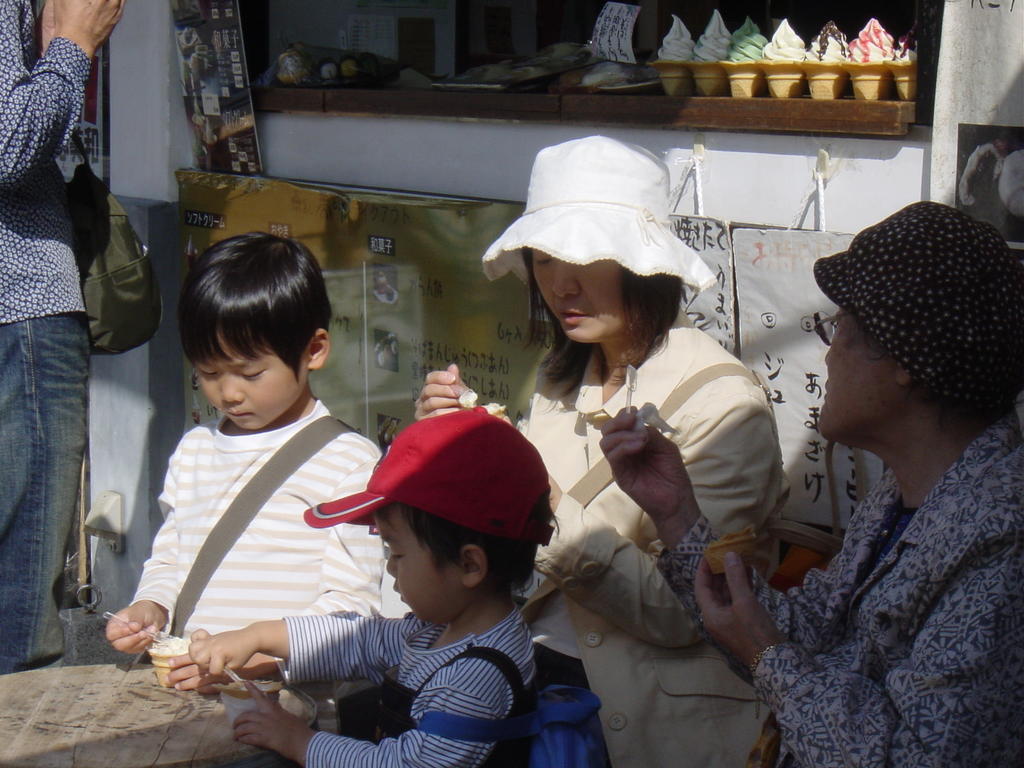
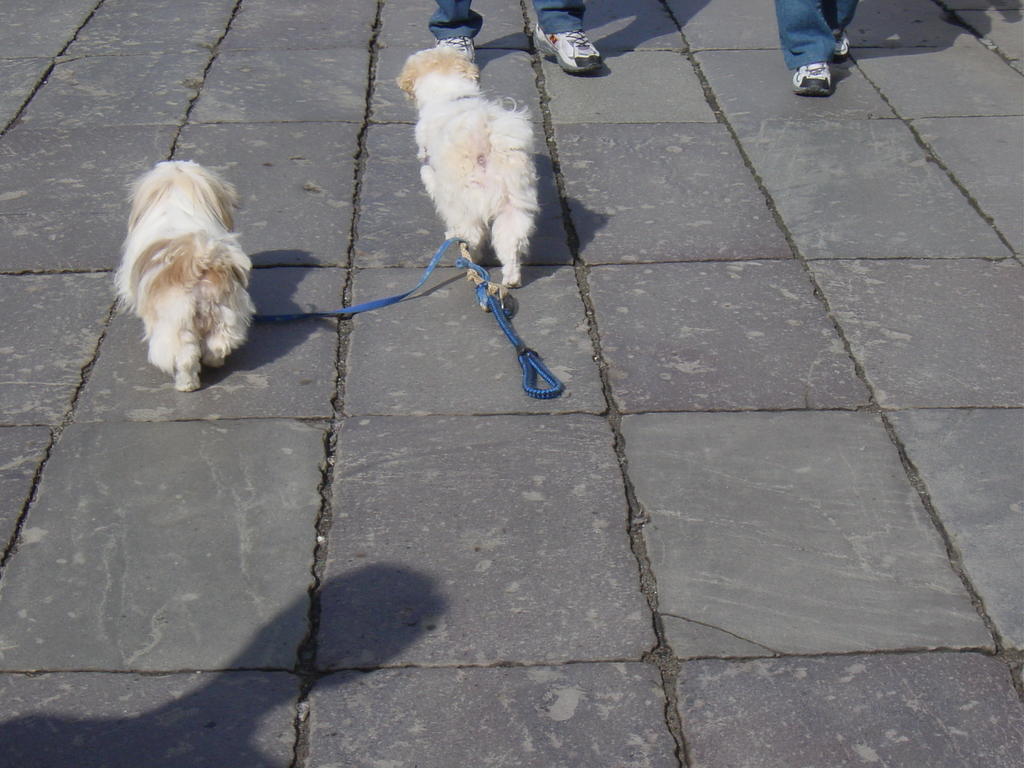
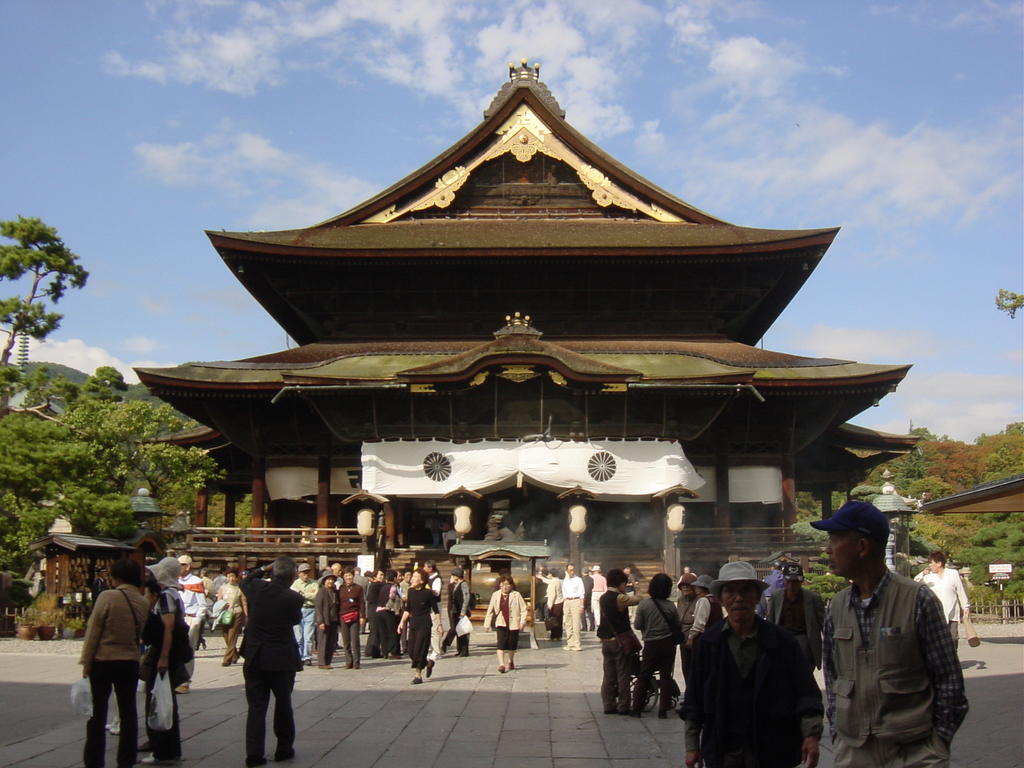
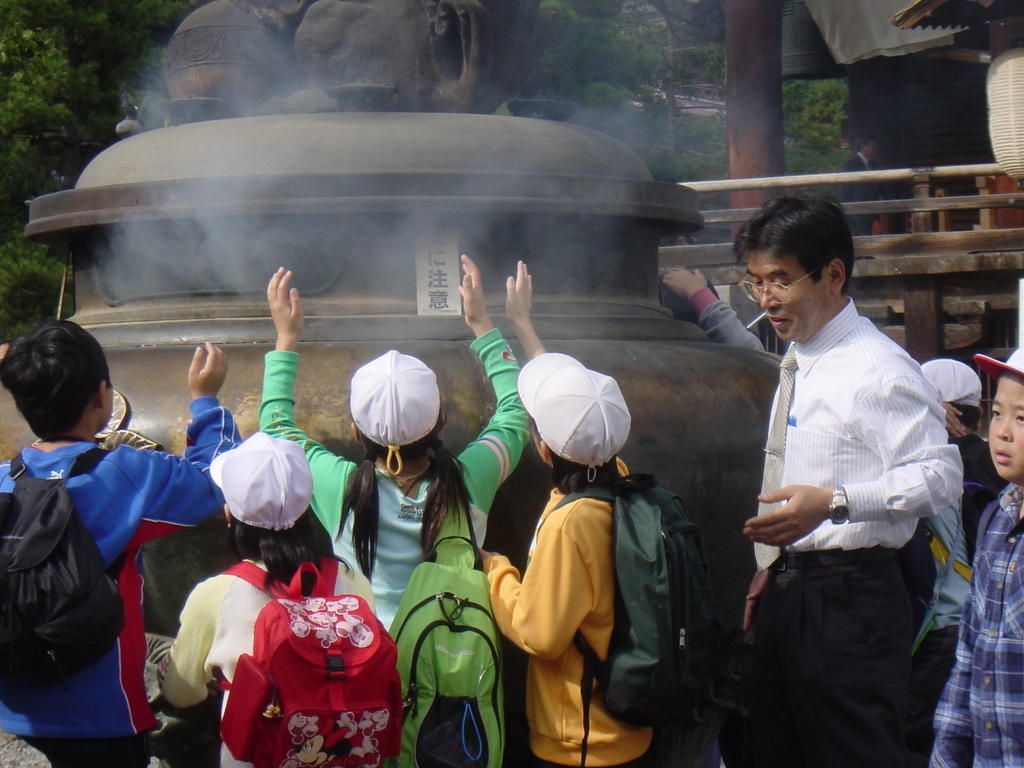
We were supposed to go hiking, but it was pouring on the trail...so we drove through to Nagano for a picnic and temple visit instead. Pic details: The smoke cures sickness and brings good health when it touches your head. Families celebrate when girls turn 3 and 7, and when boys turn 5 (I think that's right). Ice cream, however, is for all ages...and check out those dogs walking themselves!

June Bug


Yes, this goofball is a teacher -- a math teacher, at that!

The Coolest People in Japan


15 October 2005

Pontocho at Night

A sidestreet (yes, street) off Pontocho, where we spotted the first geisha.

Kiyomizu-dera


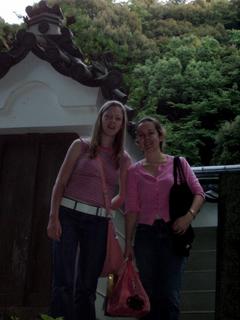
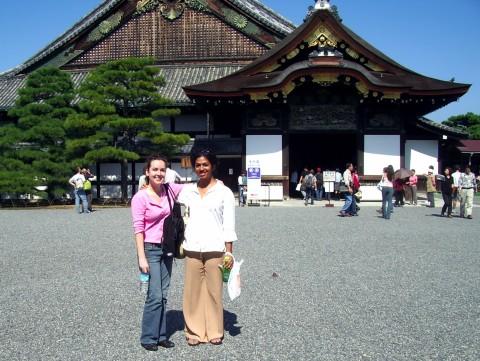
Cool Girls and Awesome Travel Buddies


Cafe Break


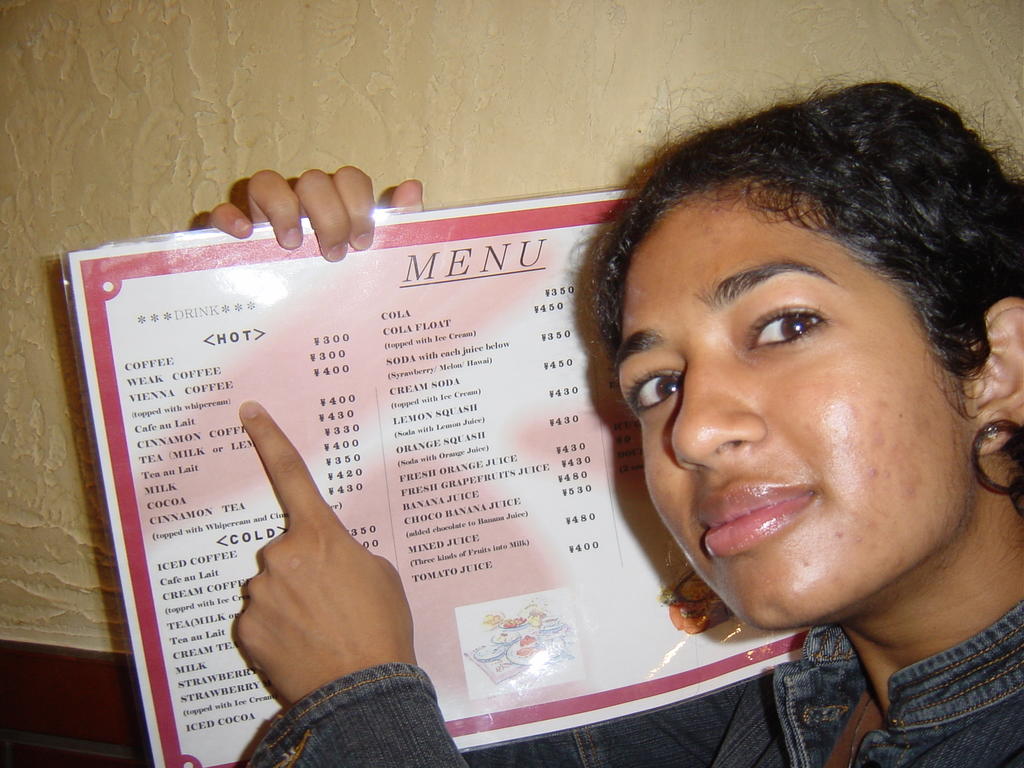
Curious "weak coffee" on the menu...also called "American coffee." Hah!

And a curiously tiny serving of cream. Just like Japan to like it small.

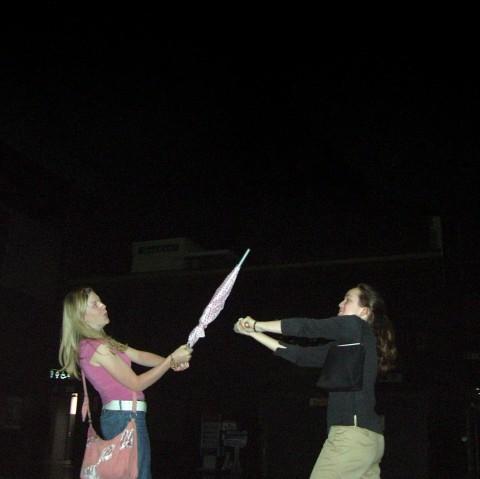
Star Wars in the Deserted Kyoto Station

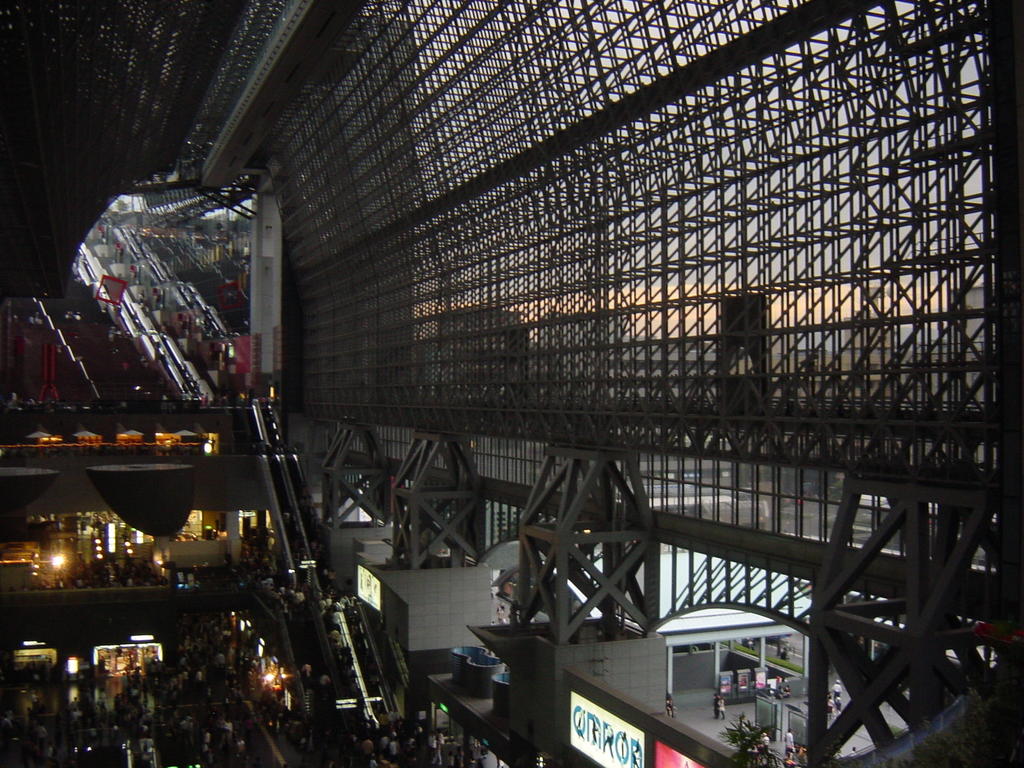
Kyoto Station Photos


Geisha Photo

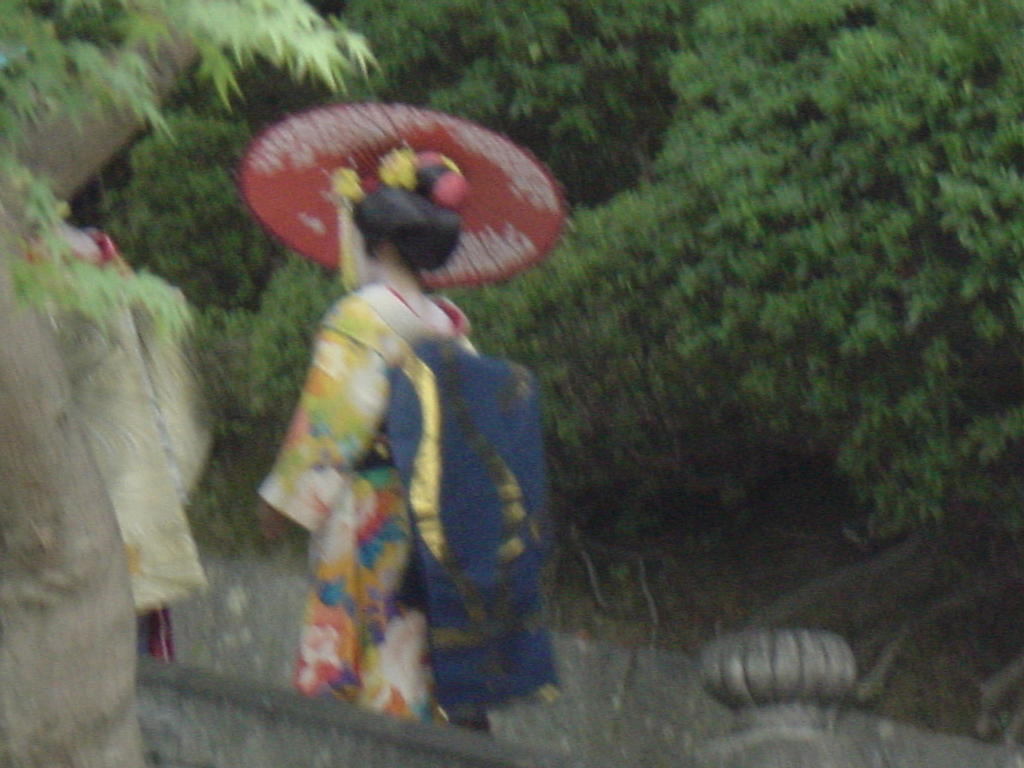
This is the second geisha I saw in Kyoto. That time, I could think fast enough to whip out my camera. Notice how she's about to disappear, and how the picture is blurry -- but a fuzzy pic is the only kind that does a geisha justice.

Dork

Today I received the first book for my Japanese (language) course in the mail, and I was ecstatic. It's ridiculous how excited I was about a textbook. All the time, I think about how nice it is that I'm no longer in school. No homework, no exams...yet I find myself still wanting to do all these school-related things: read, write, post blogs 9 times a week, and study language. As if, deep down, I still want to be in school.

What does this say about my future? I have no idea. Just don't tell anyone, okay?

Today, I tried explaining the terms "dork" and "nerd" to a fellow teacher. I described a smart, antisocial, skinny guy with over-size glasses and a pocket protector.
"Ohhhh," she laughed, "there's one in every class."
"Yeah," I agreed.

The truth is, there are at least two dorks in every class. But only one of them is a skinny guy with a pocket protector.

12 October 2005

Distinctive Taste

I gave students a recycling homework assignment. They had to write 1 sentence about how they hurt the environment, and 2 sentences about how they help. Some of them made me laugh out loud:

"I hurt the environment because I breathe air every day."
"I hurt the environment because I eat a lot of vegetables."
"I help the enviroment because one day my friend threw trash on the ground, and I told him to pick it up."

----

I want to be an awesome cook. And I want to look good doing it. And to think, some people would call me a feminisit! :) Tsk, tsk.

Last night I cooked a really good dinner and brought the left-overs in for lunch. To my embarrassment everyone commented on how good my massala chicken smelled. I hope they were being honest.

The wafts from the microwave started a whole discussion of food. Did I like squid? (No.) Octupus? (No.) Sea urchin? (Haven't tried it yet.) Raw salmon eggs? (Yes.) Nato? (So-so.) What did nato taste like to me? (Fermented coffee or cacao beans.) Really? Japanese people don't think so; I do not have Japanese taste!

But, my supervisor understood why nato tastes like coffee -- it's all about the beans. Nato is fermented soy beans that are light brown. If you imagine chocolate or coffee when you eat them, that's exactly what they taste like. Ishii Sensei tried explaining my American sense of taste to everyone else, but I don't think they got it.

"My husband hates nato because it smells like dirty socks." Ishii Sensei said. I laughed.
"It does smell bad, but I'm okay with it because I like French cheese. They smell awful but they taste amazing."
Then Ishii told me how she had seen "Heidi," so when she had the chance, she was thrilled to taste European cheese. When someone offered her goat cheese, she expected it to be really good, so she accepted.
"But when the cheese was one foot away from my nose, I almost fainted! I couldn't taste it, it smelled so bad."
Ishii's re-enactment of her fainting made me crack up. She held a ruler in front of her face, slowly drawing it closer and closer to her nose, whining in mock apprehension. Then when it was a foot away, she fell over in her chair. I almost had tears in my eyes I was laughing so hard.
"Goat cheese is my favorite cheese!" I said. It was true.
"Ohh no!!!" she cried. "But I almost fainted!"

Some tastes can cross borders, but many will remain distinctly Western, and distinctly Japanese.

11 October 2005

Ghost of a Geisha

For some reason, the photos aren't working, but I will try again another time. Sorry 'bout that.

When I came to Japan I had three goals of what I wanted to see / visit: islands, snow, and Kyoto. What I mainly wanted from Kyoto was temples (solid, predictable) and a geisha sighting (fat chance). "Geisha sighting" makes them sound like rare, wild animals. This is because they are. There are millions of people in Japan and less than 1,000 geishas in the whole country. Hoping to see one is like waiting for an endangered yellow bird to flash through the trees. If you're lucky enough to get a glimpse, you'll remember it for the rest of your life, and at some point you will probably try to write about it.

We just finished a luxurious Japanese dinner, complete with cold sake, and stepped out onto the chilly street of Pontocho. It's a narrow, winding alley packed with a variety of restaurants, adorned with lanterns and banners that many people believe were the world's first advertisements. We were laughing and immortalizing the food that had just passed our lips. The next thing I knew, my bottom jaw shot towards the ground. I feet melded to the cobblestones and I couldn't move. In slow motion I turned to my friends -- both of them had huge eyes and open mouths. We exchanged glances for a millisecond before we spun around and began walking in the opposite direction.

A geisha had appeard from nowhere, right in front of us. Despite the heavy wooden clogs on her feet, her movement was absolutely silent. She moved as smoothly and as quickly as a deer. Although we had immediately turned to follow her, we had to jog to keep pace.

Her kimono was made of thick silk and mostly white. Her inky hair was impossibly styled, a dash of red fabric visible through a slit in her bun. There was an unexpected, reddish-brown arch painted on the nape of her neck. Except for this, I saw no flesh that was not transformed to porcelain by thick, white makeup. Not even her hands remained flesh. Her lips were slicked with red. And she was moving so fast.

The three of us were silent. We were shocked into awe; her grace and presence was like nothing we had ever seen before. I wasn't even embarrassed that we were following her -- who cares if people talk about the silly gaijins? It was then I realized that everyone around us, even the Japanese, were reacting the same way. Japanese girls dropped their jaws and turned to stare, whispering to each other. Men began to follow her. In a few minutes, my friends and I were the caboose of a train led by 5 Japanese men in suits. All trying to keep up with this silent white deer. I was afraid that if I took my eyes off of her for a second, she'd vanish. Her speed and her all-white kimono made her like an apparition, not a flesh-and-blood woman like the rest of us, clicking our heels on the Pontocho cobblestones. We didn't even care how far she would walk or where she would take us -- we just wanted to follow.

At one point, the geisha looked over her shoulder, and I could see the tension around her eyes and mouth. She knew the men were following her, and it made her nervous. My friends and I were too far away. I felt a brief flash of sympathy, the kind of pity you'd feel if roses cried when they were plucked and stuck in vases. I considered backing off a little, but before I could make up my mind, she was gone. She disappeared so quickly I didn't realize it until after. There were no corners, no turns in the street -- but she threw aside an unlabled bamboo door, and was gone. The businessmen were equally surprised by her disappearance, and they gathered at the door awkwardly, like pigeons begging for crumbs. My friends and I continued walking at the same speed, looking straight ahead, disguising our intentions much better than the Japanese men. You'd think they'd be skilled at this by now. But this was one thing I learned: geisha appearances are just as rare for the Japanese as for foreigners.

When we could finally speak again, Natasha said, "Was that real? Was I dreaming?" Our thoughts spoken aloud. "Could there have been a more perfect ending to this night?" Kath asked.

She was just a lady, in a white robe, wearing white make-up. What's so special about that? Were we horrible Westerners for getting so excited about it? For exoticizing someone like that?

I don't think so.


Even Africans are afraid of lions. And even Japanese are astonished by the ghost of a geisha.

10 October 2005

Kyoto Station

After a weekend in Kyoto, I feel restored by the good food and company, but tired from the walking, talking, and general tourist activities -- the result of any truly good vacation. When Kath, Natasha and I arrived at Kyoto station Friday night, the city bustle was slowing down instead of picking up. We grabbed a drink at a little locals' bar, and later as we walked to the hostel through the station, we were shocked: it was only 1 am, but the station was completely deserted! Not only was it empty, but it was also DARK. If you knew about Kyoto's architecture, you would realize why this was so scary.

Most of Kyoto, despite popular belief, is not beautiful. The majority of Kyoto looks like the outskirts of Paris: large, blah, post-post-modernist architecture, mainly apartments and office buildings. Except for a few treasures IN the city, like Nijo Castle and the Pontocho / Gion area, most of Kyoto's attractions are on the outskirts. You can visit a temple and feel like you are in a small mountain town. The air is fresh, the hills are green, the streets are charming and steep, the temples are humongous, beautiful, and thousands of years old... Then, you walk only 30 minutes to reach Kyoto station, which looms like the freakish offspring of a skyscraper and a metal spiderweb. It's one of the largest and strangest buildings I've ever seen. All this time, we believed Star Wars was filmed using a miniaturized, hand-crafted set! No way! It was totally filmed inside Kyoto Station. At 1 am, when all the lights were off and it was deserted, Darth Vader made an appearance and we all ran screaming from the station.

During the day, Kyoto Station is an attraction in itself. It swarms with people and offers interesting views of the city. The maze of walkways led us up 6 large flights of stairs because we tried taking a "shortcut." What we discovered on the grey "rooftop" was a veritable Lovers' Lane. Archways and columns formed small crannies and every space was claimed by a couple. Every 5 steps we intruded on lovebirds parked on the floor. One girl was even sitting on her guy's lap. Aside from men reading porn on the train, it was the most shocking display I've seen in Japan. There is SO little contact between ANYONE that this tiny display (seen everywhere in Paris) seemed almost raunchy in Japan. I guess people thought they'd find privacy there, thanks to the huge and endless flights of stairs.

06 October 2005

A Morning in the Life

I still haven't gone to Kyoto yet because I'm leaving right after school today. Plan to return on Monday. But I couldn't resist another post or two before I go...

A Morning in the Life of Lauren, in Japan. I wake up a few minutes before my 6:15 alarm. I stretch a couple times. I pretend it's the weekend and that I could doze all day long if I pleased. In fact, I do just that, and manage to fall back asleep before my alarm, so that I am finally awakened to an incessant beep.

Slap the alarm. Pad to the bathroom. Say good morning to the 3-inch long cockroach I have trapped under a plastic cup. After I greet him I apologize for trapping him. Normally this plastic cup is used for tossing bugs off my balcony, instead of holding them hostage. But once I managed to trap the cockroach, I decided he was too big and too angry to toss off the balcony with only two hands. I was afraid he'd escape and fly in my face before I could get him outside. So I need help granting him an exit other than death. (He is WAY too big to kill -- I refuse to end the life of something that would squish, crunch, or exhale significantly upon death. It's just too cruel.) So I procrastinate his liberation.

Now, you may be asking yourself, "Does she really think a plastic cup is going to hold a 3 - inch cockroach?" No, silly, of course not. On top of this cup, I have constructed a minor Sears Tower of Listerine, shampoo, and hair gel. When he knocks around on the cup, I add fingernail polish to the top. So in the morning, as I avoid knocking over the tallest tower in Japan, I apologize to the cucaracha for his tiny cell. I feel sorry for him only long enough to remember his dire mistake: he flew at my face while I was sitting on the toilet. The result wasn't pretty for either of us.

After I get ready for work/school, I pass at least 6 skinks (blue-tailed lizards) sunning themselves on the walk. These creatures are so predictable. I appreciate the stability, so I say good morning to them all. Then I take my place at the bus stop and wait for The Pink Lady. I know that when I see The Pink Lady, the bus is on its way. If there is no Pink Lady then I have missed my bus (which by the way, never happens, because the bus is always 2 - 15 minutes late). The Pink Lady is a woman who drives a PINK motorcycle/motorbike. It must have been expensive, because it's the ONLY one in Japan. If it is raining, then she wears a pink, full-body, raincoat-jumpsuit getup. If it's not raining, then she wears a pink jacket to shield her (pink?) blouse from the wind. The Pink Lady always brings a big (pink?) smile to my lips, and it is then that I decide today will be a good day.

05 October 2005

Kyoto

Just a quick post to let you know that I'll be in Kyoto for a 3-day weekend. (Whoo hoo!!) Of course, the blog will continue when I return. Hope everybody has a good one.

Riddle

In my advanced English class today, students had to discuss a riddle or philosophical problem. Basically, six people are marooned on a deserted island: a Buddhist priest, a high school boy, a sick man in his 60s, a famous doctor, a politician, and a 3-month pregnant woman. A rescue plane can only take one person back. Which person should the pilot save?

Students were told to choose the "most important" person, and then arrange all 6 people in order of importance, or priority for being rescued.

(If you're interested, decide your order before reading on).

Students worked in groups to make their choices, and then wrote the results on the board. I was surprised to find that each group selected the SAME person to be rescued first. Likewise, each group selected the SAME person to be rescued last. Which people do you think they chose? None of their answers coincided with mine. I was intrigued.

Each student believed that the sick man in his 60s should be the first person rescued, because he was most immediately in need of help. When they had to prioritize, each student chose the Buddhist priest as the one to be saved last. Explanations for the Buddhist priest were all similar, but each student had a unique--and fascinating--translation of the idea. One said, "because he is best prepared to receive destiny;" or in this case, death on a deserted island. Another said, "because his spirit is strong." Yup, there's plenty of time for zazen on a deserted island. But sadly, no one to beat you with a stick.

(Joking aside, I have an enormous amount of respect for Buddhism and anyone who makes a genuine effort to practice it).

My goal was to maximize life. So, I chose the famous doctor as the first person to be rescued. Hopefully, many lives could be saved if the doctor returned to society. Following this model, my 2nd choice was the pregnant woman, because one rescued pregnant woman can mean 2 saved lives. For last place, I chose the sick man in his 60s, because he had the smallest chance of survival no matter where he was.

My students seemed really shocked by my choices, so it turned out to be quite a cultural lesson for all of us. Of course, the more I considered it, the more confused I became. Japanese people usually consider the group before the individual. Americans usually put the individual before society. But it seemed that we had done just the opposite: by saving the old man, the students were focused on individual needs. By saving the doctor, I was focused on societal needs. Why the switch?

The only explanation I could come up with is that I examined the problem from outside the group, and the students examined it from inside the group. It should not be surprising that the American set herself apart, while the Japanese were inclusive of everyone, even themselves. Ultimately I was trying to benefit myself. I thought I was trying to benefit society, but in this case, society = me. The students were trying to benefit only the group, by saving the person most in need, regardless of the people outside.

What do you think?